What archaeology says
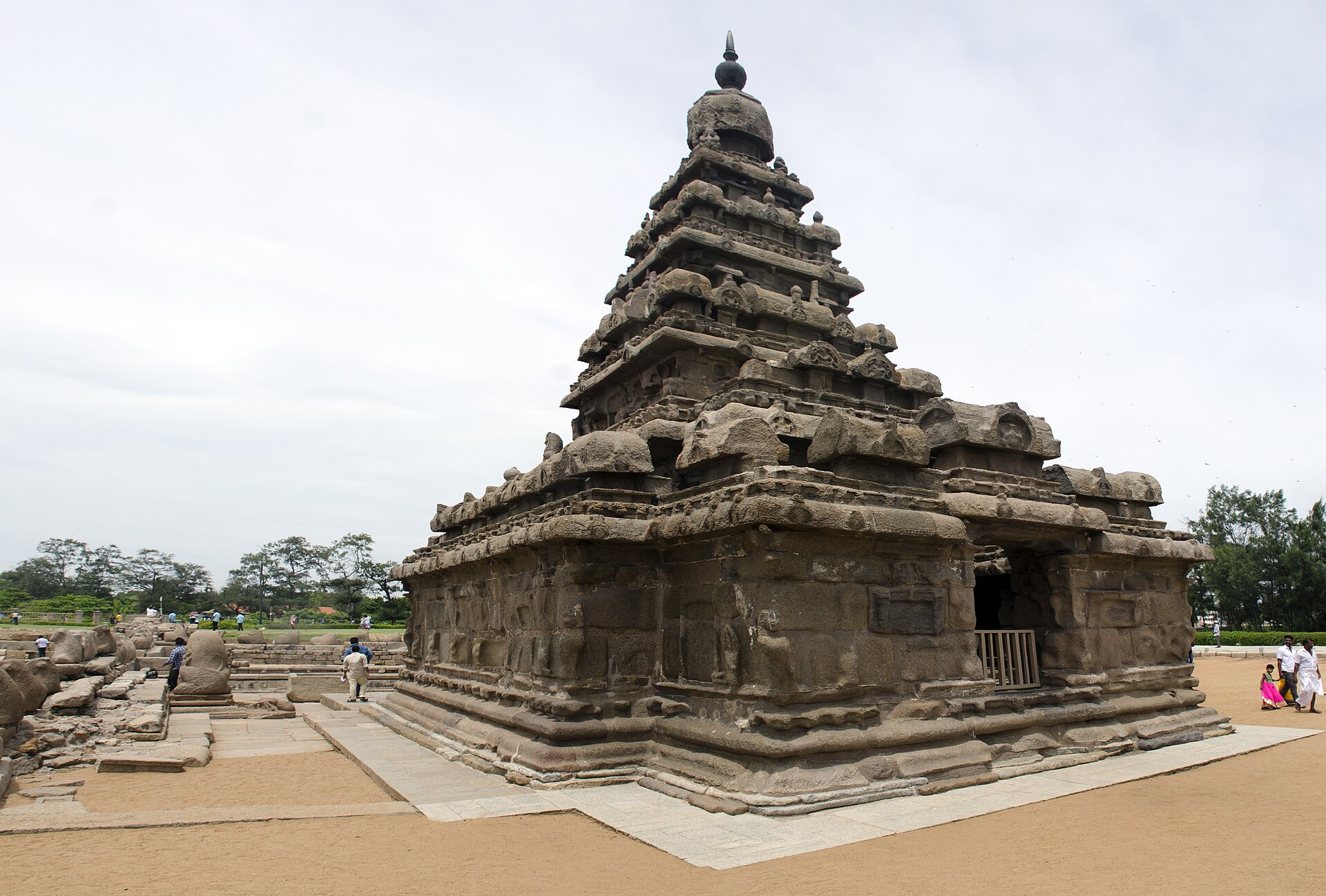
Archaeologists treat the visible monuments as securely Pallava, carved and built in the seventh and eighth centuries AD under rulers such as Narasimhavarman I 'Mamalla' and Rajasimha, with inscriptions, iconography and architectural style all consistent. The 'seven pagodas' tradition is generally read as a real memory of coastal erosion and shoreline change, not as a claim of great antiquity: this is an active, retreating coast, and structures once inland can end up in the surf zone within centuries.
Serious underwater work has been done here. In April 2002 a joint expedition by India's National Institute of Oceanography (NIO) and Britain's Scientific Exploration Society located masonry, walls and scattered dressed blocks under five to eight metres of water several hundred metres offshore, consistent with submerged temple-related structures. After the 2004 tsunami exposed carved stones and a long wall on the beach, the Archaeological Survey of India (ASI) and the Indian Navy conducted sonar and diving surveys in 2005 and identified remains of further structures within about 500 metres of the shore — including a wall roughly 70 metres long.
The mainstream reading is that these are genuine but broadly medieval remains: outlying shrines, gopurams or ancillary buildings of the Pallava-and-later temple town, lost to a combination of erosion, subsidence and storm action over the last thousand-odd years. In this view Mahabalipuram is a real drowned townscape, but one measured in centuries rather than millennia, and firmly within the historical Tamil past.
- Visible monuments securely dated to the Pallava period by inscriptions and style (c. AD 700–728)
- 2002 NIO / Scientific Exploration Society survey locating submerged walls and dressed blocks offshore
- 2005 ASI and Indian Navy sonar/diving surveys identifying a ~70 m wall and further structures near shore
- An actively eroding, subsiding coast that readily moves inland structures into the surf zone
- Carved stones exposed by the 2004 tsunami that are stylistically Pallava or later, not archaic