Origins of Civilisation · White Sands National Park, New Mexico, USA

White Sands Fossil Footprints, New Mexico

Human footprints pressed into an Ice Age lakeshore that, if their age holds, shatter the long-standing timeline for the peopling of the Americas.

Mainstream: c. 23,000–21,000 years ago (now broadly, if not universally, accepted)Alternative: Argued by sceptics to be as young as c. 15,000–13,500 years ago32.78°, -106.17°

At a glance

White Sands Fossil Footprints, New Mexico
Photo: U.S. Geological Survey · Public domain

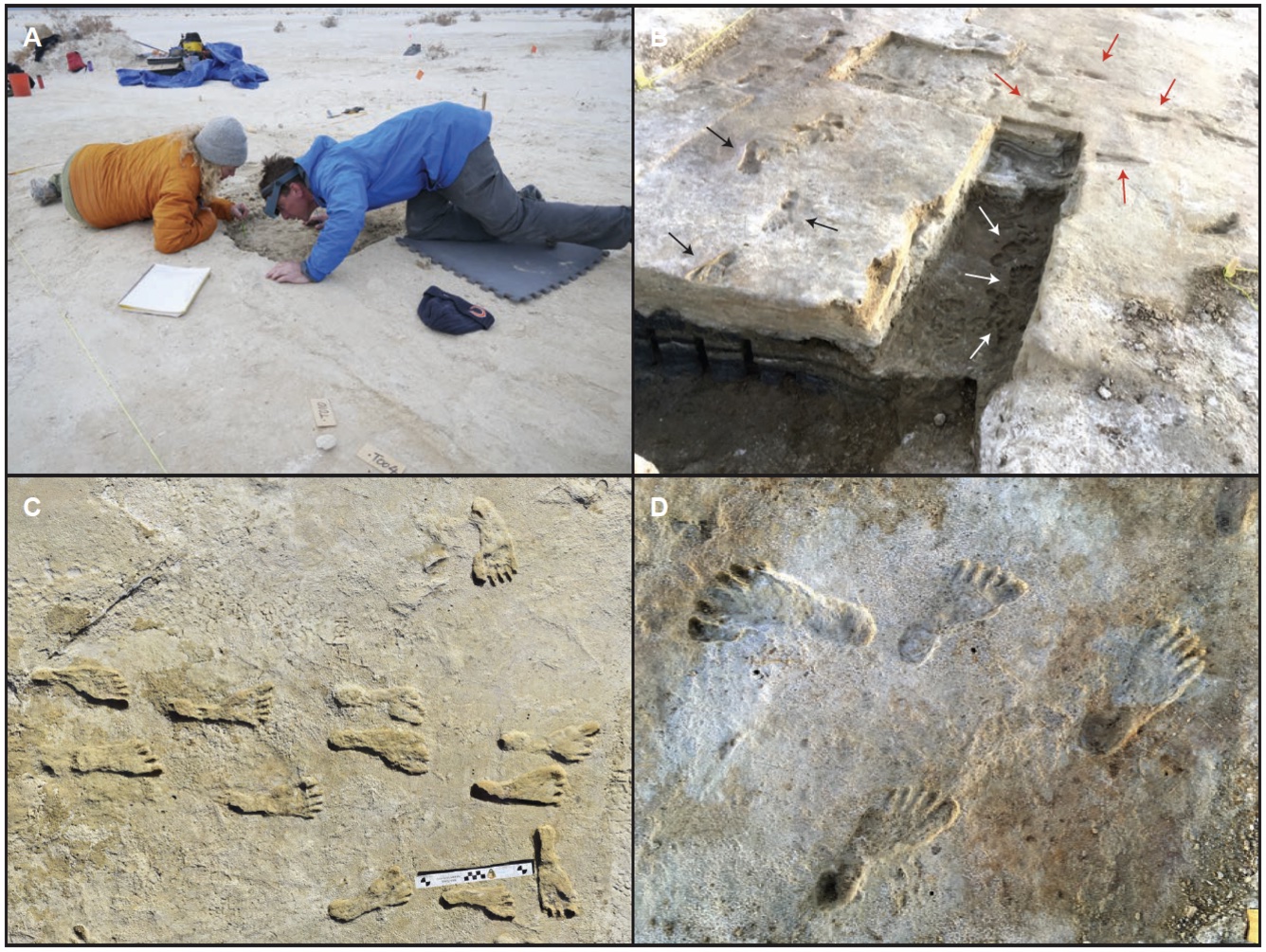
Along the margins of a vanished Ice Age lake in what is now White Sands National Park, New Mexico, a team excavated dozens of fossilised human footprints — men, women and children, some walking beside the tracks of mammoths and giant ground sloths. Preserved in fine gypsum-rich muds and revealed by erosion, the prints are extraordinarily evocative: a mother setting down a toddler, tracks doubling back. But their real significance is chronological. If the dates are right, humans were living in the interior of North America some 23,000 years ago — many thousands of years earlier than the textbooks long allowed.

See it on the globe →
The mainstream view

What archaeology says

The footprints were first dated in a 2021 Science paper led by Matthew Bennett and colleagues, working with US Geological Survey and National Park Service scientists including David Bustos, Kathleen Springer and Jeffrey Pigati. Radiocarbon dating of seeds of the aquatic plant Ruppia cirrhosa found in the same layers returned ages of roughly 23,000 to 21,000 years — placing people in the Americas at the height of the Last Glacial Maximum, when the standard model held the ice-free corridor and coastal routes were largely closed and Clovis-first thinking had already been eroded but no site was so old and so securely in the continental interior.

Because the original dates rested on aquatic seeds — vulnerable to a 'hard-water' reservoir effect, whereby plants take up ancient dissolved carbon and read too old — the team returned with independent methods. A 2023 Science paper reported radiocarbon dates on terrestrial conifer pollen from the same horizons, plus optically stimulated luminescence (OSL) ages on quartz grains within the footprint-bearing sediments; both corroborated the original chronology. A further study in 2025, dating the mud itself at two independent laboratories, again supported an age older than about 21,000 years, giving three different materials, three methods and multiple labs in agreement — some 55 consistent radiocarbon dates in all.

Most researchers now treat the roughly 22,000-year age as robust, and White Sands as strong evidence that humans were present in the Americas well before the Last Glacial Maximum peak.

Key evidence cited
  • Ruppia seed radiocarbon dates of c. 23,000–21,000 years from the footprint layers (2021 Science)
  • Independent 2023 confirmation from terrestrial pollen radiocarbon and OSL on quartz grains
  • 2025 dating of the enclosing mud at two independent labs supporting an age over 21,000 years
  • Around 55 consistent radiocarbon dates across three materials, three methods and multiple labs
  • Footprints found alongside extinct megafauna tracks, consistent with a full Ice Age setting
The alternative view

What the skeptics propose

The unusual feature of White Sands is that here the 'alternative' view is the sceptical, conservative one: a minority of mainstream scientists who resist the early date precisely because it overturns a long-defended timeline. The most substantive challenge, led by researchers including Charles Oviatt, David Madsen and Loren Davis, focused on the reservoir problem. Because Ruppia is a submerged aquatic plant that can absorb old carbon from groundwater flowing through ancient carbonate rock, its radiocarbon ages could be systematically too old. Correcting for a large reservoir effect, sceptics suggested the true age might be as young as around 15,500 to 13,500 years — still early, but far less revolutionary.

A 2024 critique pressed further methodological concerns about the pollen and OSL work, questioning sample provenance, the completeness of the pollen chemistry, and whether the dated grains truly bracketed the prints. In this reading the burden of proof for so extraordinary a claim has not been fully met, and the possibility of subtle contamination or reworking of old material into younger layers has not been entirely excluded. Sceptics note that a single site, however well documented, sits far outside the pattern of otherwise sparse pre-Clovis evidence.

Supporters respond that the convergence of three independent dating materials — seeds, pollen and luminescence, none sharing the same potential error — makes a systematic old bias vanishingly unlikely, and that the 2025 mud dates close the last major loophole. The debate has narrowed but not entirely ended, making White Sands a live test of how much evidence it takes to move a deeply entrenched timeline.

Key evidence cited
  • Hard-water reservoir risk in aquatic Ruppia seeds, potentially biasing the original dates too old
  • Reservoir-corrected estimates suggesting a far younger age of c. 15,500–13,500 years
  • 2024 critique questioning pollen sample provenance and whether dated grains truly bracket the prints
  • White Sands standing far outside the otherwise sparse and contested pre-Clovis record
  • The general principle that an extraordinary timeline claim demands especially exacting proof

Genuinely open questions

  1. Has every plausible source of a systematic old-carbon bias now genuinely been excluded?
  2. If humans were in interior North America 22,000 years ago, why is corroborating evidence elsewhere so scarce?
  3. By what route did people reach the continental interior during the closed conditions of the glacial maximum?

Worth knowing

Some of the White Sands trackways record a person carrying and repeatedly setting down a small child, then returning along the same path alone — a roughly 22,000-year-old round trip preserved in mud, one of the most intimate scenes in the entire fossil record.