Ancient Engineering · Aswan, Egypt

The Unfinished Obelisk, Aswan

A 1,168-tonne obelisk abandoned mid-carve — the ancient world's biggest stone project, frozen at the moment of failure.

Mainstream: c. 1473–1458 BC (reign of Hatshepsut, 18th Dynasty)Alternative: Date not seriously disputed — sceptics instead question whether hand-held dolerite pounders alone could have carved the scoop-marked trenches around a 1,168-tonne monolith24.08°, 32.90°

At a glance

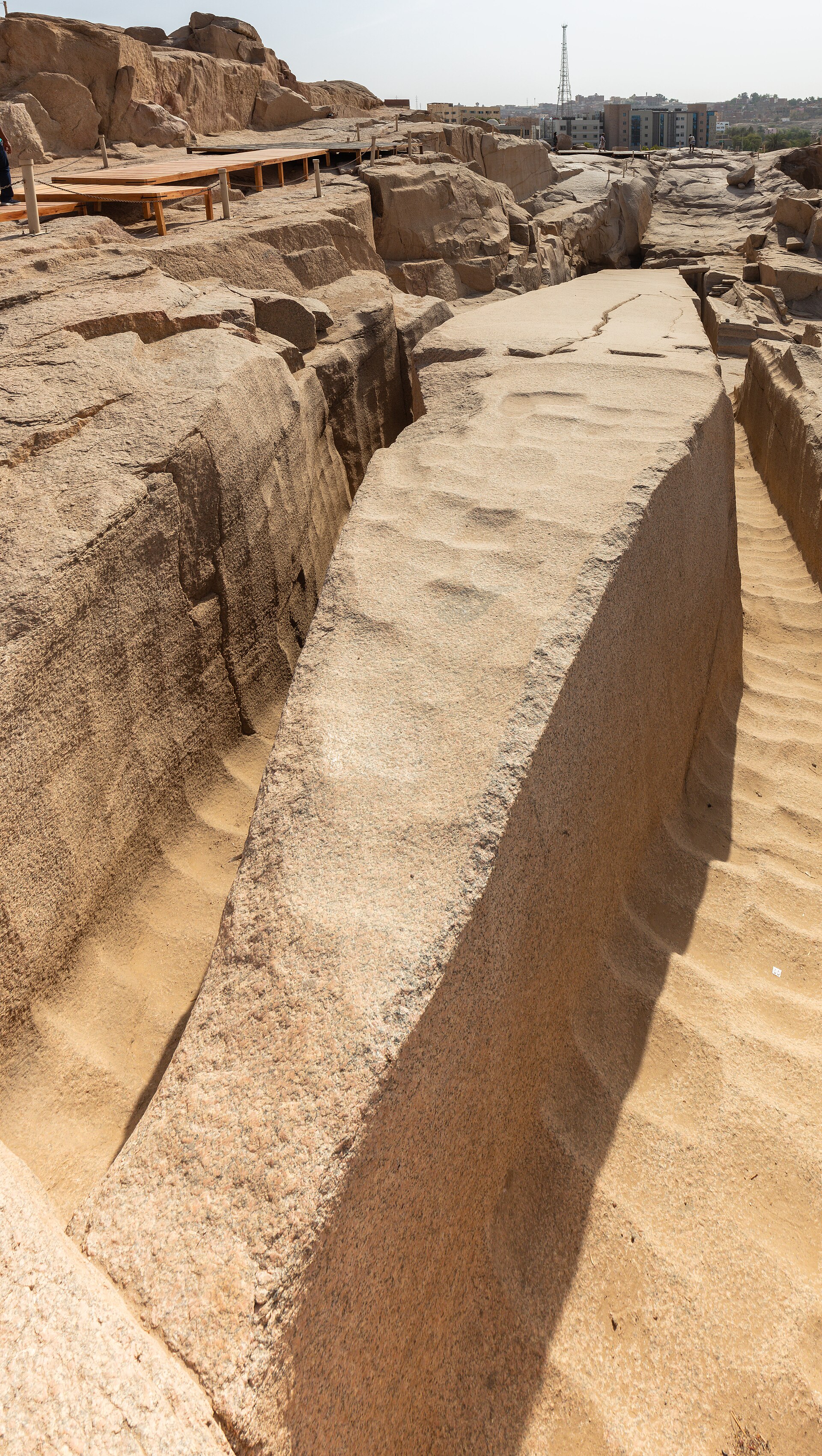
The Unfinished Obelisk, Aswan
Photo: Diego Delso · CC BY-SA 4.0

Still attached to the bedrock of the northern granite quarries at Aswan lies the largest obelisk ever attempted: roughly 41.75 metres long and an estimated 1,090–1,168 tonnes — nearly a third taller and more than twice as heavy as any obelisk actually erected. Work stopped when cracks opened in the granite, and the abandoned monolith became an accidental time capsule of Egyptian quarrying: its surfaces and the surrounding trenches are covered in rounded 'scoop marks', ochre guide-lines and test shafts. Because it preserves every stage of extraction in mid-process, the Unfinished Obelisk is ground zero for the debate over how the Egyptians actually worked hard stone.

See it on the globe →
The mainstream view

What archaeology says

Egyptologists attribute the project to the 18th Dynasty, most likely to Hatshepsut (c. 1473–1458 BC), whose completed obelisks at Karnak came from these same quarries. The site was studied in detail by Reginald Engelbach in 1922, who documented the working method: fire-setting to strip the weathered upper granite, then teams of workers pounding parallel trenches around the monolith using hand-held balls of dolerite — an igneous rock as hard as the granite itself. Thousands of used dolerite pounders still litter the quarry, and the concave scoop marks match the sweep of a two-handed pounding stroke. Ochre setting-out lines and inspection holes survive on the stone, and the project was abandoned exactly as a manual process would fail — when unforeseen fissures propagated through the mass.

Experimental archaeology has repeatedly tested the method. Engelbach himself measured pounding rates in the 1920s; Denys Stocks spent decades demonstrating that dolerite pounders, copper saws and drills fed with sand abrasive can quarry, cut and hollow granite; and a 2023 photogrammetric study in the Journal of Archaeological Science: Reports measured modern test-pounding beside the obelisk itself, confirming that the technique works and allowing labour estimates for the whole undertaking — enormous, but feasible for a state that demonstrably erected dozens of large obelisks. For mainstream scholars the Unfinished Obelisk is not a mystery but the best textbook of Bronze Age quarrying in existence: an unfinished manuscript showing every tool stroke.

The transport question is answered by Egyptian sources themselves: reliefs at Hatshepsut's temple at Deir el-Bahari show two obelisks loaded end-to-end on a giant Nile barge towed by oared ships, and the quarry sits close to the river for exactly that reason.

Key evidence cited
  • Thousands of used dolerite pounders found in situ throughout the Aswan quarries
  • Engelbach's 1922 documentation of trenches, test shafts and ochre setting-out lines
  • Experimental pounding (Engelbach, Denys Stocks, and a 2023 photogrammetric study) reproducing the scoop marks
  • Deir el-Bahari reliefs showing Hatshepsut's obelisks transported on a giant Nile barge
  • Abandonment due to natural fissures, consistent with a manual, high-risk extraction process
The alternative view

What the skeptics propose

Engineer Christopher Dunn, in Lost Technologies of Ancient Egypt, argues the scoop-marked trenches are the wrong shape for hand pounding. The scoops run in long, consistent channels of near-uniform width and curvature — including on near-vertical trench walls and under overhangs where swinging a 4–5 kilogram pounder would be awkward or impossible — and the separation trench around the obelisk is so narrow that a worker could barely crouch in it, let alone deliver effective blows for months. Dunn proposes the marks better match some form of mechanised cutter or abrasive machine, and Brien Foerster and Ben van Kerkwyk (UnchartedX) have popularised similar arguments, noting that dolerite is not meaningfully harder than the granite it is supposed to defeat, making progress agonisingly slow in modern trials.

Alternative writers also stress scale. The Egyptians did not merely attempt this monolith — they routinely extracted, dressed, transported and erected obelisks of 300–450 tonnes with, on the mainstream account, no pulleys, no cranes and no iron. The Unfinished Obelisk would have dwarfed them all, and sceptics ask why a civilisation supposedly at the limit of muscle-powered technique would gamble years of labour on a stone almost three times heavier than anything it had ever raised — unless its builders possessed, or remembered, more capable methods.

Mainstream researchers respond that the 2022–2023 field experiments produced scoop marks visually identical to the ancient ones; that uniform marks are what disciplined, repetitive team labour looks like; that no machine parts, mounts, power sources or swarf have ever been found in the quarry; and that the project's failure — abandoned because of cracks a machine-equipped culture could have anticipated or cut around — is itself the signature of a workforce at the edge of manual capability.

Key evidence cited
  • Dunn's argument that the scoop channels are too uniform, and awkwardly placed, for hand pounding
  • The cramped separation trench, seemingly too narrow for effective pounder strokes
  • Dolerite's hardness barely exceeds the granite's, making progress in trials extremely slow
  • A 1,168-tonne target far beyond anything the Egyptians ever actually moved or raised
  • No surviving Egyptian text describing how the largest monoliths were freed and lifted

Genuinely open questions

  1. How would a 1,168-tonne monolith have been freed from bedrock, moved to the Nile and erected at Karnak?
  2. How long did the project run before abandonment, and what did the failure cost the state?
  3. Why did the planners commit to a stone nearly three times heavier than any obelisk previously attempted?

Worth knowing

If completed, the Unfinished Obelisk would have weighed more than two fully loaded Airbus A380s — and its abandonment preserved the quarry so perfectly that visitors can still see the masons' red ochre guide-lines painted 3,500 years ago.