What archaeology says
Flinders Petrie and Margaret Murray located the structure in 1902–03, and Edouard Naville cleared it in 1912–14. Struck by the cyclopean masonry, Naville declared it perhaps the oldest building in Egypt — an Old Kingdom or earlier work. But Henri Frankfort's systematic excavations for the Egypt Exploration Society in 1925–30 settled the question for most Egyptologists: he found cartouches of Seti I in the fabric of the building, including on foundation elements and in the connecting passages, dedication texts, and decoration completed by Seti's grandson Merenptah. A dedication naming the building 'Menmaatre (Seti I) is Beneficial to Osiris' ties it directly to the king. Peter Brand's detailed 1998 study of Seti's monuments reaffirmed that the Osirion can be dated confidently to his reign.
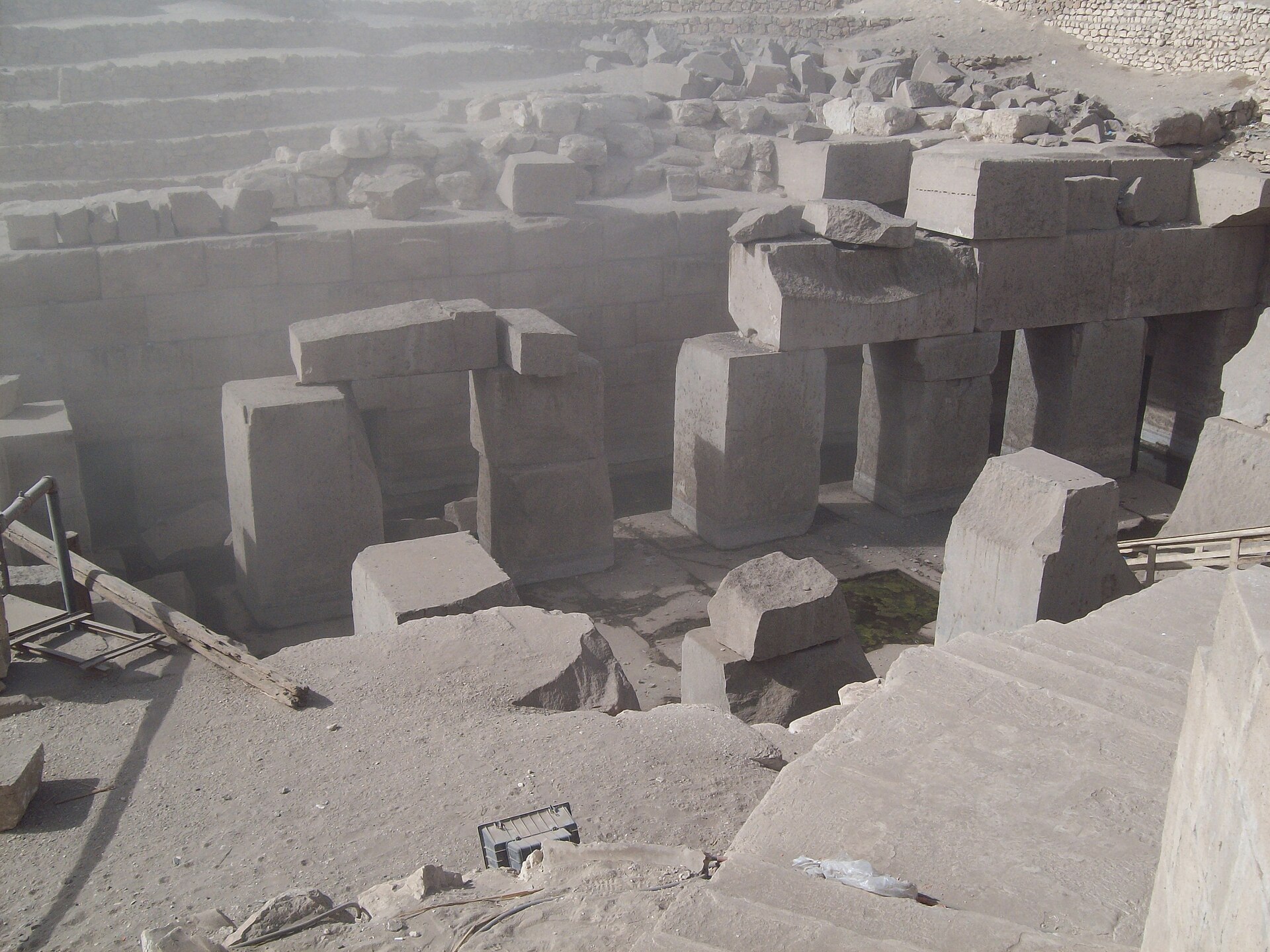
The architectural strangeness is read as deliberate archaism. The Osirion was designed as the tomb of Osiris himself: a primeval mound rising from the waters of creation, encircled by a channel so the central platform literally floats as an island. Its builders sank it into the water table on purpose and evoked the austere granite style of a mythic past — much as a modern architect might build a 'Gothic' chapel. Sloping entrance passages decorated with the Book of Gates mirror royal tombs in the Valley of the Kings.
The famous 'flower of life' circles on two granite pillars are not carved but drawn, probably in red ochre, and sit high on the columns — at a level reachable only after the hall had substantially filled with sand. Accompanying Greek letters date this graffiti to late antiquity, over a thousand years after Seti, demolishing claims that the symbol was somehow 'burned into the stone' in deep prehistory.
- Cartouches and dedication texts of Seti I integral to the structure and its passages (Frankfort, 1925–30)
- Decoration completed under Merenptah, with the Book of Gates in the entrance passage as in royal tombs
- The dedication formula naming the building as Seti's monument 'Beneficial to Osiris'
- The 'flower of life' circles are ochre drawings accompanied by Greek letters, dating to late antiquity
- The 'helicopter' panel explained as a Seti I / Ramesses II palimpsest with fallen plaster infill