What archaeology says
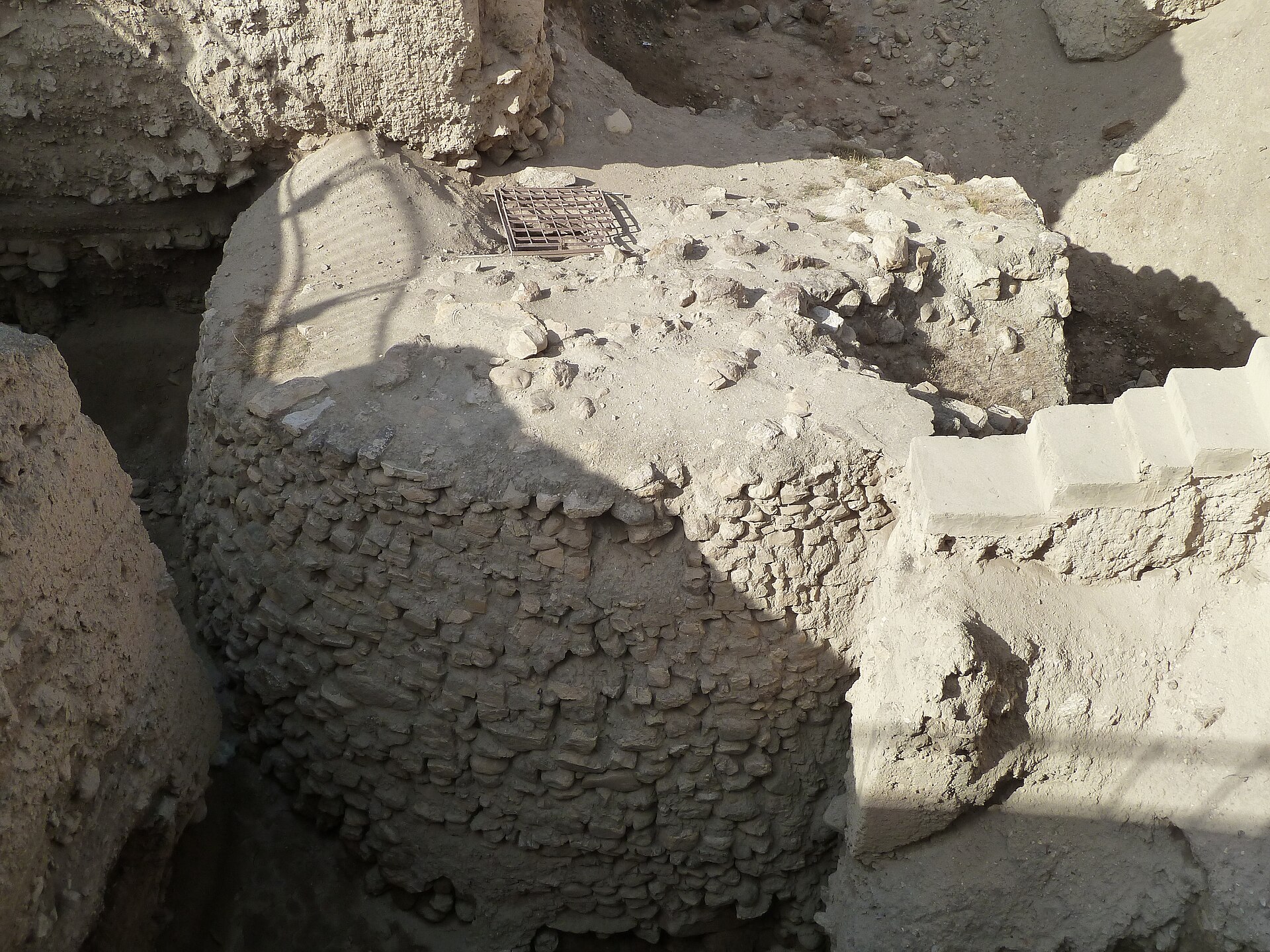
Kathleen Kenyon's excavations of 1952–58, using the then-new stratigraphic methods she pioneered, transformed Jericho into a type-site for the origins of settled life. She exposed the PPNA wall and tower and proved they belonged to the Stone Age, not the Bronze Age as her predecessor John Garstang had assumed. The tower — solid stone, conical, with the world's oldest known staircase inside — predates Egypt's pyramids by more than five millennia. Kenyon read the wall as defensive; later researchers led by Ofer Bar-Yosef argued it was flood protection against wadi torrents, while Ran Barkai and Roy Liran proposed in 2008–2011 that the tower was ideological: computer modelling shows it aligns with the summer-solstice sunset behind Mount Quruntul, its shadow falling across the town, suggesting a monument binding the community to the cosmos — or a display of power by an emerging elite.
The town's later history is equally rich: the famous plastered skulls of the PPNB period (c. 7000 BC), with faces modelled in lime plaster over ancestors' skulls and shells for eyes, are among the earliest known portraiture. In the Middle Bronze Age, Jericho became a substantial Canaanite city (City IV) with cyclopean ramparts and a plastered glacis.
On the biblical question, Kenyon concluded City IV was violently destroyed around 1550 BC — probably amid the upheavals accompanying the Egyptian expulsion of the Hyksos — and that in the late 13th century BC, the era most scholars assign to any historical conquest, Jericho was small, poor and unwalled. Radiocarbon dating of grain from the destruction layer by Hendrik Bruins and Johannes van der Plicht in 1995 supported her, centring on 1562 BC. Most archaeologists therefore treat the story of Joshua's trumpets as aetiology — a tale explaining ruins already ancient when the text was written.
- Kenyon's stratigraphy placing the wall and tower in the Pre-Pottery Neolithic, c. 8300 BC
- High-precision radiocarbon dates on charred City IV grain centring on c. 1562 BC (Bruins and van der Plicht)
- Absence of imported Late Bronze pottery expected in a 1400 BC destruction
- Little evidence of a walled city at Jericho in the late 13th century BC, the usual conquest era
- Barkai and Liran's modelling of the tower's summer-solstice alignment with Mount Quruntul