Ancient Engineering · Beit Guvrin-Maresha National Park, Judaean Lowlands, Israel

Maresha and Beit Guvrin Bell Caves

A city of caves: 3,500 chambers quarried beneath the land of a thousand hideaways

Mainstream: Iron Age town; principal cave-cutting 3rd century BC to Early Islamic periodAlternative: Heirs to a far older cave-dwelling tradition, linked by some to the biblical Horites31.60°, 34.90°

At a glance

Maresha and Beit Guvrin Bell Caves
Photo: Chai · CC BY-SA 3.0

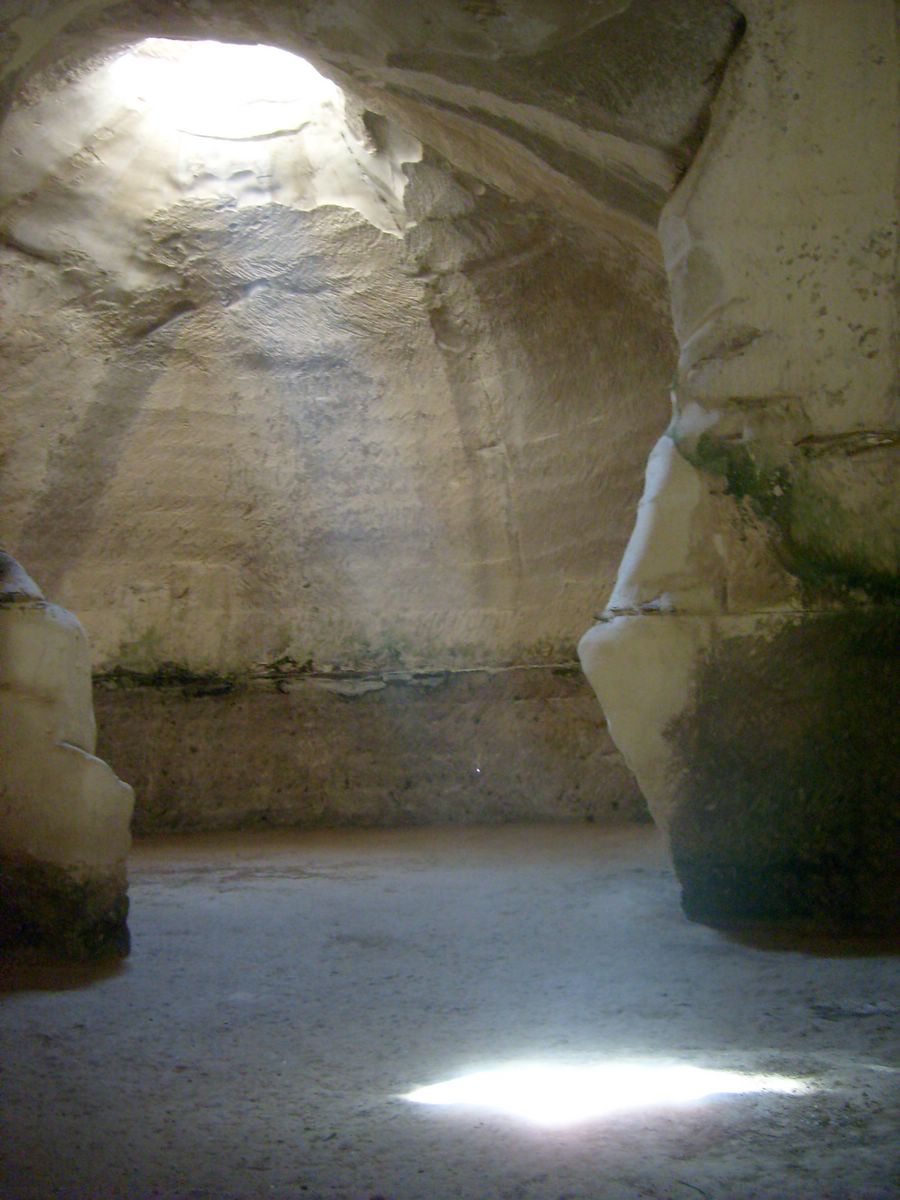
Beneath the twin ancient towns of Maresha and Beit Guvrin in Israel's Judaean lowlands lies one of the densest man-made underground landscapes on Earth: some 3,500 chambers, inscribed on the UNESCO World Heritage list in 2014 as a microcosm of the land of the caves. Residents quarried down through a hard surface crust into soft chalk and turned the resulting voids into a complete subterranean economy — cisterns, olive-oil presses, stables, baths, hideaways, tombs and columbaria housing tens of thousands of pigeon niches — while the later, cathedral-like bell caves of Beit Guvrin, some 800 of them, soar up to 25 metres high.

See it on the globe →
The mainstream view

What archaeology says

Maresha appears in the Hebrew Bible as a town of Judah and rose to prominence in the Hellenistic period as a prosperous, cosmopolitan city of Edomites, Sidonians, Judaeans and Greeks. Its inhabitants discovered that beneath a metre or two of hard nari crust lay thick, soft, self-supporting chalk: by cutting a narrow shaft through the crust they could bell out storage and working space below their own houses almost without limit. Excavations directed for decades by the late Amos Kloner documented the resulting underground city in detail — Hellenistic oil presses, water cisterns with spiral staircases, ritual baths, hideaway systems from the Bar Kokhba revolt of AD 132–135, and painted Sidonian burial caves.

The columbaria are among the most striking spaces: chambers lined with thousands of small niches for raising doves, with estimates for Maresha's columbaria running to tens of thousands of niches in total. Scholars generally interpret them economically — pigeons for meat, sacrificial use and dung fertiliser — though the sheer scale, and cruciform plans of some chambers, keep a partly ritual function under discussion.

The great bell caves concentrated at Beit Guvrin are later and different: quarries of the Byzantine and Early Islamic periods (roughly 6th–10th centuries AD), dug top-down from a narrow opening so the chalk could be extracted while the bell shape kept the roof stable. Arabic inscriptions and crosses on their walls date the workings. The whole complex, in the mainstream account, is a legible 2,000-year continuum of practical quarrying and adaptation — remarkable, but fully explained.

Key evidence cited
  • Some 3,500 chambers documented across Maresha and Beit Guvrin, UNESCO-listed in 2014
  • Coins, pottery and inscriptions date the main quarrying from the Hellenistic to Early Islamic periods
  • Amos Kloner's long-running excavations documented oil presses, cisterns, baths and Bar Kokhba hideaways in datable contexts
  • About 800 bell caves show a documented Byzantine–Early Islamic top-down quarrying technique, some bearing crosses and Arabic inscriptions
  • The nari-over-chalk geology fully explains the shaft-and-bell excavation method
  • Faunal and residue evidence supports pigeon-raising in the columbaria
The alternative view

What the skeptics propose

The alternative readings of Maresha begin with the Bible itself. Deuteronomy and Genesis speak of the Horites — a name long read as cave dwellers, from the Hebrew hor, cave — as an early people of the wider region, and writers of a biblical-antiquarian bent have argued that the Judaean lowlands' cave habit descends from a troglodyte culture far older than the Hellenistic town, pointing out that the earliest quarrying at Maresha is not directly dated and that Iron Age Judahite remains overlie still earlier occupation.

Writers on the lost-civilisation circuit, among them David Hatcher Childress, have folded the Judaean caves into a claimed worldwide pattern of ancient subterranean refuge networks — from Cappadocia to South America — suggesting that the instinct to build cities downward reflects shared memory of ancient catastrophe or conflict rather than local economics. Others question the dovecote consensus: they argue that tens of thousands of identical niches, sometimes arranged in cruciform halls kept scrupulously clean, look more like a vast ritual or funerary apparatus than poultry farming, a point on which even conventional scholars have entertained cultic readings connected with Idumean religion.

Mainstream archaeologists reply that Maresha is among the best-dated underground complexes anywhere: coins, pottery and inscriptions tie the chambers tightly to the Hellenistic through Islamic centuries, pigeon bones and dung residues support the economic reading of columbaria, and nothing at the site requires builders earlier than its known inhabitants. The Horites of Genesis, they add, are located by the text in Seir across the Jordan rift, not in the Shephelah. What is genuinely conceded is that with thousands of chambers and only a fraction excavated, the site retains real capacity to surprise.

Key evidence cited
  • The first quarrying phase at Maresha is not directly dated and could precede the Hellenistic town
  • Biblical tradition preserves memory of early cave-dwelling peoples (the Horites) in the wider region
  • Cruciform, meticulously finished columbaria halls strike some researchers as ritual rather than agricultural architecture
  • Only a fraction of the 3,500 chambers has been scientifically excavated
  • Writers such as David Hatcher Childress place the complex within a claimed global family of ancient underground cities
  • Continuous reuse over two millennia may have erased evidence of the earliest builders

Genuinely open questions

  1. How early did quarrying beneath Maresha actually begin?
  2. Were the great columbaria purely economic, or partly cultic installations of Idumean religion?
  3. What lies in the thousands of chambers still unexcavated?
  4. How far did the underground systems of neighbouring towns interconnect, if at all?

Worth knowing

Beit Guvrin's bell caves have such superb natural acoustics that they are used today as concert venues — and at Maresha, the public Dig for a Day programme lets visitors excavate genuine Hellenistic chambers, with thousands of participants having hauled out artefacts under archaeological supervision.