Ancient Engineering · Luxor (ancient Thebes), Egypt

Karnak Temple Complex

The largest religious complex of the ancient world, where 134 giant columns and 300-tonne obelisks meet tell-tale drill marks in granite.

Mainstream: c. 1970 BC - 30 BC (Middle Kingdom to Ptolemaic)Alternative: Core elements possibly older; precision work attributed to a lost toolkit25.72°, 32.66°

At a glance

Karnak Temple Complex
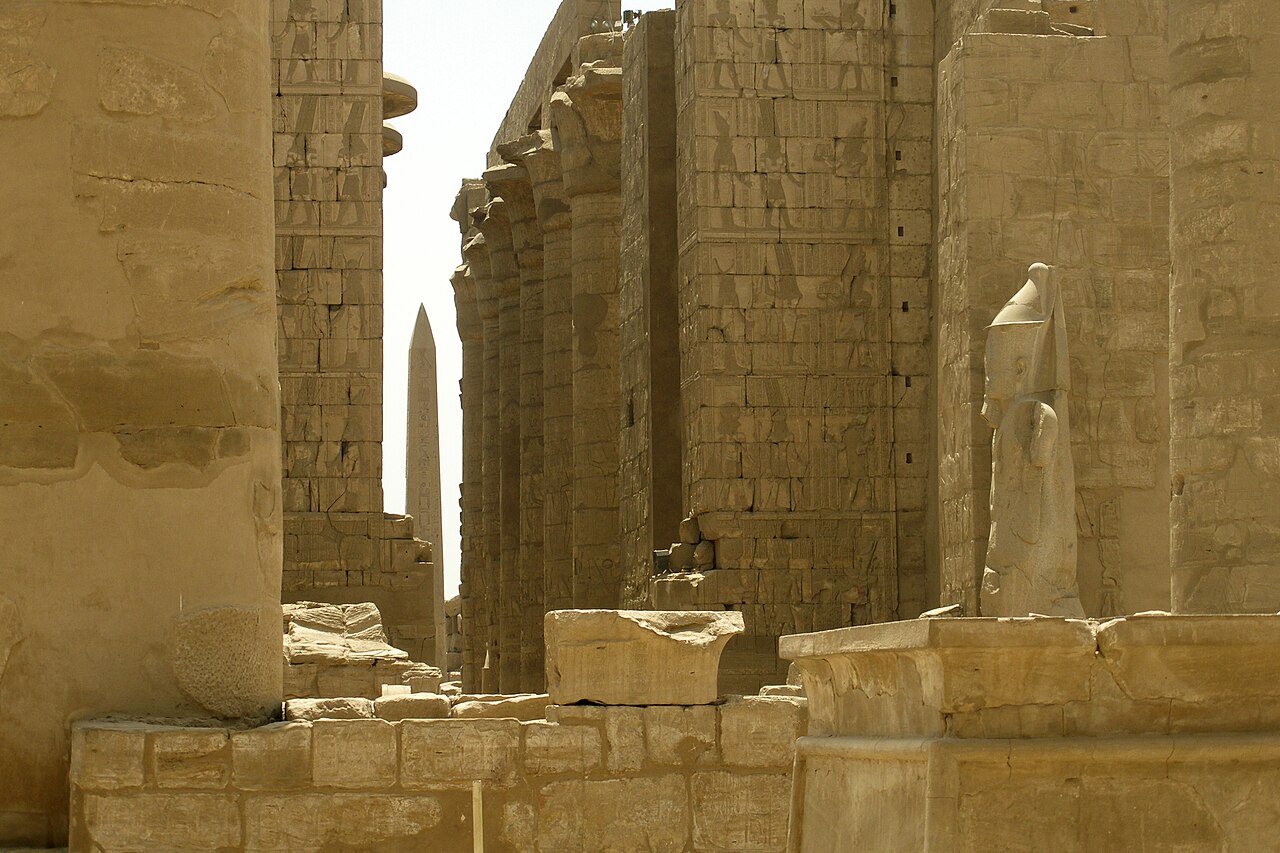
Photo: Vyacheslav Argenberg · CC BY 4.0

Karnak, dedicated above all to Amun-Ra, grew for some two thousand years as pharaoh after pharaoh added pylons, courts and shrines. Its Great Hypostyle Hall contains 134 sandstone columns, the tallest around 21 metres, while Hatshepsut's standing obelisk — a single piece of Aswan granite nearly 30 metres tall and generally estimated at over 300 tonnes — remains the tallest ancient obelisk still standing in Egypt. Amid the reliefs, visitors are often shown neat cylindrical holes and slots cut into granite thresholds and door pivots, which have become a staple of arguments about ancient drilling technology.

See it on the globe →
The mainstream view

What archaeology says

The archaeological sequence at Karnak is unusually well documented. Construction began under Senusret I in the Middle Kingdom, around 1970 BC, and continued through the New Kingdom — Hatshepsut, Thutmose III, Amenhotep III — into Ptolemaic times. The Great Hypostyle Hall was decorated under Seti I and Ramesses II, and thousands of inscriptions, foundation deposits and reused blocks let Egyptologists reconstruct the building history in detail.

The obelisks are explained by the archaeology of the Aswan quarries, where the famous Unfinished Obelisk — abandoned after cracking at over 1,000 tonnes — preserves the extraction method: pounding trenches with dolerite hammerstones. Records such as Hatshepsut's own inscriptions describe quarrying her pair of obelisks in seven months, and reliefs from Deir el-Bahari show obelisks loaded on huge Nile barges. Erection is modelled with earthen ramps and sand-pit lowering, techniques tested in modern experiments.

As for the drill marks, tubular drilling in granite is well attested from the Old Kingdom onward. Flinders Petrie catalogued drill cores in the nineteenth century, and Denys Stocks' experiments show that copper tubes rotated with quartz sand abrasive cut granite and leave exactly the kind of tapering holes and spiral-free striations seen at Karnak — slowly, but effectively, given cheap organised labour.

Key evidence cited
  • Thousands of dated inscriptions and foundation deposits document Karnak's construction sequence reign by reign
  • The Unfinished Obelisk at Aswan preserves dolerite-pounding extraction of a 1,000-tonne monolith in progress
  • Hatshepsut's inscriptions state her obelisk pair was quarried in seven months; Deir el-Bahari reliefs show obelisk barges
  • Petrie documented granite drill cores in the 1880s; Stocks replicated them with copper tubes and sand abrasive
  • Tool marks, ramp remains and construction embankments survive at Karnak itself, including against the first pylon
  • The building style, materials and iconography match the well-established Theban historical context
The alternative view

What the skeptics propose

Christopher Dunn analysed Petrie's granite drill core number 7 and argued its groove pattern implied a feed rate — depth of cut per revolution — far beyond what copper and sand could achieve, concluding that some form of powered or ultrasonic drilling was involved. Karnak's crisply cut pivot sockets and core holes in hard granite are cited by Dunn and by Ben van Kerkwyk of UnchartedX as field examples of the same lost technique.

Van Kerkwyk's UnchartedX videos filmed at Karnak highlight what he sees as two classes of work side by side: superb, symmetrical hard-stone statuary and precision-cut granite elements versus rougher sandstone construction, which he interprets as evidence that the dynastic Egyptians built around and reused finer work from an earlier, technologically advanced culture. The logistics of Hatshepsut's obelisk — quarrying, moving and erecting a 300-tonne monolith — are likewise presented as under-explained by ramps and ropes.

Graham Hancock and others have added a broader chronological argument: that key Egyptian sites incorporate remnants of a civilisation destroyed at the end of the last Ice Age, with Karnak's oldest layers deserving re-examination.

Key evidence cited
  • Christopher Dunn's analysis of Petrie's Core 7 claims a feed rate hundreds of times greater than modern hand drilling
  • Cleanly cut tubular holes and slots in hard granite thresholds are shown to tourists as machine-like work
  • UnchartedX contrasts precision hard-stone elements with rougher sandstone construction as evidence of two eras of work
  • No complete ancient drill of the required scale has been recovered from the archaeological record
  • Erection of a 300-plus tonne obelisk has never been fully replicated with attested ancient methods — a 1999 NOVA attempt used a 25-tonne stand-in
  • Proponents argue quarry-to-temple transport of the largest monoliths remains under-demonstrated

Genuinely open questions

  1. Can the feed-rate argument over Petrie's drill cores be settled with modern metrology and controlled experiments?
  2. How exactly were 300-tonne obelisks erected onto their pedestals without cracking?
  3. How much older material is reused within Karnak's earliest layers?
  4. Why did drilling and sawing of the hardest stones peak so early in Egyptian history?

Worth knowing

Hatshepsut's standing obelisk was once partly walled up by her successor Thutmose III — the masonry casing accidentally protected its lower carvings, which remain among the sharpest at Karnak.