Ancient Technology · Saqqara, Egypt

Serapeum of Saqqara

Two dozen colossal granite boxes in a tunnel under the desert — burial vaults for sacred bulls, or relics of lost precision engineering?

Mainstream: c. 1250-30 BC (Ramesses II to Ptolemaic era)Alternative: Boxes possibly millennia older, inherited by dynastic Egypt29.87°, 31.21°

At a glance

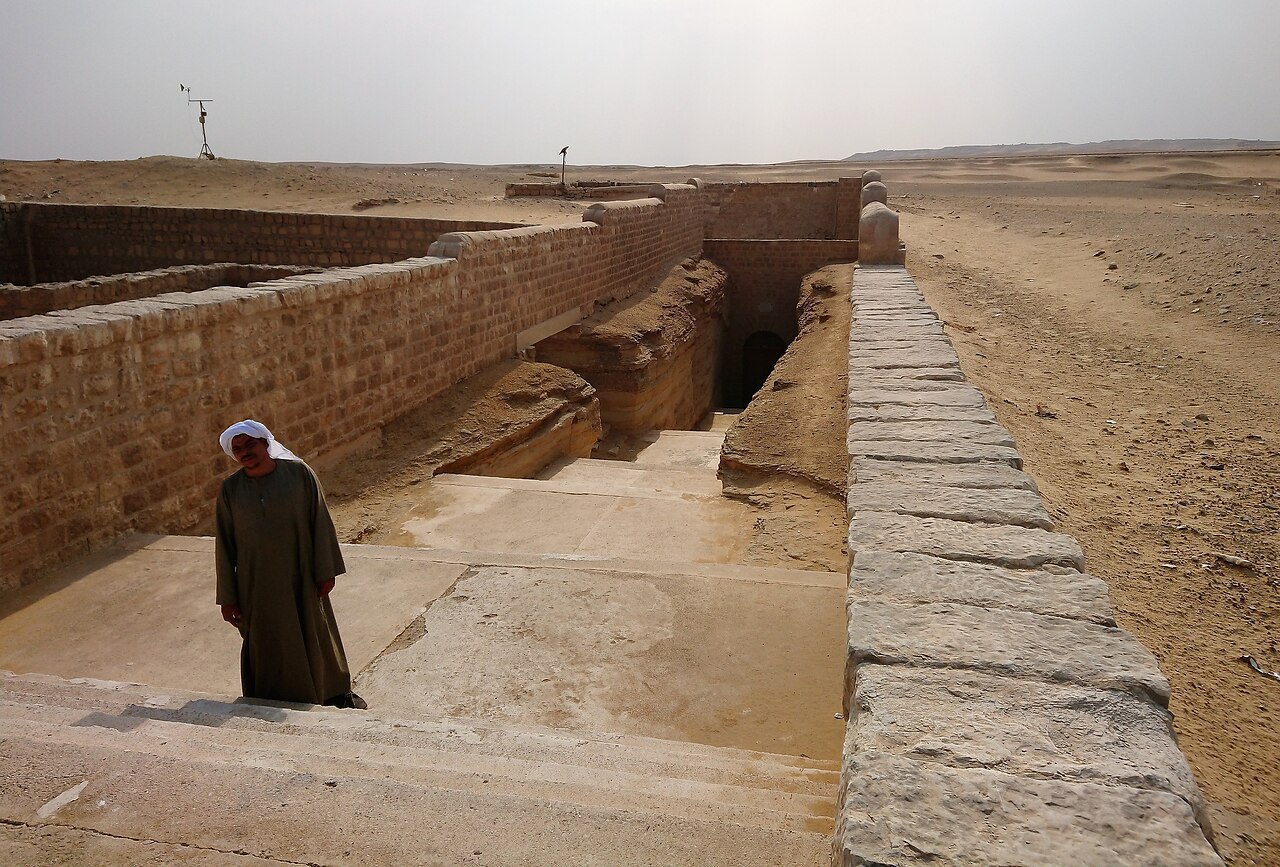
Serapeum of Saqqara
Photo: Happa · CC BY 3.0

Beneath the sands of Saqqara, a network of rock-cut galleries houses around two dozen enormous hard-stone sarcophagi, most of Aswan granite, each estimated at roughly 40 to 100 tonnes including their lids. Rediscovered by French archaeologist Auguste Mariette in 1850-51, the Serapeum served as the burial place of the sacred Apis bulls, living embodiments of the god Ptah. The sheer size of the boxes, their placement in narrow underground niches, and the mirror-like flatness of some interior surfaces have made the site a centrepiece of the modern debate over how much precision ancient Egyptian toolkits could really achieve.

See it on the globe →
The mainstream view

What archaeology says

Egyptologists date the Serapeum's galleries from the reign of Ramesses II, whose son Prince Khaemwaset organised the earlier burials, through to the Ptolemaic period. The Greater Vaults containing the giant boxes were used chiefly from the 26th Dynasty onward. Mariette's excavation recovered stelae naming specific Apis bulls with regnal dates, votive offerings, and in the older galleries wooden coffins and bull remains, anchoring the complex firmly in the historical record.

The boxes themselves are seen as the culmination of a very long Egyptian tradition of hard-stone working: pounding with dolerite balls, sawing and drilling with copper tools fed by quartz sand abrasive, and patient grinding and polishing. Experimental archaeologist Denys Stocks has replicated granite drilling and sawing with such methods. Egyptologists note that the finish is not uniform — exteriors are often rough or unfinished, one abandoned box sits in a passageway, and several bear crudely incised late inscriptions — a pattern consistent with hand-finishing to different standards rather than machine production.

Moving the boxes underground is explained by ramps, sledges, levers and sand-lowering techniques, all attested elsewhere in Egyptian engineering. The niches show cuttings interpreted as evidence for manoeuvring the boxes into place along the gallery floor.

Key evidence cited
  • Mariette's 1850-51 excavation recovered dated votive stelae naming Apis bulls and their burial years, tying the vaults to specific reigns
  • Earlier galleries contained actual bull burials, wooden coffins and canopic material linked to the Apis cult
  • An unfinished, roughly dressed box abandoned in a passageway shows work in progress, not a finished inherited artefact
  • Denys Stocks' experiments show copper saws and drills with sand abrasive can cut and hollow granite
  • Surface quality varies widely between and within boxes — consistent with hand grinding to different standards
  • Quarry marks, ramps and sledge transport are documented across Egyptian hard-stone projects of the same era
The alternative view

What the skeptics propose

Engineer Christopher Dunn, author of The Giza Power Plant and Lost Technologies of Ancient Egypt, measured interior surfaces of Serapeum boxes with precision straight edges and squares and reported flatness and squareness he argues are within thousandths of an inch — tolerances he says belong in a modern machine shop, not a Bronze Age workshop. For Dunn, such accuracy on the inside of a box, where it serves no visible ritual purpose, points to advanced machining and to lost knowledge.

Ben van Kerkwyk of UnchartedX has filmed and publicised the boxes extensively and has promoted metrological scanning of their surfaces, arguing the results show engineering-grade precision. He and others, including Brien Foerster, suggest the giant boxes may pre-date the Apis cult entirely: a far older, technologically sophisticated culture made them, and dynastic Egyptians later found, reused and crudely inscribed them — which would explain why the finest surfaces and the shakiest hieroglyphs share the same stones.

Proponents also stress the logistics: manoeuvring 70-tonne-plus boxes through narrow, dark, underground corridors and rotating them into side niches, they argue, strains ramp-and-sledge explanations that were developed for open-air construction sites.

Key evidence cited
  • Christopher Dunn's straight-edge measurements reportedly show interior flatness within thousandths of an inch
  • Near-perfect 90-degree internal corners in hard granite are difficult to explain with hand grinding, proponents argue
  • The crude, shallow inscriptions contrast sharply with the superb surface finish, suggesting to some a later reuse of older boxes
  • UnchartedX has promoted scanning-based metrology of the boxes as evidence of engineering-grade tolerances
  • Manoeuvring 70-100 tonne boxes through confined underground galleries has never been fully replicated experimentally
  • Interior precision serves no known ritual function for a bull burial, raising the question of why the effort was made

Genuinely open questions

  1. What do rigorous, peer-reviewed metrology surveys of the box surfaces actually show, and will any be published?
  2. Why do superbly finished surfaces and crude inscriptions coexist on the same monuments?
  3. How exactly were the largest boxes turned into their side niches within the narrow galleries?
  4. Why were some boxes left unfinished or abandoned mid-transport?

Worth knowing

Auguste Mariette reportedly used gunpowder to blast his way past obstructions when excavating the Serapeum in 1851 — archaeology was a rougher business in those days.