Ancient Technology · Abu Ghurab / Abusir, Egypt

Abu Ghurab Sun Temple & Abusir

A ruined sun temple whose alabaster altar, sawn basalt floors and drill holes are exhibit A in the ancient machining debate.

Mainstream: c. 2445–2421 BC (sun temple of Nyuserre, 5th Dynasty)Alternative: Date not seriously disputed — sceptics instead question whether the alabaster altar and basins, sawn basalt paving and tube-drilled holes could be products of copper-age tools29.90°, 31.19°

At a glance

Abu Ghurab Sun Temple & Abusir
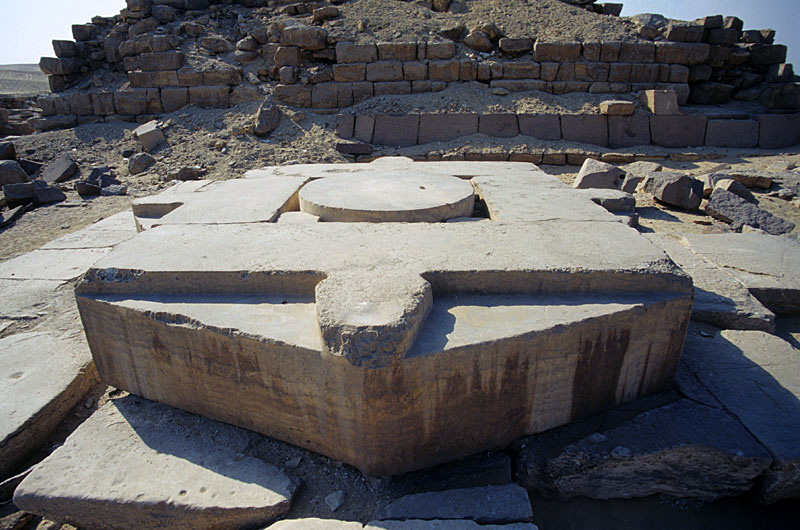
Photo: Roland Unger · CC BY-SA 3.0

A kilometre apart on the desert edge south of Giza lie Abu Ghurab and Abusir: the sun temple of Pharaoh Nyuserre — the best preserved of the 5th Dynasty's temples to the sun god Ra — and the pyramid field of kings Sahure, Neferirkare and Nyuserre himself. Abu Ghurab centres on a giant alabaster altar formed of a solar disc ringed by four hotep (offering) signs, with a row of superbly carved alabaster basins nearby. Across both sites, basalt paving slabs carry long arcing saw cuts and there are more tube-drilled holes in stone here than almost anywhere in Egypt — making this quiet, rarely visited site a magnet for researchers on both sides of the ancient-technology argument.

See it on the globe →
The mainstream view

What archaeology says

The sun temples are a documented 5th Dynasty phenomenon: royal annals record six of them, and Nyuserre's — excavated by Ludwig Borchardt and Friedrich von Bissing in 1898–1901 — comprised a squat obelisk on a monumental podium, an open courtyard with the alabaster altar, magazines, and a causeway to a valley temple. Its reliefs, now largely in Berlin, celebrate the sun's renewal of life through the seasons. The neighbouring Abusir pyramids and their mortuary temples have been excavated for decades by the Czech mission of Charles University (under Miroslav Verner and later Miroslav Bárta), while since 2019 an Italian–Polish team led by Massimiliano Nuzzolo and Rosanna Pirelli has re-excavated Nyuserre's sun temple, finding a mud-brick predecessor building beneath it and, in 2022–2025, remains of the valley temple — ordinary, incremental archaeology anchoring the whole complex firmly in the 25th century BC.

On the stonework, mainstream researchers do not deny the tool marks — they embrace them. The basalt pavements at Abusir and Abu Ghurab preserve unfinished cuts, overshoots and 'wandering' saw striations that record copper slabbing-saws fed with quartz sand abrasive, exactly the process Denys Stocks reconstructed experimentally, cutting granite and basalt with replica copper saws and tubular drills. Flinders Petrie catalogued the drill cores and saw cuts as early as 1883 and attributed them to sawing and drilling with hard abrasive. The many tube-drill holes at Abu Ghurab, some abandoned mid-hole, likewise show the stages of a laborious manual process. The alabaster altar and basins, though beautifully finished, are in calcite — a soft stone (Mohs 3) readily worked with the era's tools.

The basins and their channel system are debated within Egyptology itself — older readings as blood drains for animal sacrifice have given way to interpretations involving purification or libations — but no mainstream researcher sees anything at either site beyond ambitious Old Kingdom craft.

Key evidence cited
  • Royal annals naming the 5th Dynasty sun temples and their builders
  • Borchardt and von Bissing's excavations tying obelisk podium, altar and reliefs to Nyuserre
  • Denys Stocks' experiments cutting basalt and granite with copper saws, drills and sand abrasive
  • Unfinished cuts, overshoots and abandoned drill holes recording a manual, stage-by-stage process
  • The 2022–2025 Italian–Polish excavations revealing a mud-brick predecessor temple and valley temple remains
The alternative view

What the skeptics propose

For the alternative camp, Abu Ghurab and Abusir offer some of the most striking physical evidence in Egypt. Christopher Dunn has analysed the tube-drilled holes and the drill cores Petrie collected, arguing the spiral striations and feed rates imply cutting far faster and more forceful than copper tubes with sand can achieve; Ben van Kerkwyk's UnchartedX documentaries on the Egyptian tube drills, filmed partly at Abu Ghurab, make the same case to a large audience. The long, sweeping cuts in the basalt paving — smooth arcs with consistent curvature, some with visible overcuts where a blade appears to have run beyond its line — are presented as the signature of large circular or straight saws under mechanical control rather than teams hand-stroking a soft copper blade for weeks.

The alabaster altar and basins draw a further set of claims. Writers such as Stephen Mehler — drawing on the indigenous 'Khemitology' tradition of Abd'el Hakim Awyan — describe Abu Ghurab as a place of harmonic or energetic technology, with the altar as a resonant platform (some popular accounts call it a 'crucible' and point to scooped, almost melted-looking features in the alabaster). The precision circularity of the basins, and the question of what liquid or process the channels served, are cited as evidence the site's function has been misread. More broadly, proponents argue the hardest, finest stonework at Abusir belongs to an inherited toolkit from an earlier, more capable civilisation, with the 5th Dynasty structures built around older elements.

Mainstream rebuttals: Stocks' experiments did cut basalt and granite with copper and sand, producing striations like the ancient ones, merely slowly; the 'wandering' and overshooting of the Abusir saw cuts are exactly the errors of manual sawing, not machine control; unfinished holes and cores show step-by-step manual progress; calcite is soft enough that the altar demonstrates skill, not superhuman capability; and the sun temples are woven so tightly into 5th Dynasty texts, reliefs and stratigraphy that inserting an earlier civilisation requires ignoring the site's entire documentary context.

Key evidence cited
  • Dunn's analysis of drill cores suggesting cutting rates beyond copper-and-sand capability
  • Long arcing saw cuts in basalt paving with smooth, consistent curvature
  • An unusual concentration of tube-drilled holes, some in awkward positions with no obvious purpose
  • The alabaster altar and basins' precision, and scoop-like features proponents read as process damage
  • Khemitology traditions (Awyan, Mehler) describing the site as a place of energy or resonance

Genuinely open questions

  1. What ritual or practical function did the alabaster basins and their channel system actually serve?
  2. How were the large basalt paving slabs sawn and laid so efficiently, and why was basalt chosen for floors?
  3. Where are the four missing sun temples that ancient texts say other 5th Dynasty kings built?

Worth knowing

Ancient records name six 5th Dynasty sun temples, but in more than a century of searching archaeologists have securely located only two — four entire royal temples are presumably still lying under the sand between Abusir and Giza.