What archaeology says
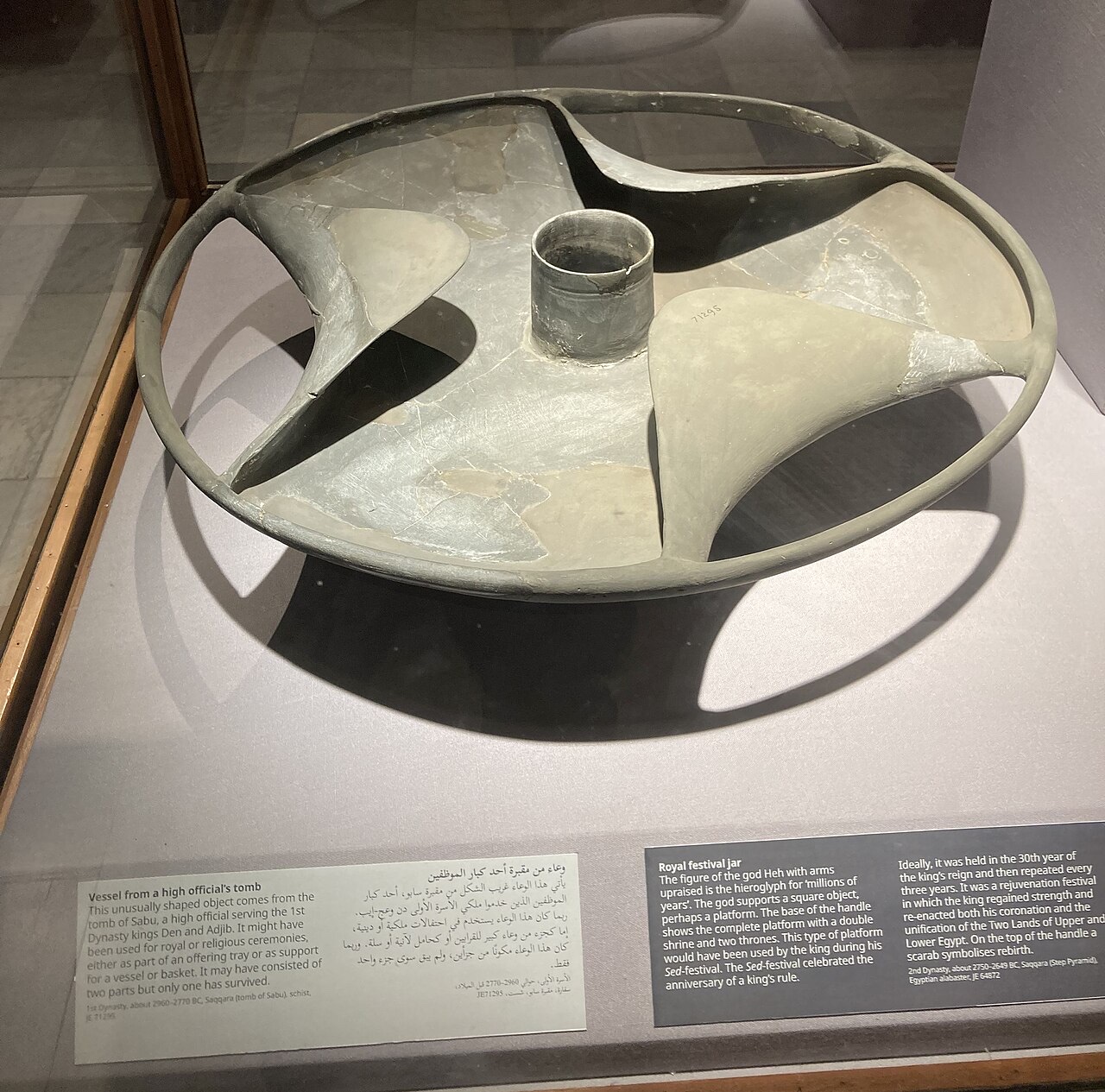
Egyptologists place the disc firmly within the extraordinary Early Dynastic tradition of hardstone vessel carving, when craftsmen produced tens of thousands of vessels in everything from granite to rock crystal, including deliberately thin, virtuosic 'show' pieces imitating other materials. Emery himself thought it might have formed part of a stand; subsequent interpretations, discussed by specialists in early stone vessels such as Ali el-Khouli, cluster around a few options: an imitation in stone of a metal or basketry bowl, a stand for a ritual hes vase, an oil lamp component, or a stylised lotus form — the three incurved lobes reading as petals folding over the rim.
The mainstream emphasises context: the disc lay in a First Dynasty tomb among conventional grave goods, part of a funerary assemblage, not a workshop; metasiltstone is brittle and utterly unsuited to mechanical rotation under load; and the central hub matches sockets used for mounting vessels on stands elsewhere in the corpus. Its uniqueness is real but not unparalleled as a phenomenon — Early Dynastic tombs regularly yield one-off virtuoso vessels.
Scholars also note that the disc's 'aerodynamic' look is an artefact of modern pattern-matching: nothing about First Dynasty technology, which is richly documented from tools to workshops, involves rotary machines beyond the simple drill and the potter's wheel's precursors.
- The disc was excavated in a documented First Dynasty funerary context among conventional stone vessels and grave goods
- Early Dynastic Egypt produced tens of thousands of hardstone vessels, including unique virtuoso forms imitating other materials
- Metasiltstone is brittle and could not survive use as a rotating mechanical component under load
- The central hub and collar parallel mounting features on known vessel-and-stand combinations
- The incurved lobes are consistent with lotus-petal and folded-rim motifs in early Egyptian design
- No axles, bearings, machines or mechanical depictions exist anywhere in the vast Early Dynastic archaeological record