What archaeology says
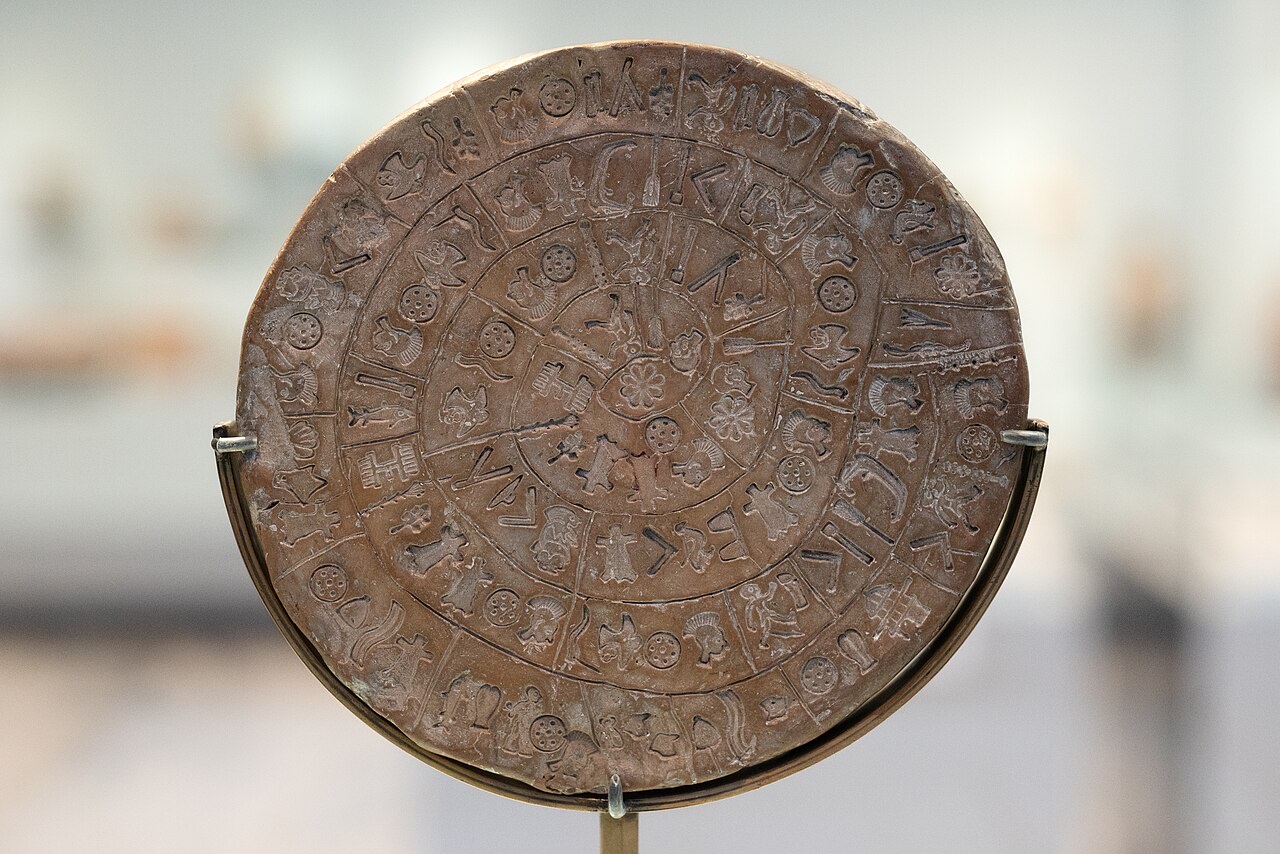
The mainstream position holds the disc to be a genuine Bronze Age artefact of the mid-second millennium BC, found in a datable context in Building 101 at Phaistos with a Linear A tablet nearby. Most scholars treat the script as a syllabary — the sign count of 45 fits syllabic systems like Linear A and B — probably recording Minoan speech, and most concede that with only 241 signs of text, statistical decipherment is impossible unless more examples surface. Yves Duhoux's studies remain standard, and the disc is a centrepiece of the Heraklion Archaeological Museum.
On authenticity, most specialists reject Eisenberg's forgery case. Duhoux and others answer his points directly: the disc's context included datable pottery; the Arkalochori axe, excavated in the 1930s by Spyridon Marinatos, shares sign forms and could not have informed a 1908 forger; and details like the corrected over-stampings scattered through the text are odd behaviour for a faker but natural for a scribe. The Greek authorities have declined to release the disc for the thermoluminescence test Eisenberg demanded, citing its fragility — a refusal mainstream scholars regard as unfortunate but not sinister.
Among serious decipherment attempts, the reading by linguists Gareth Owens and John Coleman — treating it as a Minoan religious text addressed to a mother goddess, using Linear A/B sound values — has received attention but remains unproven and is regarded by most epigraphers as speculative.
- The disc was excavated by a professional mission in a Middle Minoan context alongside a Linear A tablet and datable pottery
- Several signs closely parallel those on the later-excavated Arkalochori axe, which a 1908 forger could not have known
- Over-stamped corrections in the text suit a working scribe far better than a forger seeking a clean showpiece
- The 45-sign inventory is statistically consistent with a genuine syllabary, comparable to Linear A and B
- Sign punches imply a stamping technology attested indirectly by other Minoan seal and stamp practice
- No physical examination of the clay or firing has ever produced evidence of modern manufacture