Ancient Engineering · Pythagoreion, Samos, Greece

The Tunnel of Eupalinos

Two teams of Greek workmen dug towards each other through a kilometre of solid mountain in the sixth century BC — and met, thanks to geometry alone.

Mainstream: c. 550–530 BC (reign of the tyrant Polycrates)Alternative: Date not seriously disputed — the argument is over exactly how a sixth-century BC engineer aimed two blind headings through a mountain and met in the middle37.69°, 26.93°

At a glance

The Tunnel of Eupalinos
Photo: Tomisti · CC BY-SA 4.0

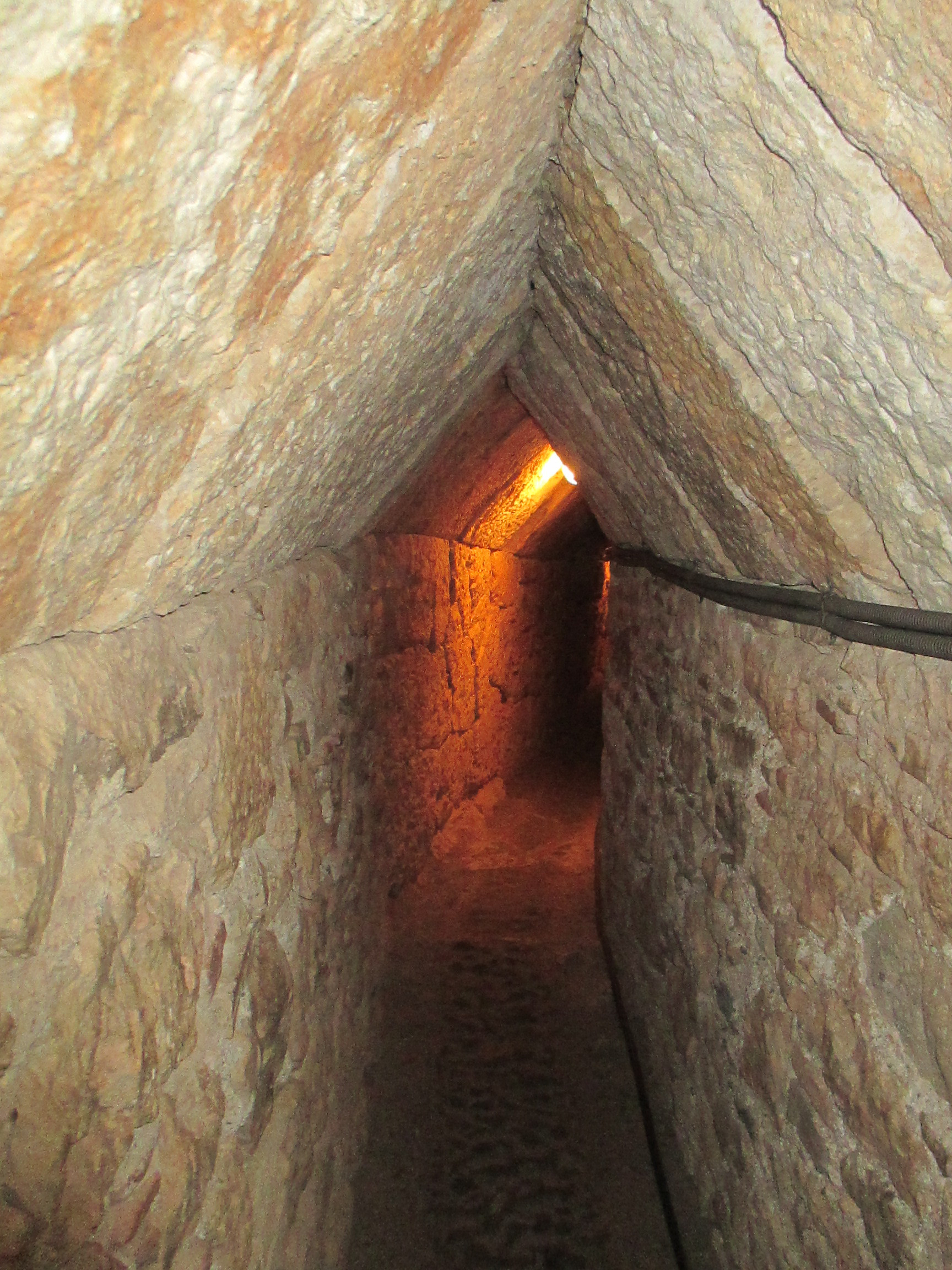
Beneath Mount Kastro on the island of Samos runs a 1,036-metre aqueduct tunnel, roughly 1.8 metres square, cut in the mid-sixth century BC to bring water from the Agiades spring to the fortified city now called Pythagoreion. Because a besieged city could not rely on surface pipes, the tyrant Polycrates commissioned an engineer named Eupalinos, son of Naustrophos, from Megara, to hide the supply inside the mountain — the water flowed in terracotta pipes laid in a deeper trench beneath the walking level. What makes the tunnel immortal is how it was dug: from both ends simultaneously ('amphistomon' — double-mouthed, as the Greeks called it), by two crews who could not see, hear or signal each other, converging under 170 metres of rock. It is the earliest tunnel in history known to have been set out by geometrical survey, and the two headings met with a closing error of well under a metre after years of digging. Herodotus, writing a century later, ranked it first among the three greatest engineering works of the Greek world. Rediscovered via the spring by Victor Guérin in 1853 and cleared in the 1880s, the tunnel was fully excavated by the German Archaeological Institute under Ulf Jantzen in 1971–73, exhaustively surveyed by Hermann J. Kienast, and reopened to visitors in 2017 after an extensive restoration.

See it on the globe →
The mainstream view

What archaeology says

Kienast's geodetic survey, published as the definitive monograph in 1995, effectively reverse-engineered Eupalinos' method from the tunnel itself. Eupalinos first established a straight 'mountain line' over the summit — probably staked out with ranging poles and levelled with simple instruments like the chorobates — fixing the two portals on the same line and the same contour. Each crew then dug inward along its bearing. Painted red survey marks and a reference line named for the letter 'kappa' survive on the walls, recording his running measurements in Samian feet.

The subtleties are what impress engineers. Knowing that two nominally straight headings might still slide past each other, Eupalinos deliberately bent both tunnels into a dog-leg near the expected meeting zone, converting a possible parallel miss into a guaranteed crossing — a piece of error-management reasoning centuries ahead of its formal mathematics. Vertically, he held both headings to the same level so precisely that the floors met with a discrepancy of only a few decimetres; horizontally the junction is nearly perfect. When the north crew hit bad ground and had to detour, he adjusted the geometry and lengthened the other heading's target zone to compensate. Mathematician Tom Apostol's widely read 2004 analysis walks through how every step is achievable with rope, stakes, right angles and patience; a later, more instrument-heavy explanation using the dioptra, described by Hero of Alexandria around AD 60, is generally considered anachronistic for the sixth century BC.

Excavation and inscriptions leave the attribution secure: Herodotus names Eupalinos and Samos in Histories 3.60, the pottery and construction details fit Polycrates' era, and the tunnel served the city for roughly a thousand years before falling out of use in Byzantine times.

Key evidence cited
  • Herodotus (Histories 3.60) naming Eupalinos of Megara and ranking the tunnel among the Greeks' greatest works
  • Kienast's full geodetic survey documenting the mountain line, dog-leg strategy and closing error of under a metre
  • Painted survey marks and the 'kappa' measuring system preserved on the tunnel walls
  • German Archaeological Institute excavations (1971–73) dating construction to Polycrates' reign
  • Roughly a thousand years of use confirmed by pipe replacements and Byzantine-era abandonment deposits
The alternative view

What the skeptics propose

There is no serious dispute about who dug the tunnel or when — which makes Eupalinos a useful control case for this catalogue. The live debates are about method and pedigree. Some historians of science have argued that such confident applied geometry cannot have sprung from nothing on a sixth-century Aegean island, and must descend from older Egyptian and Mesopotamian surveying traditions — rope-stretchers and canal levellers whose techniques the Greeks absorbed and formalised. Others emphasise that no earlier culture is known to have attempted a two-ended blind tunnel at all: the Assyrian and Judahite precedents (like Hezekiah's roughly contemporary tunnel at Jerusalem) wander sinuously, suggesting they followed karst fissures or worked by trial and error, while Eupalinos' headings are ruler-straight. On that reading, something genuinely new — proof-driven geometric confidence — appears here, a generation before Pythagoras, who was born on Samos as the tunnel was being dug.

A related scholarly argument concerns the instruments. The elegant reconstruction using only staked lines over the summit (Kienast, Apostol) competes with proposals involving sighting instruments, water levels, or the triangulation scheme Hero of Alexandria later described using the tunnel as his textbook example. Each explanation works on paper; the tunnel itself, with its painted marks and deliberate dog-leg, is the only witness, and it does not say which tools were used.

Writers in the 'lost ancient knowledge' genre occasionally recruit the tunnel as evidence of mysteriously advanced capability. The mainstream answer is that the tunnel is indeed advanced — and completely documented: a named client, a named engineer, a historian's account within living memory, survey graffiti on the walls and a millennium of use. It demonstrates what Iron Age humans provably achieved with geometry and organisation, which is precisely why it is the standard rebuttal exhibit whenever ancient precision is claimed to be impossible.

Key evidence cited
  • Claimed descent of the surveying method from older Egyptian and Mesopotamian rope-stretching traditions
  • Hero of Alexandria's later dioptra-based reconstruction, arguing more sophisticated instruments existed
  • The contrast with the meandering, fissure-following tunnels of earlier Near Eastern engineering
  • The vertical precision — floors meeting within decimetres — cited as beyond simple levelling tools
  • The absence of any surviving Greek text explaining which instruments Eupalinos actually used

Genuinely open questions

  1. Which instruments did Eupalinos actually use to carry line and level over the mountain?
  2. Was the geometric method his own invention, or inherited from Egyptian and Near Eastern surveyors?
  3. How long did the excavation take, and how were the crews' daily bearings checked in the dark?

Worth knowing

Eupalinos hedged against missing in the dark by deliberately bending both headings into a dog-leg — mathematically guaranteeing the tunnels would cross. Pythagoras, geometry's most famous name, was born on Samos while the geometry-guided tunnel was being dug.