Ancient Engineering · Argolid, Greece

Mycenae & Tiryns Cyclopean Walls

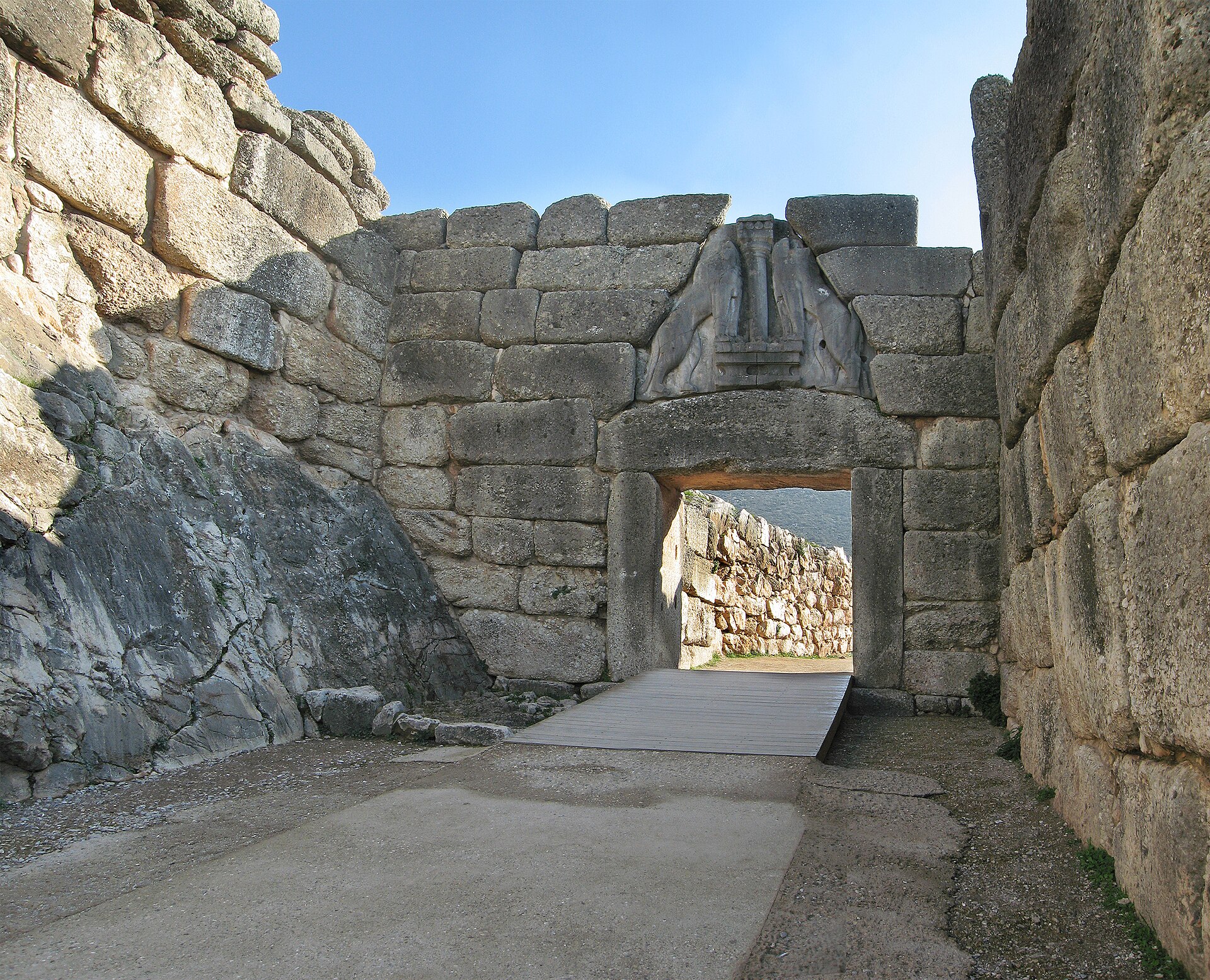
Walls so massive the classical Greeks refused to believe humans built them, and credited one-eyed giants instead — with a Lion Gate lintel of some 20 tonnes.

Mainstream: c. 1350–1200 BC (Late Bronze Age, Mycenaean)Alternative: Date not seriously disputed — the debate is over how a Bronze Age society lifted the heaviest lintels, and over the ancient Greeks' own myth of giant builders37.73°, 22.76°

At a glance

Mycenae & Tiryns Cyclopean Walls
Photo: Andreas Trepte · CC BY-SA 2.5

Mycenae and nearby Tiryns are the great fortified citadels of Late Bronze Age Greece, the strongholds of the civilisation Homer remembered as the Achaeans who sailed against Troy. Their defining feature is 'Cyclopean' masonry: enormous, roughly-worked limestone boulders, some weighing well over ten tonnes and the largest estimated near a hundred, stacked without mortar into ramparts up to eight metres thick. At Mycenae the walls funnel visitors through the Lion Gate, crowned by a triangular relief of two lionesses above a lintel block weighing on the order of twenty tonnes; at Tiryns the walls conceal corbelled galleries and casemates inside their thickness. The term Cyclopean is itself a piece of ancient testimony — later Greeks, gazing at stones they could not imagine moving, concluded that only the Cyclopes, the one-eyed giants of myth, could have raised them.

See it on the globe →
The mainstream view

What archaeology says

Archaeologists attribute the walls to the Mycenaeans themselves, built and repeatedly expanded during the palatial period of roughly the fourteenth and thirteenth centuries BC, with the main circuit and the Lion Gate at Mycenae dated to around 1250 BC. The construction is understood in ordinary Bronze Age terms: boulders were quarried locally, often barely dressed, and set in courses with smaller stones and clay packed into the gaps. The engineering is real but explicable. To move the heaviest blocks, work gangs are thought to have levered them onto timber sledges, hauled them over log rollers and up purpose-built earthen ramps, and lowered them into place — the same repertoire of ramps, levers, rollers and sheer organised manpower documented across the Bronze Age world.

The Lion Gate showcases the builders' sophistication. Rather than let the massive wall bear directly on the lintel and snap it, they used a corbelled 'relieving triangle' above the lintel to divert the load into the flanking jambs, filling the resulting void with a lighter carved relief slab. Tiryns displays comparable cleverness in its internal corbel-vaulted galleries. Excavation from Heinrich Schliemann in the 1870s onward, and a century and a half of subsequent study, place these citadels firmly within a well-attested Mycenaean society — with Linear B archives, palaces, workshops and trade networks — that plainly had the administrative capacity to marshal the labour such walls required.

Key evidence cited
  • Walls stratified within a securely dated Mycenaean palatial context (c. 14th–13th c. BC)
  • Locally quarried, only roughly dressed boulders set with clay and smaller packing stones
  • The Lion Gate's engineered 'relieving triangle' diverting load off the lintel
  • Documented Bronze Age methods of sledges, log rollers, levers and earthen ramps
  • Linear B archives and palace remains showing the administrative capacity to organise the labour
The alternative view

What the skeptics propose

Unusually, the primary 'alternative' voice here is the ancient Greeks themselves. By the classical period the memory of who built the citadels had been lost, and writers such as Pausanias recorded the local belief that the walls of Tiryns and Mycenae were the work of the Cyclopes, giants brought from Lycia because no mortal could handle stones so vast. This is the origin of the archaeological term still in use today. The myth is a genuine data point: it shows that even people living relatively close in time found the scale of the work hard to credit with human muscle, a reaction modern visitors often share.

Contemporary alternative writers pick up that thread, focusing on the largest lintels and the roughly hundred-tonne blocks reported in some stretches of wall, and questioning whether ramps, sledges and rollers really suffice for the heaviest lifts on the steep, uneven terrain of the citadels. Some fold Mycenae into a wider argument that a pre-Greek or pre-Bronze-Age culture, or a lost tradition of megalithic engineering, is responsible for the most massive stonework around the Mediterranean, with the Mycenaeans inheriting or reusing older walls. Mainstream archaeologists counter that the walls are stratified into a securely dated Mycenaean context, that the stones are local and only roughly shaped, and that Egyptian and Near Eastern parallels show Bronze Age societies routinely moved comparable and heavier loads — but the intuitive disbelief that named the Cyclopes has never entirely gone away.

Key evidence cited
  • The ancient Greeks' own attribution of the walls to the giant Cyclopes (recorded by Pausanias)
  • Lintel blocks around 20 tonnes and reported wall blocks approaching 100 tonnes
  • The steep, uneven citadel terrain complicating simple ramp-and-roller lifting
  • The claim that the heaviest stonework belongs to a lost megalithic tradition later reused
  • The persistent intuitive disbelief, ancient and modern, that muscle alone raised such stones

Genuinely open questions

  1. Exactly how were the heaviest lintels, like the Lion Gate's ~20-tonne block, raised into position?
  2. Why had the Greeks themselves forgotten who built the walls within a few centuries?
  3. How much of the circuit is original Mycenaean work versus later repair and reuse?

Worth knowing

The word 'Cyclopean', used by architects and archaeologists worldwide for any wall of huge rough-fitted stones, comes straight from the ancient Greek conviction that the ramparts of Mycenae and Tiryns were literally built by the one-eyed giants of the Cyclops myth.