Ancient Engineering · Delphi, Phocis, Greece

Polygonal Wall of Delphi

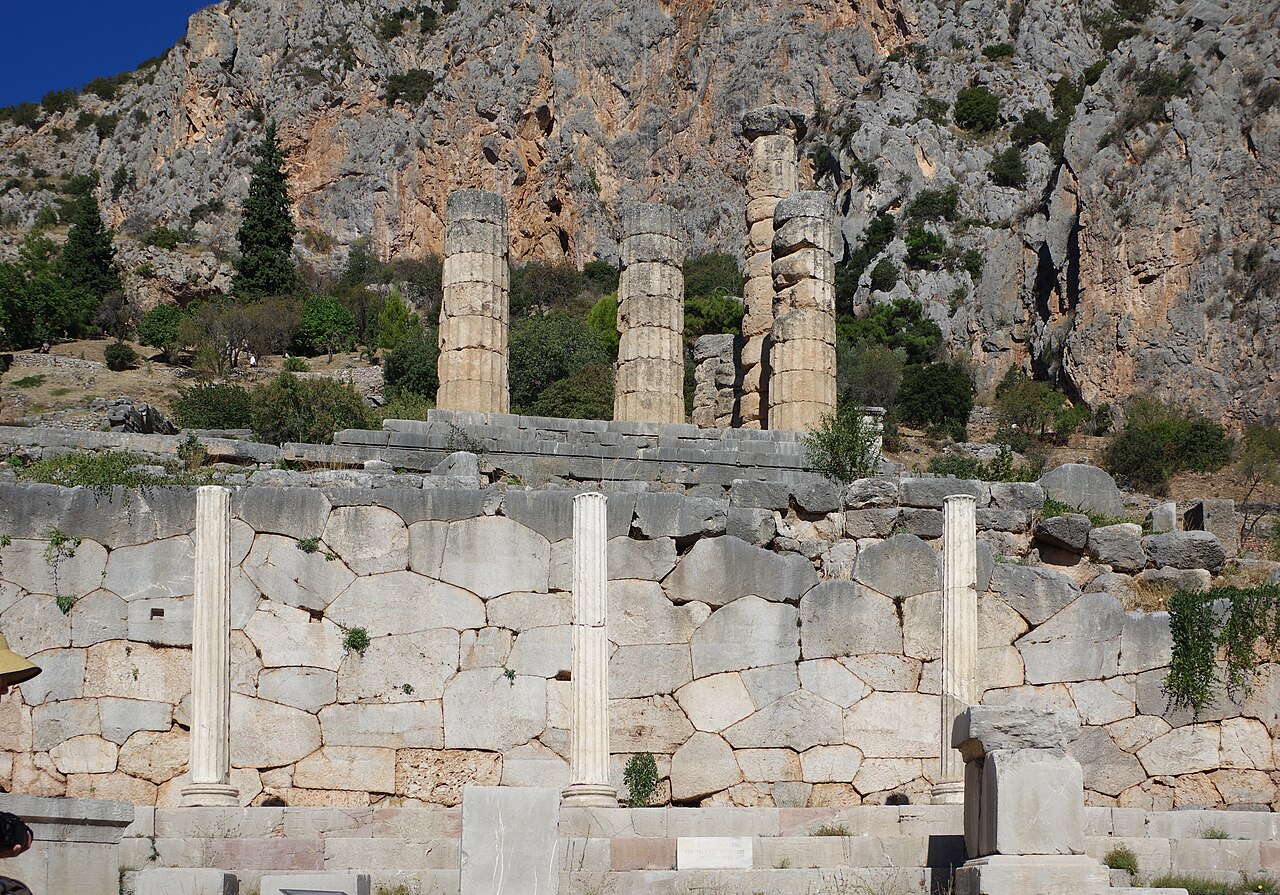
A sixth-century BC Greek retaining wall whose curving, jigsaw-fitted stones look uncannily like the masonry of Cusco, half a world away.

Mainstream: c. 548-510 BCAlternative: Style linked by some to a much older global megalithic tradition38.48°, 22.50°

At a glance

Polygonal Wall of Delphi
Photo: Berthold Werner · CC BY-SA 3.0

Below the Temple of Apollo at Delphi runs one of the finest examples of polygonal masonry in the classical world: a retaining wall some 80 metres long built of irregular limestone blocks with curved, interlocking joints fitted so tightly that the wall has shrugged off two and a half millennia of earthquakes. Built to terrace the temple platform after the old temple burned in 548 BC, the wall later became a public archive — more than 800 inscriptions, mostly records freeing slaves, were carved directly into its stones. Its resemblance to Inca walls in Peru has made it a favourite exhibit in debates about a supposed worldwide megalithic style.

See it on the globe →
The mainstream view

What archaeology says

Classical archaeologists date the wall securely to the second half of the sixth century BC. When the Temple of Apollo burned in 548 BC, the sanctuary was re-terraced on a grander scale, and the polygonal wall was built to retain the enlarged temple platform, financed partly by the Alcmaeonid family of Athens. The date rests on the archaeological sequence of the terrace fills, the wall's relationship to the temple foundations, and the broader, well-documented history of the sanctuary.

Polygonal and so-called Lesbian masonry with curved joints was a recognised Greek technique of the seventh and sixth centuries BC, seen at sites across Greece and Asia Minor. Engineers note that interlocking curvilinear joints are a rational choice for a retaining wall in one of Greece's most seismically active zones: the joints allow micro-movement and dissipate energy, and the style also economised on stone by fitting blocks as they came rather than squaring them.

The hundreds of manumission inscriptions carved into the wall from the second century BC onward show it standing and revered through antiquity, and Greek literary sources discuss the sanctuary's rebuilding, leaving little room chronologically for a mysterious earlier origin.

Key evidence cited
  • The wall's stratigraphic relationship to the post-548 BC temple terrace dates it to the late 6th century BC
  • Polygonal and Lesbian masonry are attested at many archaic Greek sites, showing a living local tradition
  • Over 800 inscriptions from c. 200 BC onward were carved into the wall, documenting its continuous classical history
  • Curved interlocking joints are recognised seismic engineering, well suited to Delphi's earthquake zone
  • Ancient sources record the sanctuary's rebuilding programme and its Alcmaeonid financing
  • The limestone is local, with tool marks consistent with iron-age Greek stoneworking
The alternative view

What the skeptics propose

Alternative researchers, including Brien Foerster and writers in the tradition of Graham Hancock, highlight the visual kinship between Delphi's wall and the polygonal masonry of Cusco, Sacsayhuaman and other Andean sites — cultures with no accepted contact with archaic Greece. For them, the recurrence of tight-jointed, curvilinear megalithic walls in Greece, Peru, Italy (the Latium 'Cyclopean' cities), Turkey and Japan hints at a shared inheritance from a forgotten seafaring civilisation, or at least a lost body of engineering knowledge.

Some point out that classical Greeks themselves attributed older 'Cyclopean' walls at Mycenae and Tiryns to mythical giants, suggesting even the Greeks had lost the memory of who built the earliest megalithic work in their land. On this reading, sixth-century Delphians could have been imitating — or incorporating — remnants of a far older technique.

Mainstream scholars reply that convergent engineering is expected: polygonal fitting is simply what skilled masons in earthquake country arrive at when working with irregular stone, and the Greek and Inca walls are separated by two thousand years as well as an ocean. But the alternative camp counters that the level of joint precision at Delphi exceeds structural necessity, and that 'convergence' is asserted more often than demonstrated.

Key evidence cited
  • The wall's curvilinear jigsaw joints closely resemble Inca masonry at Cusco, built by an unrelated culture
  • Similar polygonal walls appear worldwide — Peru, Italy, Turkey, Egypt, Japan — suggesting to some a common source
  • Greeks themselves credited older Cyclopean walls to giants, implying lost knowledge of their builders
  • The joint precision arguably exceeds what a simple retaining function required
  • The wall has survived earthquakes that damaged later, mortared structures at the same site
  • No construction records for the wall itself survive, only for the temple above it

Genuinely open questions

  1. Is worldwide polygonal masonry truly convergent engineering, or is the similarity deeper than mainstream scholarship allows?
  2. How exactly did archaic masons achieve such tight curved joints — by trial fitting, templates, or another method?
  3. How much did the wall's design contribute to its exceptional seismic survival?
  4. Were older structures or terraces incorporated into the 6th-century rebuild?

Worth knowing

Delphi's polygonal wall doubles as a stone ledger: more than 800 acts freeing enslaved people were inscribed on it, turning a retaining wall into one of antiquity's largest legal archives.