What archaeology says
The destruction of Helike is among the best-attested natural catastrophes of the classical world. Diodorus Siculus, Strabo, Pausanias and others describe the night of the disaster, complete with eerie precursors — Eratosthenes, who visited the site himself, reported ferrymen pointing out the drowned bronze Poseidon standing upright in the 'poros', a hazard to fishing nets. The event became the ancient world's textbook example of divine wrath and seismic ruin, and the Gulf of Corinth remains one of the most seismically active rifts in Europe, where earthquake-triggered coastal collapse and tsunamis are well documented both instrumentally and in the sediment record.
For most of the 20th century searchers, including Spyridon Marinatos and teams with Jacques Cousteau, hunted for Helike on the seabed and found nothing. The breakthrough came when Katsonopoulou and Soter, who launched the Helike Project in 1988, re-read the sources: the 'poros' in which the city sank need not mean the open gulf, but could be an inland lagoon formed when the earthquake dropped the land and the sea rushed in. The lagoon would then have silted up over centuries, burying the city under the coastal plain of the rivers Selinous and Kerynites. Bore-hole drilling and trench excavation proved them right in 2001 near the village of Rizomylos, where Classical-period destruction layers lie sealed under lagoonal sediments containing marine and brackish-water microfauna — the signature of sudden submergence.
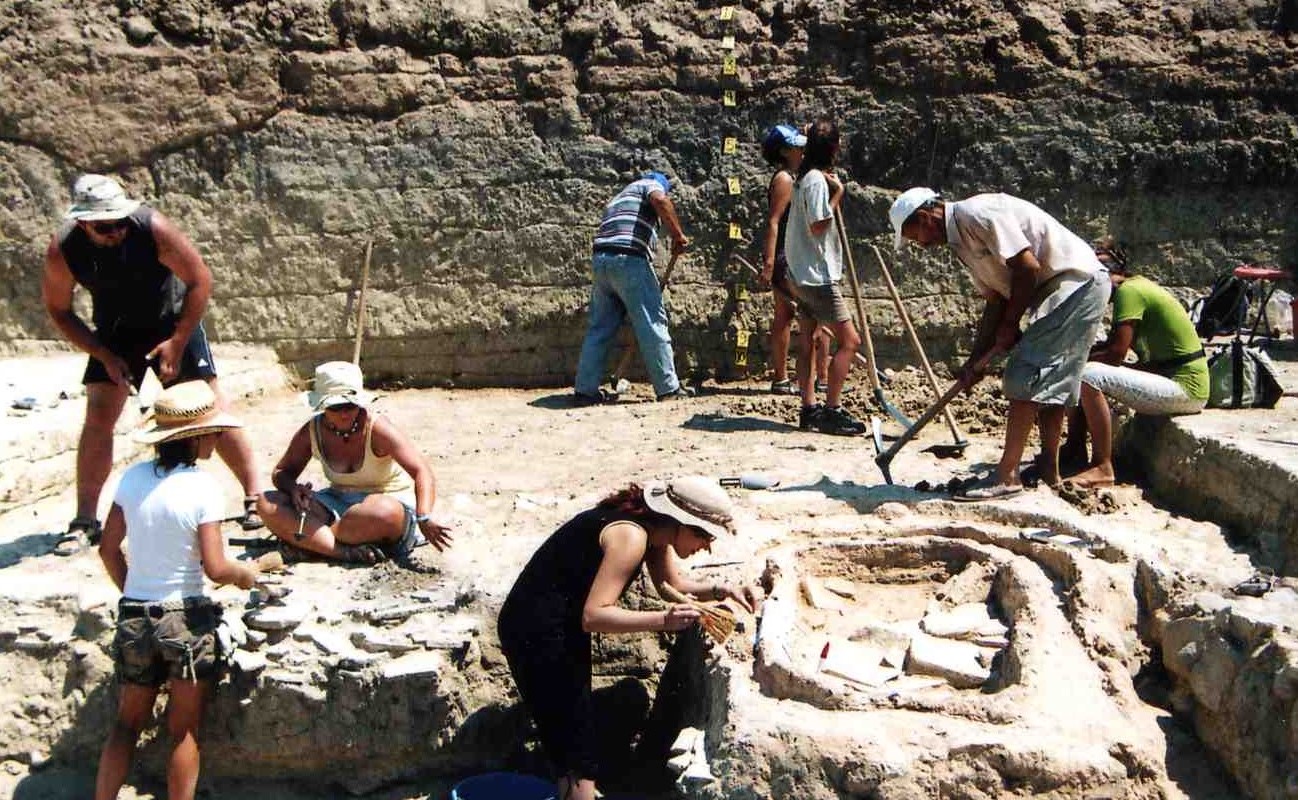
Excavations since have revealed far more than the 373 BC city: an exceptionally preserved Early Bronze Age town of c. 2600–2300 BC (itself apparently destroyed by an earthquake), a Hellenistic dye-works, a Roman road, and at Nikoleika a sanctuary with an apsidal temple of c. 710 BC and an altar of c. 750 BC — very plausibly the famous sanctuary of Poseidon Helikonios, with bronze and clay votives excavated through the 2023–2024 seasons. Helike is thus a rare place where a legendary destruction, its geological mechanism and its archaeology all line up.
- Multiple independent ancient accounts (Diodorus, Strabo, Pausanias, Eratosthenes) of the 373 BC destruction
- Rediscovery in 2001 by Katsonopoulou and Soter, buried in lagoonal sediments near Rizomylos
- Marine and brackish microfauna in sediments over the ruins — direct evidence of sudden submergence
- The Gulf of Corinth's documented record of earthquakes, coastal subsidence and tsunamis
- The Nikoleika sanctuary with 8th-century BC temple and altar, matching the famed cult of Poseidon Helikonios