Ancient Technology · Off Antikythera Island, Greece

The Antikythera Shipwreck & Mechanism

A corroded lump from a Roman-era shipwreck turned out to be a geared astronomical computer 1,400 years ahead of its time.

Mainstream: Ship sank c. 70–60 BC; mechanism built c. 200–70 BCAlternative: Date not seriously disputed — the debate is over how such sophistication arose, and how much comparable ancient technology has been lost without trace35.89°, 23.31°

At a glance

The Antikythera Shipwreck & Mechanism
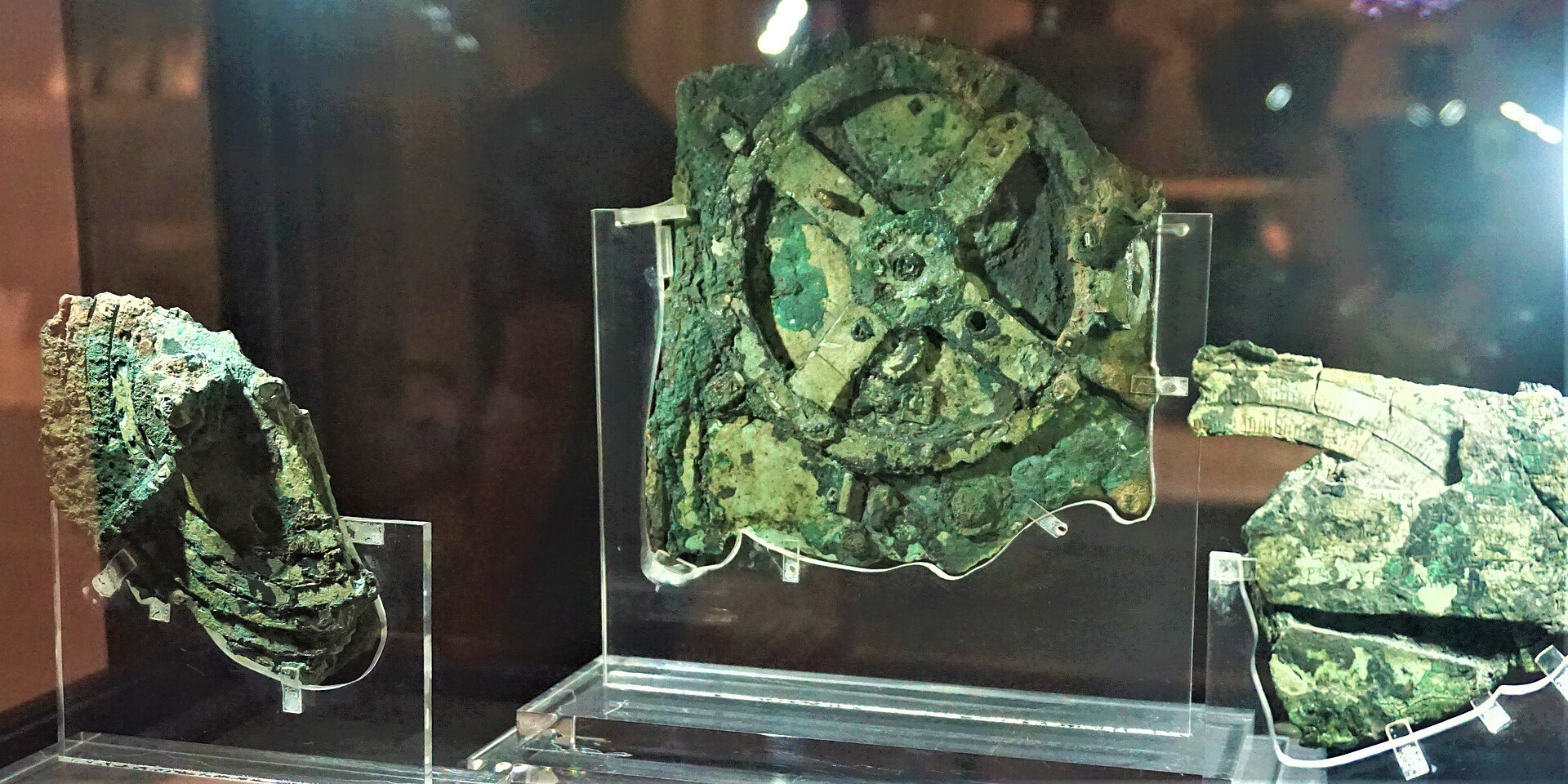
Photo: Joyofmuseums · CC BY-SA 4.0

In 1900, Greek sponge divers sheltering from a storm found an ancient shipwreck 45–60 metres down off the islet of Antikythera, loaded with bronze and marble statues, luxury glass and coins — a Roman-era cargo ship, probably hauling Greek treasures west, that sank around 70–60 BC. Among the finds was a corroded shoebox-sized lump that split open in the National Archaeological Museum in 1902, revealing precisely cut bronze gearwheels and inscriptions. The Antikythera mechanism is now recognised as the world's oldest known analogue computer: a hand-cranked device of some 30 surviving gears that modelled the Sun, Moon and probably the five visible planets, predicted eclipses, and tracked multiple calendars. Nothing of comparable mechanical complexity survives from the following 1,400 years, until the astronomical clocks of medieval Europe.

See it on the globe →
The mainstream view

What archaeology says

A century of research has progressively decoded the device. Derek de Solla Price's X-ray study, published as Gears from the Greeks in 1974, first revealed the differential-style gearing; the international Antikythera Mechanism Research Project's microfocus X-ray CT scans in 2005 then exposed hidden inscriptions and tooth counts, allowing Tony Freeth, Mike Edmunds and colleagues to reconstruct dials for the 19-year Metonic calendar, the Saros eclipse cycle — complete with glyphs predicting eclipse times and colours — and even the four-year cycle of Panhellenic games including the Olympics. In 2021 Freeth's UCL team published a full working model of the front 'Cosmos' display, deriving planetary gear trains from cycles described in the mechanism's own inscriptions. In 2024, gravitational-wave researchers Graham Woan and Joseph Bayley applied Bayesian statistics to X-ray images of the broken calendar ring, showing it originally held 354 holes — a lunar calendar — and demonstrating that its holes were placed with remarkable hand-crafted accuracy. A 2025 simulation by Argentine physicists suggested the surviving gears' triangular teeth and spacing errors would have caused jamming — though the authors caution that two millennia of corrosion may distort the measurements.

Crucially, mainstream scholarship does not see the mechanism as an isolated miracle. Cicero, writing in the first century BC, describes geared planetary spheres built by Archimedes and by Posidonius of Rhodes; the mechanism's Corinthian month names and Babylonian-derived astronomy root it in known Hellenistic science; and a thin thread of descendants — a Byzantine geared sundial-calendar, Islamic geared astrolabes described by al-Biruni — connects Greek gearing to the medieval clockmakers. The wreck itself remains under active excavation: the 'Return to Antikythera' programme, led since 2021 by the Swiss School of Archaeology in Greece under Angeliki Simosi and Lorenz Baumer, recovered a young man's skeleton (2016), statue fragments, and in 2024–2025 a connected section of the ship's hull — while confirming a second ancient vessel lies nearby.

Key evidence cited
  • X-ray CT scans (2005) revealing gearing, tooth counts and thousands of Greek inscription characters
  • Freeth's 2021 UCL Cosmos model reproducing planetary cycles stated in the mechanism's own inscriptions
  • Cicero's first-hand descriptions of geared planetaria by Archimedes and Posidonius
  • Corinthian month names and Babylonian-derived eclipse cycles rooting the device in Hellenistic science
  • Ongoing wreck excavations (hull section recovered 2025; second ship confirmed) documenting an ordinary 1st-century BC cargo vessel
The alternative view

What the skeptics propose

The mechanism has long been a favourite of the ancient-mysteries literature. Erich von Däniken presented it as an out-of-place artefact hinting at knowledge seeded from outside; later writers, including Graham Hancock, deploy it differently — not as alien, but as the single best proof of how completely a technology can vanish. The steelman of this position is genuinely uncomfortable for orthodoxy: had one storm not sunk one ship on one reef, nothing in the surviving textual or archaeological record would justify crediting the ancient Greeks with precision gear trains, and any claim that they possessed them would itself sound like pseudo-history. Sceptics of the mainstream narrative ask what else has been lost — pointing out that the device implies generations of prior development, workshops, failed prototypes and a supply chain of specialist toolmaking, none of which has ever been found.

Some alternative writers push further, arguing the mechanism's sophistication fits a pattern — alongside precision stonework in Egypt and megalithic engineering elsewhere — of a technological inheritance from an older, lost civilisation, with Hellenistic Greeks as recipients rather than originators. Others note the oddity that no second geared device has surfaced in more than a century of Mediterranean archaeology, despite thousands of excavated wrecks.

The mainstream response is that the mechanism, however astonishing, is saturated with its own cultural fingerprints: its inscriptions are in Koine Greek, its calendar is Corinthian, its astronomy is the Babylonian-Greek hybrid of its exact era, and its eclipse scheme matches cycles documented on cuneiform tablets — nothing about it points anywhere but Hellenistic Greece. Bronze was endlessly recycled in antiquity, which is precisely why geared instruments would rarely survive except in shipwrecks; the textual tradition (Cicero, and later authors describing Archimedes' spheres) independently attests the technology; and modern craftsmen have reconstructed the device using hand tools plausible for the period. On this view the lesson is real but historical, not mysterious: sophisticated knowledge can be lost when the societies sustaining it collapse — which both camps, for once, agree on.

Key evidence cited
  • No comparable geared device survives from the following 1,400 years — the technology vanished
  • The mechanism implies generations of prior development for which no workshop or prototype has been found
  • Only chance — a single storm and a single wreck — preserved any evidence such devices existed at all
  • More than a century of Mediterranean archaeology has produced no second example
  • The 2025 jamming study raises questions about whether the surviving design was even fully functional as reconstructed

Genuinely open questions

  1. Who designed and built the mechanism, and where — Rhodes, Corinth or a Syracusan tradition descending from Archimedes?
  2. Are earlier or contemporary geared devices still awaiting discovery in unexcavated wrecks or unexamined museum corrosion lumps?
  3. How accurately did the mechanism actually run — precision instrument, teaching model, or brilliant but jam-prone prototype?

Worth knowing

In 2024, two gravitational-wave scientists borrowed the statistical methods used to detect colliding black holes to count the holes in the mechanism's broken calendar ring — concluding it originally had 354, the length of the lunar year.