Ancient Engineering · Ellora, Maharashtra, India

Kailasa Temple, Ellora

The largest monolithic building on Earth — an entire multi-storey temple carved downward out of a mountain, with no room for error.

Mainstream: c. AD 756–773 (reign of Krishna I, Rashtrakuta dynasty)Alternative: Some claim the temple is thousands of years older, or that its excavation was impossible in a single reign without lost high technology20.02°, 75.18°

At a glance

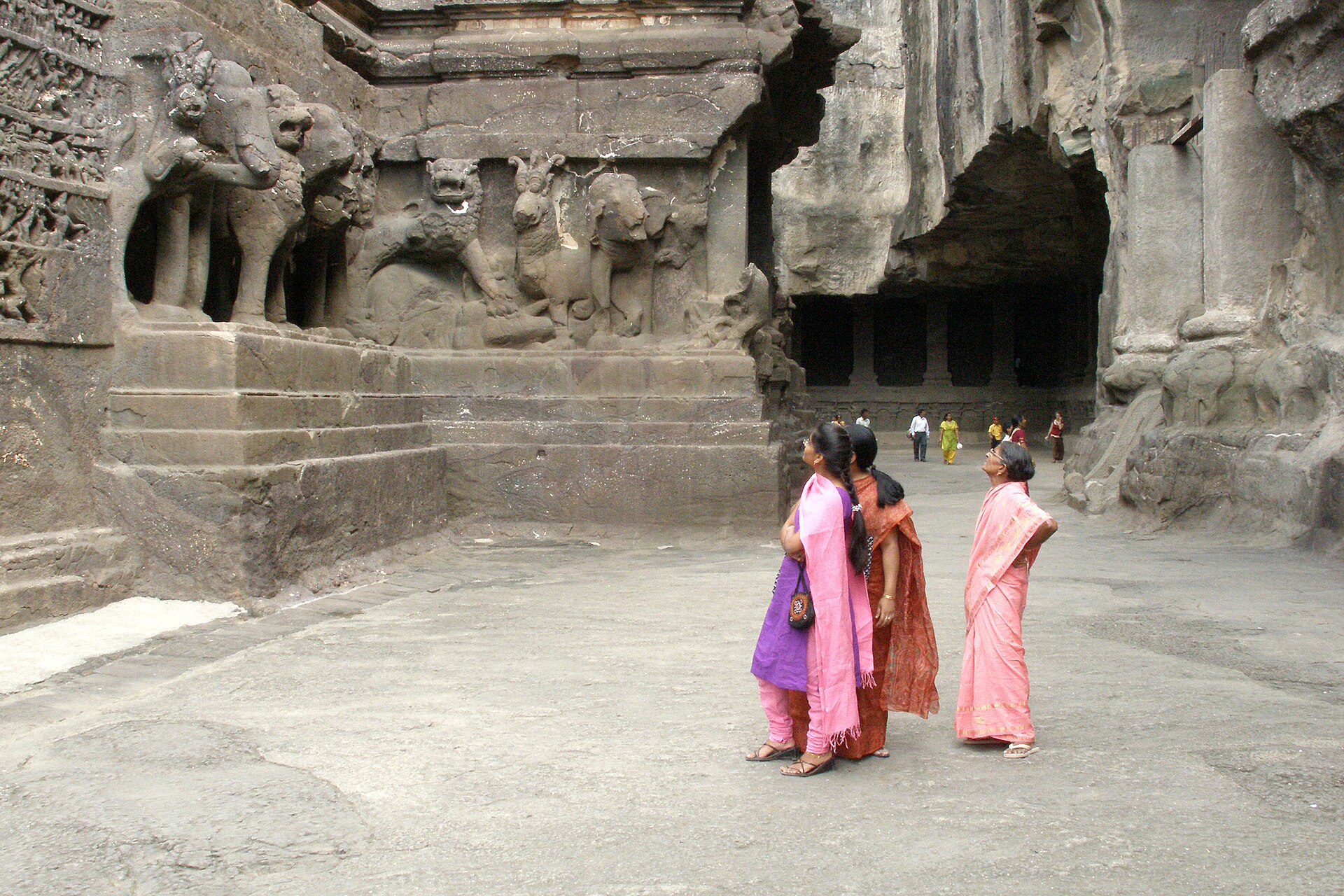
Kailasa Temple, Ellora
Photo: Vyacheslav Argenberg · CC BY 4.0

Cave 16 at Ellora is not really a cave at all: it is a complete freestanding Hindu temple complex — gateway, pavilion, colonnades, a three-storey main shrine about 30 metres tall, life-sized elephants and victory pillars — carved in one piece from the basalt of the Charanandri Hills. The builders worked from the top of the cliff downward, excavating three enormous trenches to isolate a block roughly 82 by 46 metres and then sculpting the temple out of what remained, removing an estimated 200,000 to 400,000 tonnes of rock. Dedicated to Shiva and modelled on his Himalayan home Mount Kailash, it sits within a larger escarpment holding 34 Buddhist, Hindu and Jain rock-cut monuments spanning roughly AD 600–1000, and has been a UNESCO World Heritage site since 1983.

See it on the globe →
The mainstream view

What archaeology says

Historians attribute the Kailasa to King Krishna I of the Rashtrakuta dynasty (r. c. 756–773). The key document is the Baroda copper-plate inscription of Karka II (c. AD 812), which describes a wonderful Shiva temple at Elapura (Ellora) built by Krishna that astonished even the gods and left its own architects marvelling that they could not have made it a second time. Architectural historians add that the temple's plan and sculptural program closely follow the Virupaksha temple at Pattadakal and, behind that, the Kailasanatha at Kanchipuram — southern structural temples the Rashtrakutas knew well after their campaigns in the Deccan — so the design did not appear from nowhere but translated an existing masonry blueprint into living rock.

The engineering, while extraordinary, sits inside a 1,200-year Indian tradition of rock-cut architecture that runs from the Mauryan Barabar caves through Ajanta, Elephanta and the earlier Ellora excavations. Working top-down eliminated the need for scaffolding, and the vesicular Deccan basalt, though hard, splits predictably under iron chisels and wedges. Archaeologists such as M. K. Dhavalikar have argued that the bulk of the monument — the main shrine, gateway and Nandi pavilion — was excavated in a single well-planned campaign under Krishna I, with subsidiary shrines, the river-goddess shrine and galleries added by later rulers, which is why unfinished passages and rough-dressed surfaces survive in the outer parts. Earlier, art historian Hermann Goetz went further, proposing the complex accumulated over multiple reigns from Dantidurga onward — a mainstream debate about phasing, not feasibility.

On the arithmetic, even the high-end estimate of 400,000 tonnes over about 20 years requires removing some 50–60 tonnes of rock a day — heavy but achievable for a royal workforce of several hundred labourers splitting basalt with wedges rather than pulverising it, since large blocks could be levered off and tipped down the slope. Chisel marks remain visible across the monument, and traces of the white plaster that once made the temple gleam like a snow-capped mountain still cling to the tower.

Key evidence cited
  • Baroda copper-plate inscription of Karka II (c. AD 812) crediting a marvellous Shiva temple at Elapura to Krishna
  • Close architectural dependence on the dated Virupaksha temple at Pattadakal and Kailasanatha at Kanchipuram
  • Visible chisel marks, wedge slots and unfinished surfaces recording manual excavation stages
  • A continuous 1,200-year Indian rock-cut tradition, with 33 other excavations at Ellora itself
  • Workload calculations showing block-splitting by a few hundred workers fits a two-decade royal campaign
The alternative view

What the skeptics propose

The Kailasa is a fixture of alternative-history media precisely because its statistics sound impossible. YouTube researcher Praveen Mohan, whose videos on the temple have tens of millions of views, argues the excavation arithmetic does not work for hammer and chisel: he calculates that removing hundreds of thousands of tonnes in under two decades would demand a rock-removal rate he considers beyond manual labour, and he points to smoothly cut channels, symmetrical features and what he interprets as machine-like tool marks. He and others also highlight sealed and partly buried passages beneath and around the courtyard, suggesting unexplored levels, and note a medieval legend (recorded in the Katha-Kalpataru) in which the temple was begun so that a queen could see its finial quickly — offered as a memory of an unusually rapid, top-first construction.

Ancient-astronaut proponents on the History Channel's Ancient Aliens have gone further, claiming the temple could only have been achieved with extraterrestrial assistance or lost high-energy tools, and some writers assert the shrine is vastly older than the Rashtrakutas, who merely claimed or refurbished it. A frequently repeated story holds that the Mughal emperor Aurangzeb sent a workforce to destroy the temple in the 17th century and that years of effort barely defaced it — cited as evidence of the stone's ferocious hardness and, by extension, the mystery of how it was carved at all.

Mainstream researchers respond that the workload calculations used by proponents assume the rock was crushed rather than split and carried off in blocks, that visible chisel marks and unfinished areas record entirely conventional technique, and that the temple's close stylistic dependence on dated 7th–8th century structural temples rules out a much older origin. The buried passages, they note, are known drainage and circumambulatory features, not hidden cities. Even so, no contemporary Rashtrakuta record describes the construction process itself — the silence into which the alternative theories flow.

Key evidence cited
  • Praveen Mohan's rock-removal arithmetic, which he argues exceeds plausible manual chiselling rates
  • Smooth channels, symmetry and tool marks proponents read as machining rather than chisel work
  • Sealed and partly buried passages around the courtyard suggested as unexplored lower levels
  • The Katha-Kalpataru legend of a temple built top-first with startling speed
  • Reports that Aurangzeb's demolition crews could barely damage the temple over three years

Genuinely open questions

  1. Was the Kailasa excavated in one campaign under Krishna I, or over several reigns as Goetz argued?
  2. Why does no Rashtrakuta record describe the construction methods of the dynasty's greatest monument?
  3. What lies behind the sealed passages and undercuttings that have never been fully surveyed?

Worth knowing

The temple was originally coated in white plaster so that it would gleam from a distance like the snow-covered Mount Kailash it represents — locals later knew part of the complex as the 'Rang Mahal', the painted palace.