Ancient Engineering · Hellinikon, Argolis, Greece

Pyramid of Hellinikon

A small stone 'pyramid' in the Argive hills — and a dating fight that briefly made it older than Giza.

Mainstream: Late 4th century BC (Classical–early Hellenistic)Alternative: c. 2720 BC (thermoluminescence dates published by Theocaris and Liritzis)37.59°, 22.67°

At a glance

Pyramid of Hellinikon
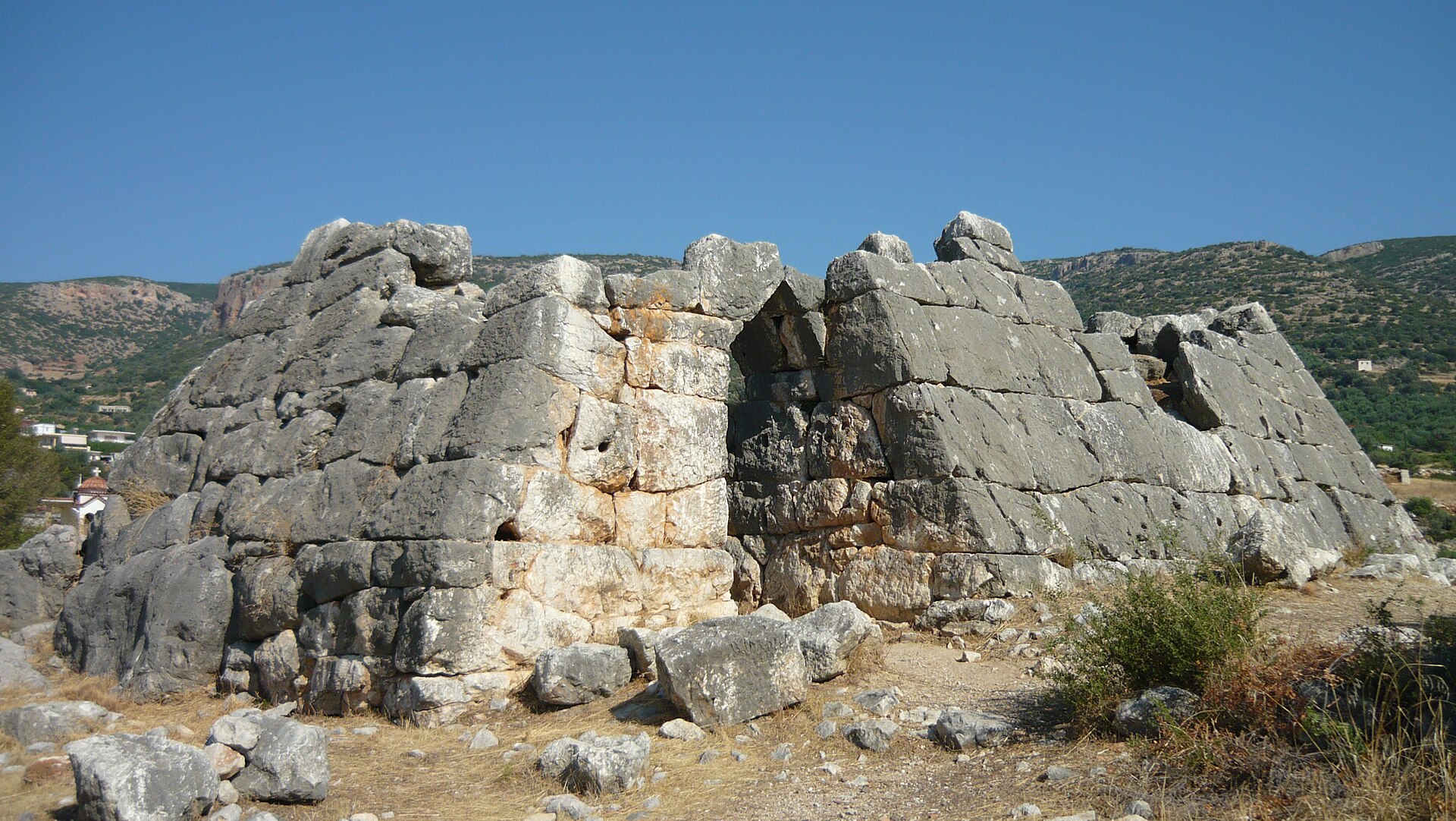
Photo: Egerváry Gergely · CC BY 3.0

On a low rise above the Argive plain near the village of Hellinikon stands a curious limestone building: a rectangle of about 7 by 9 metres whose outer walls slope inward at roughly 60 degrees, giving it the profile of a truncated pyramid. Built of large grey limestone blocks in a trapezoidal, partly polygonal style, it is the best preserved of a handful of 'pyramids' recorded in the Argolid — the traveller Pausanias saw at least two in the 2nd century AD. Modest in size, it became internationally famous in the 1990s when Greek scientists announced luminescence dates suggesting it predated the pyramids of Egypt, igniting a controversy that has never entirely died.

See it on the globe →
The mainstream view

What archaeology says

The conventional account rests on excavation. Pausanias, writing around AD 150, described a pyramid-like monument near this road as a polyandrion — a common tomb, which he connected to warriors fallen in an archaic struggle between Argos and Sparta (tradition links it to the Battle of Hysiae, 669 BC) — though scholars debate whether his description even refers to this building. Theodor Wiegand excavated the structure in 1901 with inconclusive results, and in 1937 the American School of Classical Studies re-excavated it, with Louis Lord publishing the results in 1938. Lord's team found pottery of the 4th century BC in and around the building, along with later Roman lamps, and concluded it was no tomb: the door opens inward from a corridor, there were no burials, and the layout matched small fortified posts of the region.

Lord interpreted the Hellinikon building and its twin at Ligourio as guardhouses or signal posts capable of housing a small garrison, controlling the roads out of Argos towards Tegea and the coast; the Greek Ministry of Culture today describes it in similar terms as a small fortress of the type that watched over arterial routes. The pyramidal batter of the lower walls, on this reading, is simply a robust way to build a tower base — the sloping section rises only about 3.5 metres before the walls become vertical.

Mainstream archaeologists regard the 4th-century pottery as decisive, noting that no Early Bronze Age settlement context, artefacts or parallels exist for monumental pyramid-building in Helladic Greece, and that the masonry style fits Classical-to-Hellenistic fortification work in the Argolid.

Key evidence cited
  • 4th-century BC pottery recovered in the 1937 American School excavation (Lord 1938)
  • Inward-opening door, corridor plan and absence of any burials, arguing against a tomb
  • Masonry consistent with Classical–Hellenistic fortification work in the Argolid
  • No Early Bronze Age monumental parallels or settlement context anywhere in Greece
  • Pausanias's 'pyramid' descriptions fit funerary or roadside monuments of historic times
The alternative view

What the skeptics propose

In the mid-1990s the monument became a scientific cause célèbre. Physicist Petros Theocaris of the Academy of Athens and archaeometrist Ioannis Liritzis applied a novel technique — optically stimulated luminescence dating of the stone surfaces themselves, measuring when the blocks' undersides last saw sunlight — to Hellinikon and Ligourio. Their published results, including a construction date for Hellinikon of roughly 2720 BC (with quoted uncertainties of several centuries), would make the little building centuries older than the Great Pyramid of Giza. Supporting arguments included ceramic luminescence dates reaching back to around 3000 BC and a claimed astronomical orientation of the entrance corridor towards the rising of Orion's belt in the mid-3rd millennium BC. Greek media celebrated the result, and the case is still cited by proponents of a suppressed, older chapter of Aegean civilisation.

The rebuttal was led by classicist Mary Lefkowitz, who argued the team had used a previously untested method to confirm a conclusion already desired, that the quoted error margins were enormous, and that nothing prevents Classical builders from using older, recycled blocks — or blocks whose buried faces had complex exposure histories — which would make surface luminescence dates meaningless for the building's assembly. She also noted the excavated pottery sequence was simply set aside. Liritzis has continued to defend the methodology, publishing responses as late as 2011 insisting Lefkowitz misunderstood the physics, and surface luminescence dating has since matured into a respected technique in other contexts.

The stand-off is genuinely interesting: a pioneering scientific method versus conventional stratigraphy, with each side accusing the other of privileging its preferred evidence. No independent redating campaign has been carried out, so the anomaly — real or artefactual — remains on the books.

Key evidence cited
  • Surface luminescence dates of c. 2720 BC published by Theocaris and Liritzis
  • Ceramic luminescence results reaching back towards 3000 BC
  • Claimed alignment of the entrance corridor to Orion's belt rising c. 2400–2000 BC
  • The method's later maturation, which proponents say vindicates its application here
  • The unresolved possibility that older structures underlie the Classical building

Genuinely open questions

  1. Would a modern, independent luminescence and radiocarbon campaign settle the date?
  2. Was Pausanias actually describing this building when he wrote of the Argive pyramids?
  3. Why were pyramid-shaped guardhouses built in the Argolid and almost nowhere else in Greece?

Worth knowing

When the luminescence dates were announced, headlines briefly claimed Greece had out-pyramided Egypt — yet the entire Hellinikon 'pyramid' would fit comfortably inside a single course of the Great Pyramid's core blocks.