What archaeology says
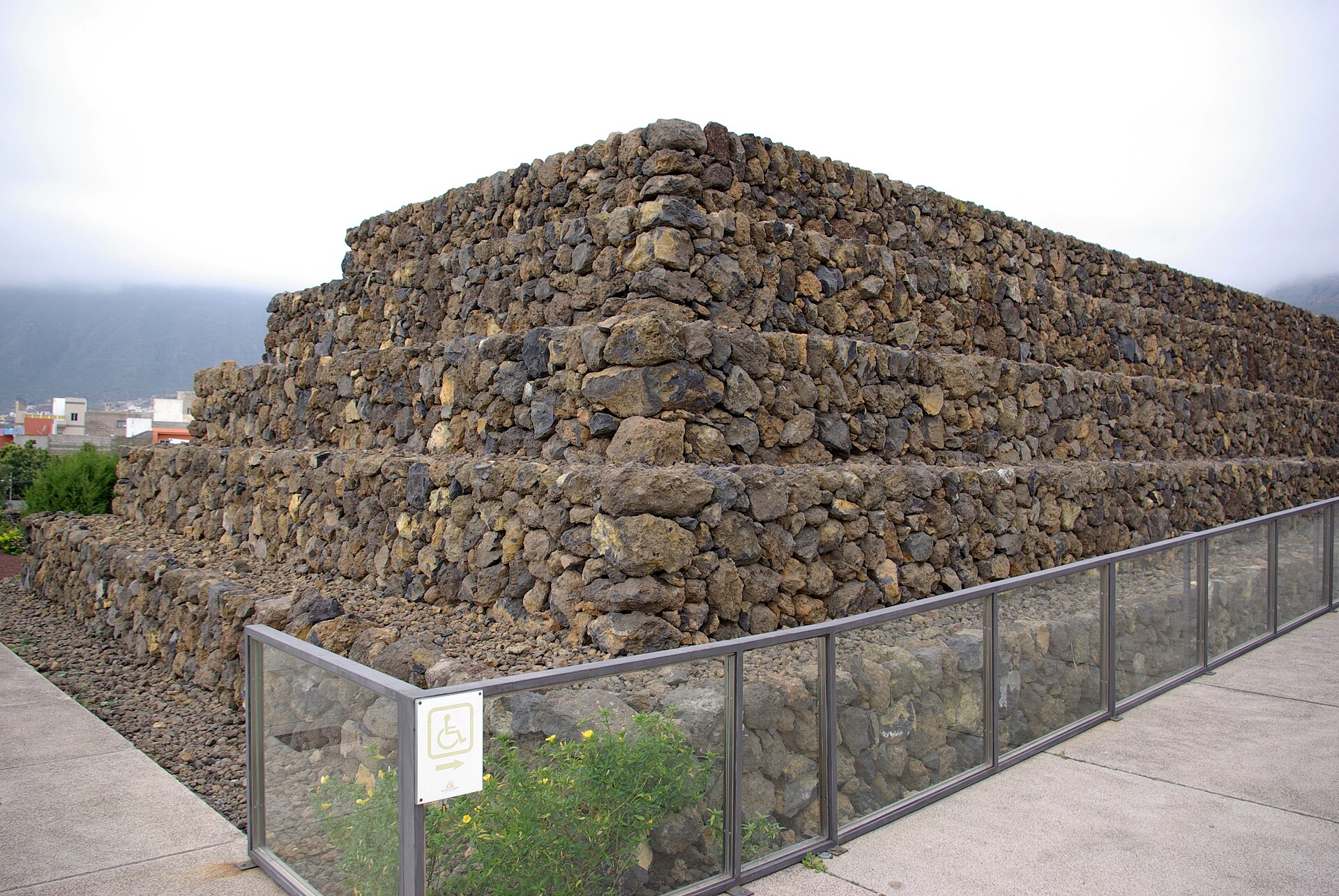
Archaeologists and historians of the Canary Islands hold that the Güímar structures are terraced stone mounds of the 19th century, built when the land was cleared for cultivation. Rural Canarians habitually piled field stones into neat walled heaps called majanos, and on sloping volcanic terrain these took terraced, sometimes strikingly regular forms; comparable structures existed across Tenerife and the other islands, many demolished for building material in the 20th century. Between 1991 and 1998 archaeologists from the University of La Laguna excavated at the site with Heyerdahl's agreement. The stratigraphy was decisive: beneath the lowest courses of the pyramids lay a thin layer containing pottery sherds and artefacts of the 19th century — including an official seal dated 1848 — meaning the structures on top cannot be older. A natural lava cave beneath the edge of one pyramid did yield Guanche artefacts from roughly AD 600–1000, but as the cave predates the pyramid above it, it dates only the cave's use, not the construction.
Intriguingly, the mainstream account has absorbed a genuine astronomical discovery. In 1991 Juan Antonio Belmonte, Antonio Aparicio and César Esteban of the Instituto de Astrofísica de Canarias showed that the long sides of several structures mark the summer and winter solstices, and from the platform of the largest pyramid the summer-solstice sun can be seen to set twice behind the peaks above. Aparicio and Esteban later proposed that the 19th-century builders oriented the terraces deliberately, possibly influenced by Masonic symbolism current among the island's landowners — the property's owner in the mid-1800s is documented as a Freemason. On this view the pyramids are both recent and meaningful: solstice-aligned farm architecture.
- 19th-century pottery in the layer directly beneath the pyramids' lowest courses
- An official seal dated 1848 sealed under the structures during excavation
- Documented majano stone-clearing mounds throughout the Canary Islands
- University of La Laguna excavations (1991–1998) finding no pre-Hispanic material in the fabric
- Land records showing the site under cultivation during the 19th century