Ancient Engineering · Carnac, Brittany, France

Carnac Alignments

More than 3,000 standing stones marching for kilometres across Brittany — Europe's oldest and largest megalithic array.

Mainstream: c. 4600–4300 BC (main alignments; megalithic activity continuing to c. 3000 BC)Alternative: Date not seriously disputed — sceptics instead argue the rows encode a vast lunar observatory (Thom) or even a seismic instrument (Méreaux), rather than a ceremonial landscape47.59°, -3.08°

At a glance

Carnac Alignments
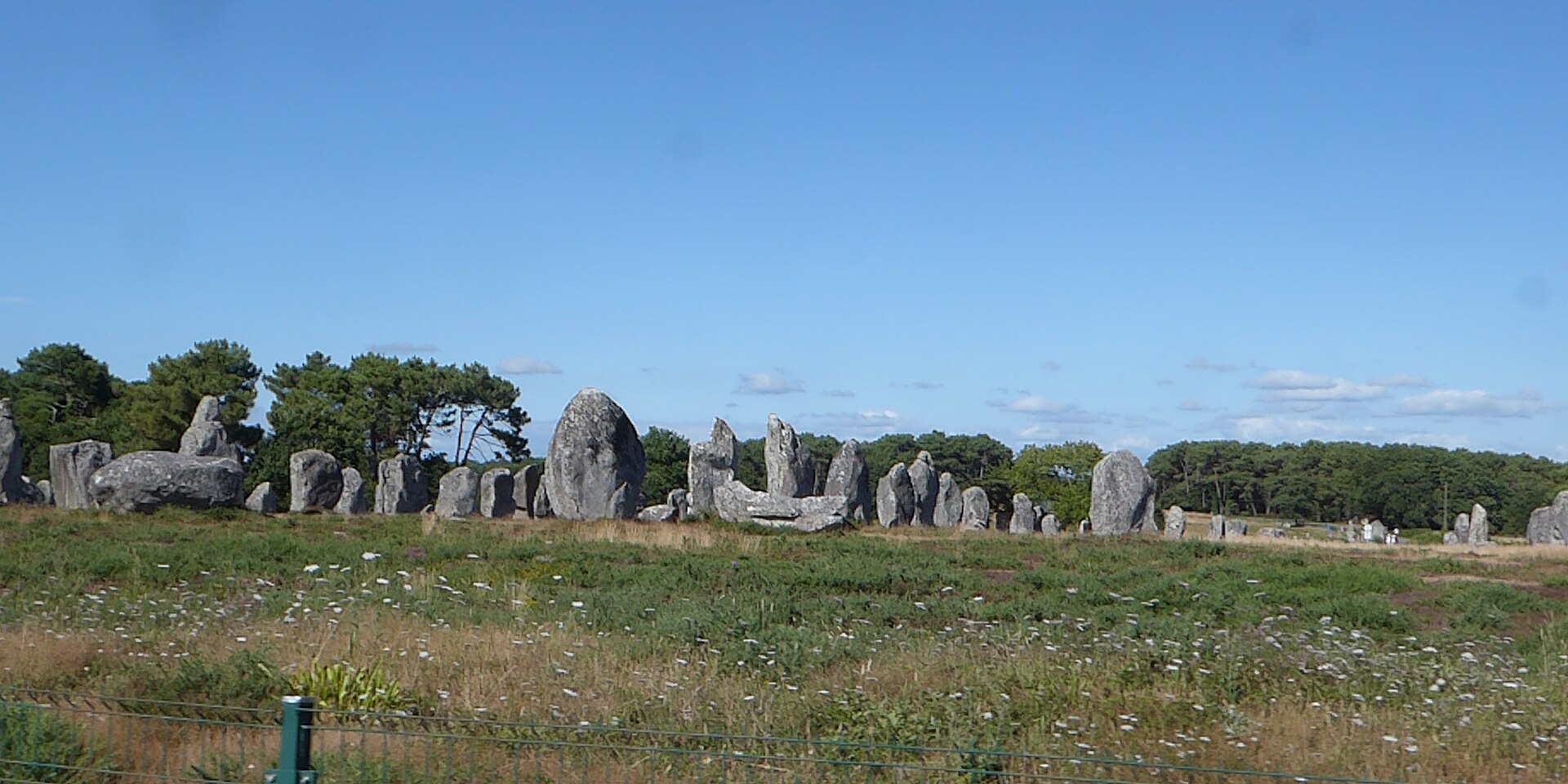
Photo: Le Passant · CC BY-SA 4.0

Around the town of Carnac in southern Brittany, roughly 3,000 surviving menhirs run in long parallel rows across the countryside, grouped into the great alignments of Ménec, Kermario and Kerlescan, with outliers, dolmens, tumuli and the shattered 280-tonne Grand Menhir Brisé nearby at Locmariaquer. The rows generally grade from tall stones (up to 4 metres) at the western ends down to knee-high markers in the east, and originally numbered many thousands more. In July 2025 the 'megaliths of Carnac and the shores of Morbihan' — over 550 monuments — were inscribed as a UNESCO World Heritage site, and new dating published the same year made them among the earliest megalithic monuments anywhere in Europe.

See it on the globe →
The mainstream view

What archaeology says

Dating standing stones is notoriously difficult — granite cannot be radiocarbon dated, and centuries of antiquarian digging destroyed much of the context. The breakthrough came from rescue excavations at Le Plasker in neighbouring Plouharnel and from the Franco-Swedish NEOSEA project led by Bettina Schulz Paulsson at the University of Gothenburg: nearly 50 radiocarbon dates from hearths, stone sockets and construction pits, modelled with Bayesian statistics, showed the alignments in the Bay of Morbihan were erected between about 4600 and 4300 BC — more than a millennium before Stonehenge, and among the oldest megalithic projects on Earth. The region had already produced the enormous Carnac mounds and the decorated menhirs of Locmariaquer, supporting the view, argued by Schulz Paulsson's earlier work, that European megalithism was born in north-west France and spread by sea.

What the rows were for remains genuinely open within archaeology. Leading interpretations see them as processional or ceremonial ways, territorial and ancestral markers raised over generations by communities competing in monumental display, or boundary works framing a sacred zone — with some rows referencing solstice directions without being precision instruments. Excavation shows the stones were socketed with care, sometimes over earlier hearths, and that the complex accumulated over centuries rather than following a single master plan.

Local folklore had its own explanation: the stones are a Roman legion turned to rock by Pope Cornelius (Saint Cornély), patron saint of Carnac — a legend still celebrated in the town. Archaeologists note wryly that the stones predate Rome by four millennia.

Key evidence cited
  • Nearly 50 radiocarbon dates with Bayesian modelling (NEOSEA, published in Antiquity 2025) placing construction at c. 4600–4300 BC
  • Excavated stone sockets, construction pits and hearths at Le Plasker showing how and when rows were erected
  • Regional context of Carnac mounds and Locmariaquer menhirs supporting Brittany as a birthplace of European megalithism
  • Evidence of piecemeal construction over centuries rather than a single engineered master plan
  • UNESCO World Heritage inscription (July 2025) recognising over 550 monuments as a coherent Neolithic cultural landscape
The alternative view

What the skeptics propose

The most influential alternative reading came from Alexander Thom, the retired Oxford engineering professor who, with his son Archie, surveyed Carnac intensively between 1970 and 1974. Thom argued the alignments and outlying giants such as the Grand Menhir Brisé formed a colossal lunar observatory — the fallen 20-metre menhir serving as a universal foresight for tracking the moon's 18.6-year standstill cycle from stations kilometres away — and that the rows were set out in exact multiples of his 'megalithic yard' of 0.829 metres. Archaeoastronomers who re-examined his survey data, including Clive Ruggles, concluded that the long sightlines mostly fail on closer inspection (several proposed backsights turned out to be natural rocks or later features) and that the megalithic yard dissolves into ordinary pacing; but Thom's work remains the high-water mark of the 'megalithic science' school and still anchors popular accounts.

A stranger engineering theory came from Pierre Méreaux, a Belgian-born engineer who spent three decades measuring the alignments and noted that Carnac sits in the most seismically active corner of Brittany, that the rows run broadly perpendicular to local fault lines, and that many stones rest on unstable rocker-like bases. He proposed the complex was a giant earthquake detector or 'seismograph' — an idea without mainstream support but frequently cited as an example of rigorous amateur observation. Beyond that, the alignments feature in earth-energy and ley-line literature descending from John Michell, which treats Carnac as a node in a planetary energy grid, and in dowsing traditions claiming the rows channel telluric currents.

Mainstream archaeology's rebuttal is less a refutation than a redirection: the 2025 dating shows the rows were built piecemeal over three centuries by farming communities, which fits monument-building as social practice far better than a single-purpose scientific instrument. Even so, researchers concede that no one has proven what the rows meant — a rare case where the honest mainstream answer is still 'we don't know'.

Key evidence cited
  • Thom's surveys claiming the Grand Menhir Brisé served as a universal lunar foresight for the 18.6-year cycle
  • Thom's statistical case for a standardised 'megalithic yard' underlying the spacing of the rows
  • Méreaux's observations linking the alignments' orientation to Brittany's fault lines and seismicity
  • The graded heights and sheer scale of the rows, argued to exceed any simple ceremonial need
  • Persistent folk traditions — petrified legions, fertility rites — hinting at lost layers of meaning

Genuinely open questions

  1. What were the rows actually for — procession, territory, astronomy, ancestor display, or something not yet imagined?
  2. How was the 280-tonne Grand Menhir Brisé raised at all, and when and why did it fall?
  3. How many stones originally stood, and how much of the design has been lost to quarrying and road-building?

Worth knowing

Local legend says the Carnac stones are a Roman legion petrified by Saint Cornély as it chased him to the sea — which would make them the only Roman army standing at attention 4,000 years before Rome was founded.