What archaeology says
Excavated between 1962 and 1975 by Michael J. O'Kelly of University College Cork, Newgrange produced radiocarbon dates from burnt material sealed in the structure centring on about 3200 BC — several centuries before the Great Pyramid and roughly seven before Stonehenge's sarsens. O'Kelly himself was in the chamber on 21 December 1967 to witness and formally document the solstice beam entering through the roof-box, confirming a local tradition that the sun entered the tomb. Cremated and unburnt remains of the dead were found in the chamber's stone basins, and the surrounding kerb and passage stones carry Europe's richest concentration of megalithic art, studied in depth at neighbouring Knowth by George Eogan.
Science has kept adding layers. In 2020, ancient-DNA work led by Lara Cassidy and Dan Bradley at Trinity College Dublin showed that a man buried in the central chamber was the son of a first-degree incestuous union — a pattern known historically from royal dynasties such as Egypt and the Inca — suggesting Newgrange's builders included a socially sanctioned elite, and that distant relatives of the same kin network were buried at other passage tombs across Ireland. Archaeoastronomers accept the solstice orientation as deliberate: the passage's alignment on midwinter sunrise is shared in mirror-image by Dowth's setting-sun chamber and, in Orkney, by Maeshowe.
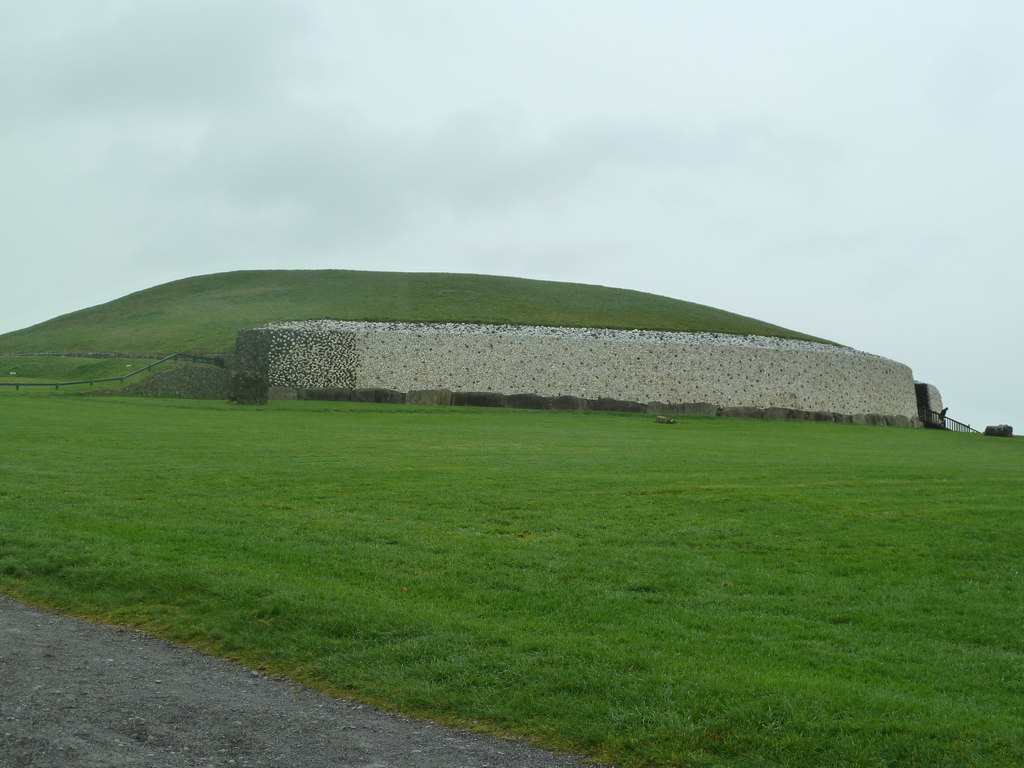
Mainstream researchers do acknowledge the reconstruction debate. The gleaming white quartz facade, rebuilt in the 1970s on a concrete retaining wall from quartz and granite cobbles found fallen at the entrance, is O'Kelly's interpretation rather than a certainty — many archaeologists suspect the quartz originally lay as a plaza on the ground, as it was left at Knowth.
- Radiocarbon dates from sealed contexts centring on c. 3200 BC (O'Kelly's excavations, 1962–75)
- The documented midwinter solstice beam, first formally observed by O'Kelly in 1967 and photographed ever since
- 2020 ancient-DNA study revealing an incestuous elite burial and kin links across Ireland's passage tombs
- Europe's richest megalithic art corpus across Newgrange and Knowth, catalogued by George Eogan
- A coherent developmental sequence of Irish passage tombs, from small early examples at Carrowmore to the Boyne giants