What archaeology says
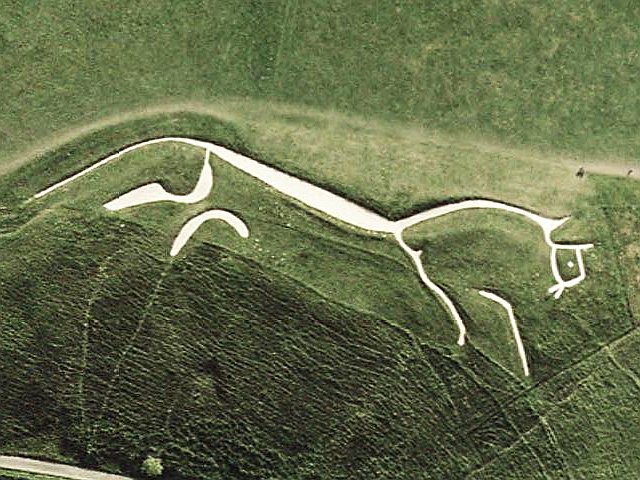
For centuries antiquarians guessed wildly at the horse's age — Francis Wise argued in 1738 that it commemorated King Alfred's victory over the Danes at Ashdown in AD 871. The question was finally settled in the 1990s, when David Miles and Simon Palmer of the Oxford Archaeological Unit excavated sections of the figure and applied optically stimulated luminescence (OSL) dating to buried silts between its layered chalk fills. The results placed the original cutting between about 1380 and 550 BC, most likely in the late Bronze Age or early Iron Age — making it Britain's oldest dated hill figure by a wide margin. The dating also revealed that the horse has been rebuilt layer upon layer, drifting slightly upslope over the centuries while its distinctive beaked, disjointed outline was preserved.
Most archaeologists accept the figure as a horse: its flowing form closely matches stylised horses on British Iron Age coins and on decorated metalwork such as the Marlborough bucket, and horses carried enormous symbolic weight in later prehistoric Britain. Interpretations of purpose range from a territorial or tribal emblem visible for tens of kilometres across the Vale, to a cult image connected with a horse deity later known from the Romano-Celtic goddess Epona.
The most influential recent reading is Joshua Pollard's 'sun-horse' hypothesis, published in Antiquity in 2017 and given fresh attention through the 2023 Oxoniensia study of the site as a winter solstice sunrise observatory and the publicity around the 2024–25 restoration work. Pollard, of the University of Southampton, noted that in midwinter, viewed from the vale, the sun rises behind the horse and climbs along its line of movement, appearing to overtake it — echoing the widespread Indo-European myth of the sun drawn across the sky by a horse. On this view the figure is not a badge but a working cosmological image, animated once a year by the sun itself.
- 1994 OSL dates on buried silts placing the first cutting at c. 1380–550 BC (Miles and Palmer)
- Excavation showing deliberate trench construction refilled with chalk, rebuilt in repeated layers
- Close stylistic parallels with horses on Iron Age coins and the Marlborough bucket
- Documented scouring tradition from Francis Wise (1736) onward, implying continuous maintenance
- Pollard's observation that the midwinter sun rises behind and 'overtakes' the horse along its axis