Ancient Knowledge · Salisbury Plain, Wiltshire, England

Stonehenge

Britain's most famous monument — where the stones themselves travelled further than anyone imagined.

Mainstream: c. 3000–2500 BC (main phases; earthwork begun c. 3000 BC, sarsens raised c. 2500 BC)Alternative: Construction dates not seriously disputed — sceptics instead argue the bluestones arrived by glacier rather than human hauling, and point to Mesolithic activity on the site from c. 8000 BC51.18°, -1.83°

At a glance

Stonehenge
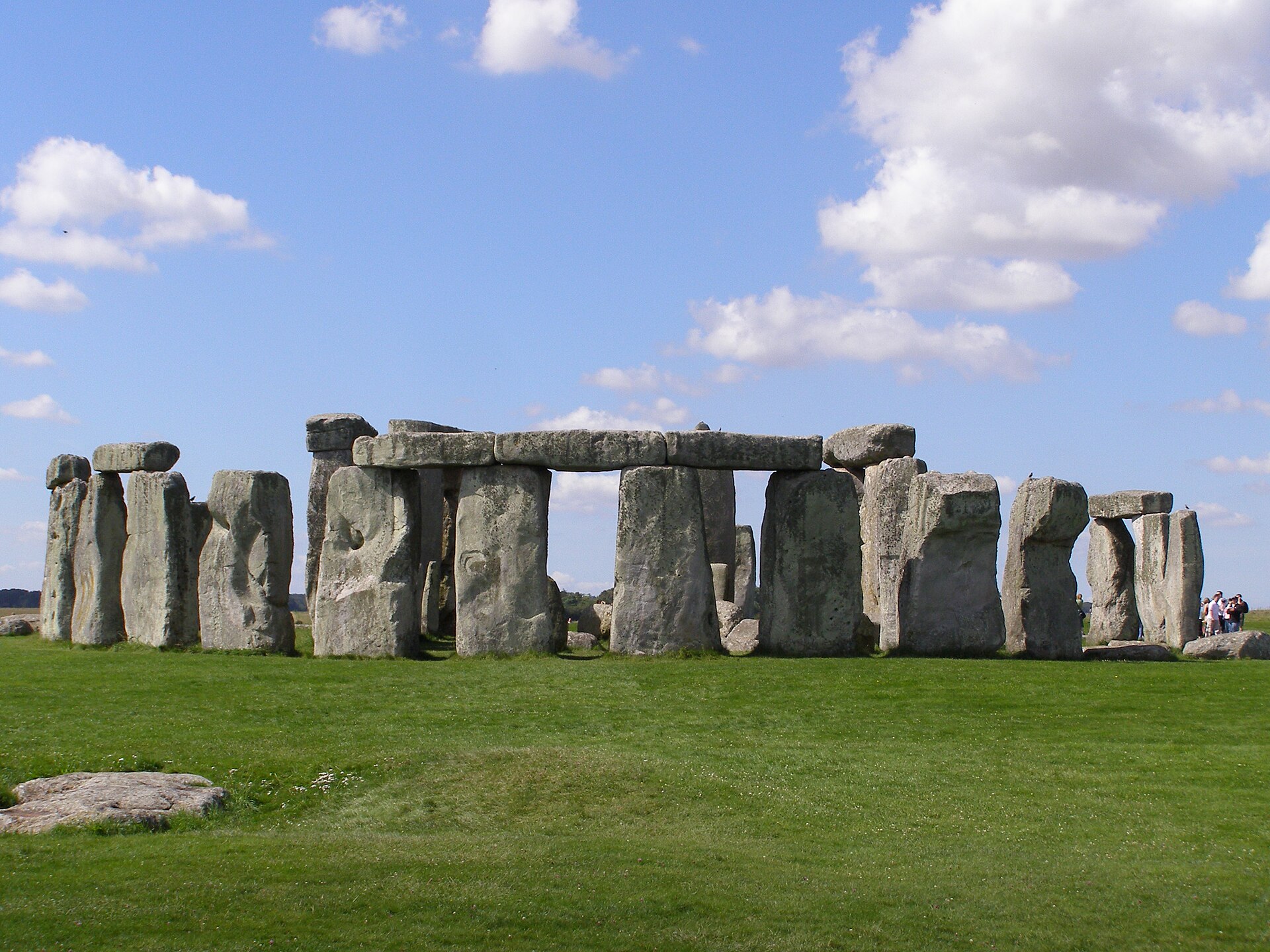
Photo: garethwiscombe · CC BY 2.0

Stonehenge is a ring of sarsen trilithons and smaller 'bluestones' set within a circular earthwork on Salisbury Plain, built and remodelled over roughly 1,500 years. The sarsens, weighing up to 30 tonnes, came from the Marlborough Downs about 25 kilometres north; the two-to-five-tonne bluestones came from the Preseli Hills of west Wales, some 225 kilometres away; and in 2024 the six-tonne Altar Stone was traced to north-east Scotland, at least 750 kilometres distant. The monument is aligned on the solstice axis — midsummer sunrise and midwinter sunset — and sits in a landscape dense with barrows, avenues and the giant henge of Durrington Walls.

See it on the globe →
The mainstream view

What archaeology says

Modern excavation and dating — notably the Stonehenge Riverside Project led by Mike Parker Pearson — place the first circular ditch-and-bank, with its ring of 56 'Aubrey Holes', at about 3000 BC, when the monument served as Britain's largest cremation cemetery. The great sarsen circle and trilithons were erected around 2500 BC, contemporary with a vast builders' and feasting settlement at nearby Durrington Walls, where pig bones show midwinter gatherings drawing people and animals from across Britain. Isotope studies of cattle teeth and cremated bone confirm the monument drew participants from as far away as Wales and Scotland.

Geologists Richard Bevins and Rob Ixer have matched specific bluestones to outcrops at Craig Rhos-y-felin and Carn Goedog in the Preseli Hills, where Parker Pearson's team excavated what they interpret as Neolithic quarries with radiocarbon dates of 3400–2900 BC — evidence, they argue, that people deliberately quarried and hauled the stones to Wessex, perhaps via a dismantled first circle at Waun Mawn. In August 2024, a Nature paper by Anthony Clarke and colleagues at Curtin University stunned the field by fingerprinting the Altar Stone's zircon, apatite and rutile grains to the Old Red Sandstone of the Orcadian Basin in north-east Scotland — implying a sea or overland journey of 750 kilometres or more, and a level of long-distance coordination in Neolithic Britain far beyond what most researchers had assumed. Follow-up work in 2025 ruled out Orkney itself, pointing to the Moray Firth coastal zone.

Archaeologists now read Stonehenge as a monument of the ancestors and of unification — a place whose very stones materialised alliances between distant regions — while conceding that no single explanation of its purpose commands universal assent.

Key evidence cited
  • Radiocarbon-dated sequence: ditch and cremation cemetery c. 3000 BC, sarsen settings c. 2500 BC
  • Bluestones geochemically matched to Preseli outcrops, with excavated quarry evidence dated 3400–2900 BC
  • 2024 Nature study tracing the Altar Stone to the Orcadian Basin of north-east Scotland (750+ km)
  • Durrington Walls feasting settlement with isotope evidence of pigs and cattle brought from across Britain
  • Absence of any glacial deposits or bluestone erratics on Salisbury Plain despite extensive survey
The alternative view

What the skeptics propose

The longest-running dissent concerns transport. Glacial geomorphologist Brian John has argued for decades that the bluestones were not hauled by people but carried east by the Irish Sea Glacier and picked up on or near Salisbury Plain as erratics — in his view the 'Neolithic quarries' at Craig Rhos-y-felin are natural features over-interpreted by archaeologists, and Waun Mawn's 'lost circle' dissolved on excavation into a handful of stone sockets. Mainstream geologists counter that no bluestone erratics or glacial deposits have ever been found on Salisbury Plain, and a 2025 re-analysis of the 'Newall boulder' — long cited as a possible erratic — concluded it was quarried rhyolite carried by humans. John published a rebuttal the same year; the argument continues in the journals.

A second strand treats Stonehenge as a precision scientific instrument. Astronomer Gerald Hawkins' 1965 book Stonehenge Decoded claimed the monument was a Neolithic computer for predicting eclipses, an idea elaborated by cosmologist Fred Hoyle and by Alexander Thom, who surveyed it as part of his case for a standardised 'megalithic yard' and high-precision lunar observatories. Archaeoastronomers such as Clive Ruggles accept the deliberate solstice axis but find the more elaborate eclipse-predictor and precision claims statistically unconvincing. Earlier, Alfred Watkins' 1920s 'ley line' theory wove Stonehenge into a web of straight alignments across England — an idea with no archaeological support but enduring popular appeal.

Others push the site's significance deeper in time: four large Mesolithic postholes near the old car park, dated to around 8000 BC, are cited by alternative writers as evidence the location was already sacred millennia before the henge — a point mainstream archaeology partly accepts, while rejecting any continuous 'lost civilisation' behind it. Timothy Darvill and Geoffrey Wainwright's suggestion that the bluestones were believed to heal — making Stonehenge a Neolithic Lourdes — sits at the respectable end of the speculative spectrum, supported by the trauma and disease visible in burials around the monument and by the centuries of chipping at the bluestones for talismans.

Key evidence cited
  • Brian John's geomorphological case that the bluestones are glacial erratics, not quarried monoliths
  • The sparse and contested results at Waun Mawn, where the proposed 'first Stonehenge' yielded few stone sockets
  • Hawkins', Hoyle's and Thom's astronomical analyses suggesting eclipse prediction and precision surveying
  • Mesolithic postholes of c. 8000 BC showing the spot mattered 4,000+ years before the monument
  • Darvill and Wainwright's healing-centre reading, backed by injured and sick individuals buried nearby

Genuinely open questions

  1. How exactly was the six-tonne Altar Stone moved at least 750 kilometres from north-east Scotland — by sea, or dragged overland?
  2. Were the bluestones first erected in Wales and later dismantled and re-erected at Stonehenge, as the Waun Mawn hypothesis proposes?
  3. What did Stonehenge actually do — cemetery, temple, calendar, healing centre, unifying monument — or all of these across its 1,500-year life?

Worth knowing

The Altar Stone's Scottish fingerprint means at least one Stonehenge megalith travelled further than any other known monument stone in prehistoric Europe — a journey longer than London to Edinburgh, made without wheels or written plans.