What archaeology says
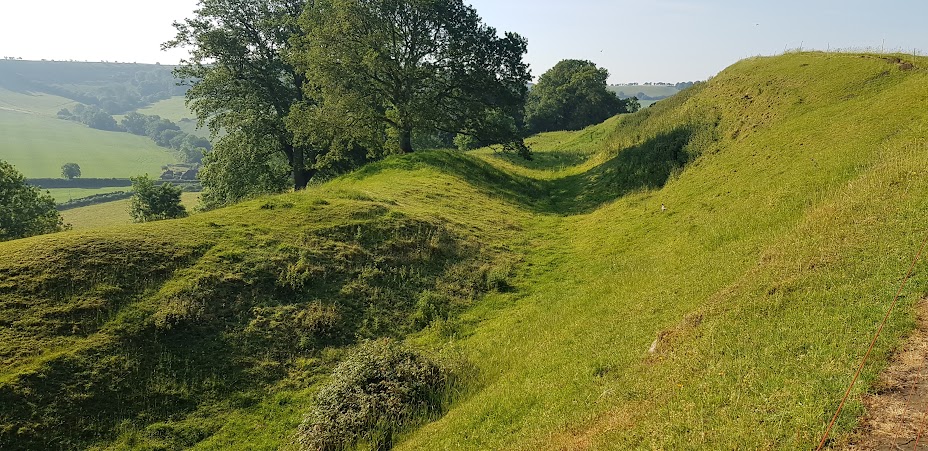
The Camelot Research Committee excavations of 1966–1970, directed by Leslie Alcock, remain among the most celebrated digs in British archaeology. Beneath the Iron Age defences Alcock found that around AD 470–580 the entire 1.2-kilometre perimeter of the innermost rampart had been rebuilt with a timber-framed, stone-filled fighting wall, pierced by a gate-tower — a refortification demanding resources and manpower on a scale implying a major regional ruler. On the summit plateau stood a timber feasting hall of about 20 by 10 metres, and the site yielded quantities of imported Mediterranean amphorae and fine wares, evidence of elite trade reaching Byzantium. Whoever held Cadbury around AD 500 commanded wealth and warriors: the archaeology is not in dispute.
The retreat has been from the name. Alcock himself, initially open to a historical Arthur in his 1971 book Arthur's Britain, grew steadily more cautious, and by his definitive 1995 site report he analysed 'Cadbury/Camelot' purely as the citadel of an anonymous British potentate. Historians such as Nicholas Higham and Guy Halsall have since argued that the case for any historical Arthur rests on sources written centuries after the events, and that Camelot itself is a 12th-century French literary invention that no archaeology could ever locate. On this view Leland's 1542 identification reflects Tudor folklore — helped along by the nearby River Cam and the villages of Queen Camel and West Camel — rather than surviving ancient memory. The mainstream position is thus a curious split: Cadbury's Dark Age citadel is real and remarkable; its connection to Arthur is unprovable and its connection to 'Camelot' anachronistic by definition.
- Camelot is absent from all early Arthurian sources; it first appears in Chretien de Troyes, c. 1180
- Alcock's excavations dated Cadbury's great refortification to c. AD 470–580 on stratigraphy, finds and radiocarbon
- The 20 x 10 metre timber hall and gate-tower attest an anonymous elite, with no inscription naming any ruler
- Leland's 1542 identification is the earliest record linking Cadbury to Camelot, plausibly inspired by local Cam- place-names
- Higham's and Halsall's source-criticism finds no contemporary evidence for a historical Arthur at all