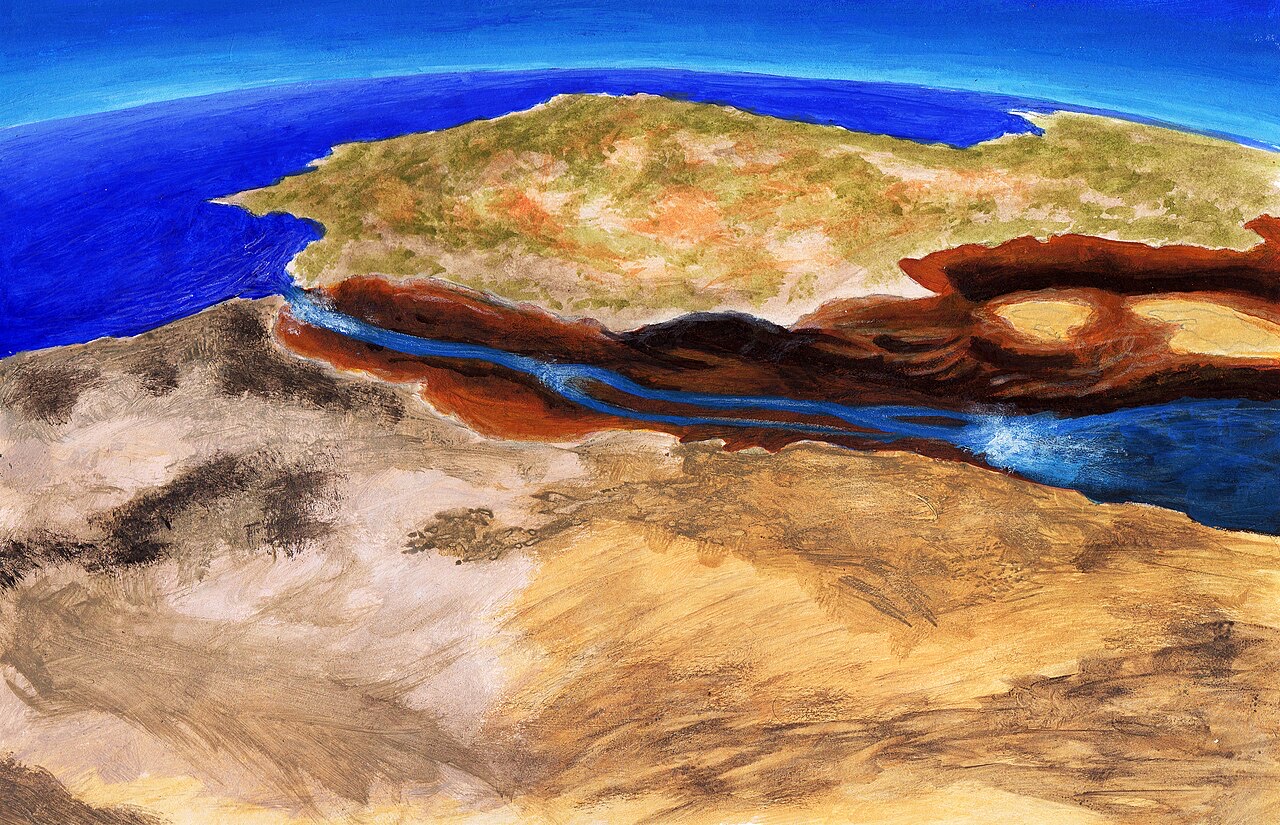
Catastrophe & Climate · Strait of Gibraltar, between Iberia and Morocco (erosion channel runs into the western Mediterranean)

The Zanclean Megaflood

The largest flood known to science refilled an entire sea, and it has nothing to do with any lost city.

Mainstream: c. 5.33 million years agoAlternative: Sometimes misused for far more recent, human-scale flood claims35.95°, -5.60°

At a glance

The Zanclean Megaflood
Photo: Paubahi · CC BY-SA 3.0

At the end of the Messinian Salinity Crisis the Mediterranean basin had largely dried into a deep, salt-encrusted desert far below sea level. Then the Atlantic broke through at the Strait of Gibraltar and refilled it in what may have been a geological blink, cutting a colossal channel across the sill. It is the largest flood identified in the geological record, and a striking case study in how deep-time catastrophe can be misborrowed for human-scale legends.

See it on the globe →
The mainstream view

What archaeology says

Between roughly 5.97 and 5.33 million years ago the Mediterranean was cut off from the Atlantic and lost most of its water to evaporation, leaving thick salt deposits, the Messinian Salinity Crisis. The refilling that ended it is the Zanclean flood, named for the earliest stage of the Pliocene.

In 2009 Daniel Garcia-Castellanos and colleagues published evidence in Nature for a catastrophic rather than gentle refill. A roughly 200-390 kilometre erosion channel runs from the Gulf of Cadiz across the Gibraltar sill into the Mediterranean, and modelling suggested discharge on an almost unimaginable scale, with water levels in the basin possibly rising many metres a day and a large fraction of the sea filling in perhaps months to a couple of years.

Later work, including studies seeking independent sedimentary evidence, has debated just how sudden the event was and how much of the fill was truly catastrophic. But the outline is widely accepted: an ocean poured through a broken sill and drowned a desert the size of a sea.

Key evidence cited
  • Thick Messinian salt (evaporite) deposits beneath the Mediterranean record its near-desiccation before the flood.
  • A large erosion channel crossing the Gibraltar sill, mapped by Garcia-Castellanos and colleagues (2009), records catastrophic incision.
  • Hydraulic modelling reproduces extreme discharge capable of refilling much of the basin in a geologically short time.
  • The Zanclean marks a sharp stratigraphic transition from evaporites to normal open-marine sediments.
  • Micropalaeontology shows Atlantic marine life abruptly reoccupying the basin after the refill.
  • Subsequent studies searching for sediment fans have tested and refined the sudden-flood model.
The alternative view

What the skeptics propose

The Zanclean flood is not itself an alternative-history claim; it is orthodox geology at its most spectacular. Its place on a site like this is as a cautionary example. Because it is genuinely the largest known flood, the phrase gets lifted out of its 5.3-million-year context and dropped into writing about Atlantis, Noah or a drowned Ice Age civilisation, as if an ocean-scale catastrophe had struck within human memory.

It had not. No people existed anywhere near the Mediterranean 5.3 million years ago; the flood predates the genus Homo by millions of years. Any narrative that ties the refilling of the Mediterranean to a human deluge story is conflating deep time with recorded time.

Where careful alternative writers use it well, they use it as an analogy: proof that Earth can rearrange a whole sea catastrophically, so smaller sudden floods within the human era are at least physically conceivable. Used that way it is fair. Used as literal backstory for a lost city, it is simply the wrong epoch by a factor of a thousand.

Key evidence cited
  • It is, by discharge, the largest flood documented in Earth history, which makes it rhetorically attractive.
  • It demonstrates that a strait can breach and an entire sea can be transformed catastrophically.
  • The imagery of a mile-high cascade at Gibraltar echoes the scale of deluge myth.
  • It shows sea basins can lie far below ocean level and then flood, a general point some apply to smaller basins like the Black Sea.
  • It is cited by analogy to argue that rapid, dramatic flooding is physically possible, not just mythic.
  • Its very fame means it is repeatedly, if wrongly, name-checked in popular lost-civilisation writing.

Genuinely open questions

  1. How sudden was the refill really, months, years, or a longer staged process?
  2. How much of the Mediterranean was truly dry desert versus a chain of hypersaline lakes?
  3. Can independent sediment fans confirm the discharge implied by the erosion channel?
  4. Does the flood correlate with any global sea-level or climate signal of the earliest Pliocene?

Worth knowing

At peak flow the water pouring through Gibraltar has been estimated at up to a thousand times the discharge of the modern Amazon, filling most of a sea in perhaps a couple of years.