Ancient Engineering · Antequera, Andalusia, Spain

Dolmen of Menga

A 6,000-year-old chamber roofed by a 150-tonne capstone — hailed in 2024 as the greatest engineering feat of the Neolithic.

Mainstream: c. 3800-3600 BCAlternative: Broadly accepted, though some question Neolithic capability at this scale37.02°, -4.55°

At a glance

Dolmen of Menga
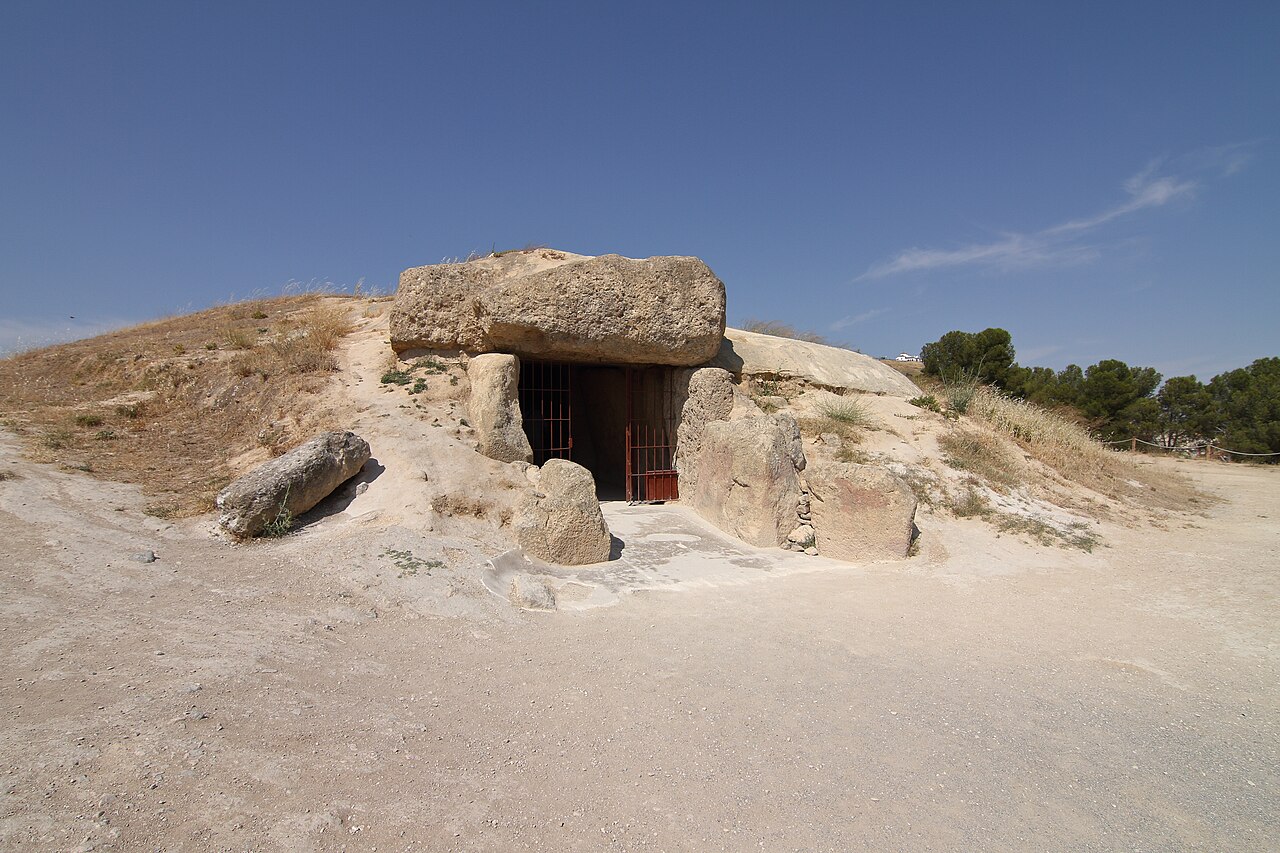
Photo: Malopez 21 · CC BY-SA 4.0

The Dolmen of Menga is a colossal chambered mound outside Antequera in southern Spain, built around 3800-3600 BC — centuries before Stonehenge's sarsens were raised. Its chamber is formed of some 32 megaliths, the largest being Capstone 5, estimated at about 150 tonnes: the heaviest stone ever moved in Iberian prehistory and one of the largest in Europe. Uniquely among European dolmens, Menga faces not a solstice horizon but La Pena de los Enamorados, a mountain shaped like a sleeping human face, and contains a 19.5-metre well cut through bedrock at the rear of its chamber. In 2024 a study in Science Advances declared its construction a work of 'early science'.

See it on the globe →
The mainstream view

What archaeology says

A decade-long research programme led by Leonardo Garcia Sanjuan of the University of Seville, published in Science Advances in August 2024, reconstructed Menga's construction in detail. The builders quarried soft, fragile calcarenite from Cerro de la Cruz, roughly a kilometre away and uphill of the site, meaning the megaliths could be moved largely downhill — probably on timber trackways with sledges — while being protected from cracking en route. Wear patterns and geometry show the uprights were lowered into deep foundation sockets cut into bedrock, set leaning slightly inward to form a trapezoidal section that channels the capstones' load down through the walls.

The team argues the builders understood friction, centre of gravity and rudimentary geometry: stones interlock with millimetre-scale precision, the first capstone was likely slid into place over the already-embanked chamber, and the whole structure was then sealed under a mound that both stabilised and waterproofed it. Because the soft stone would have shattered under crude handling, the paper describes Menga as a feat of planning and knowledge transfer, calling it among the greatest engineering achievements of the Neolithic.

For mainstream prehistorians, Menga demonstrates that fully 'Stone Age' societies commanded sophisticated practical science — no lost civilisation required, just accumulated skill, social organisation and deep familiarity with materials.

Key evidence cited
  • Radiocarbon dates place construction at c. 3800-3600 BC, among the earliest great dolmens of Iberia
  • The 2024 Science Advances study (Garcia Sanjuan et al.) reconstructed quarry source, downhill transport route and foundation sockets
  • Uprights lean inward in a trapezoidal section, an intentional load-managing design
  • Millimetre-precision interlocking of soft calcarenite blocks shows careful dressing and trial fitting
  • The covering mound engineering protected the fragile stone from water damage for nearly six millennia
  • Comparable, smaller dolmens nearby (Viera, El Romeral) show a developing local tradition
The alternative view

What the skeptics propose

Menga features less in lost-civilisation literature than Egyptian or Andean sites, but alternative writers, including Graham Hancock's readership and megalith-focused researchers such as Hugh Newman, cite it when arguing that official prehistory keeps underestimating the ancients. A 150-tonne capstone moved and placed around 3700 BC by farmers with no metal, no wheel and no draught animals suitable for such loads is, they argue, exactly the kind of anomaly that suggests inherited knowledge from an earlier megalithic tradition — one they trace through sites like Gobekli Tepe, millennia older still.

Some also emphasise Menga's anomalous features: its orientation to an anthropomorphic mountain rather than the sun, and the deep well inside the chamber, whose date and purpose remain debated — a minority suspect the well and perhaps parts of the site are older than the dolmen itself.

Notably, the 2024 engineering study narrowed the rhetorical gap between camps: mainstream scientists now openly describe Menga's builders as possessing 'early science', which alternative proponents read as vindication of their long-standing claim that Neolithic peoples were far more capable — and perhaps far better taught — than textbooks allowed.

Key evidence cited
  • Capstone 5, at roughly 150 tonnes, is far heavier than the stones of Stonehenge, built over a millennium later
  • No written records or images document how Neolithic Iberians organised such a project
  • The orientation to La Pena de los Enamorados is unique, hinting at knowledge systems we barely understand
  • The 19.5-metre bedrock well inside the chamber is undated and unexplained
  • Moving fragile 150-tonne slabs without cracking implies engineering finesse only recently acknowledged by mainstream science
  • Proponents see Menga as one node in a wider megalithic knowledge tradition spanning continents

Genuinely open questions

  1. When was the chamber's deep well cut, and what was it for?
  2. How many people, and what social organisation, did the build actually require?
  3. Why was Menga aligned on a mountain silhouette rather than a celestial event?
  4. How was the 150-tonne capstone raised onto the uprights — ramp over the mound, or another method?

Worth knowing

Menga's builders deliberately quarried one of the region's weakest stones — soft calcarenite — and still built something that has stood for nearly 6,000 years, a choice the 2024 study compared to solving an engineering problem on hard mode.