Ancient Knowledge · Near Evora, Alentejo, Portugal

Almendres Cromlech

Nearly a hundred granite monoliths on a Portuguese hillside, raised while Britain was still Mesolithic

Mainstream: c. 6000-3000 BC (built in phases)Alternative: c. 6000 BC — Europe's oldest astronomical sanctuary, two millennia before Stonehenge38.56°, -8.06°

At a glance

Almendres Cromlech
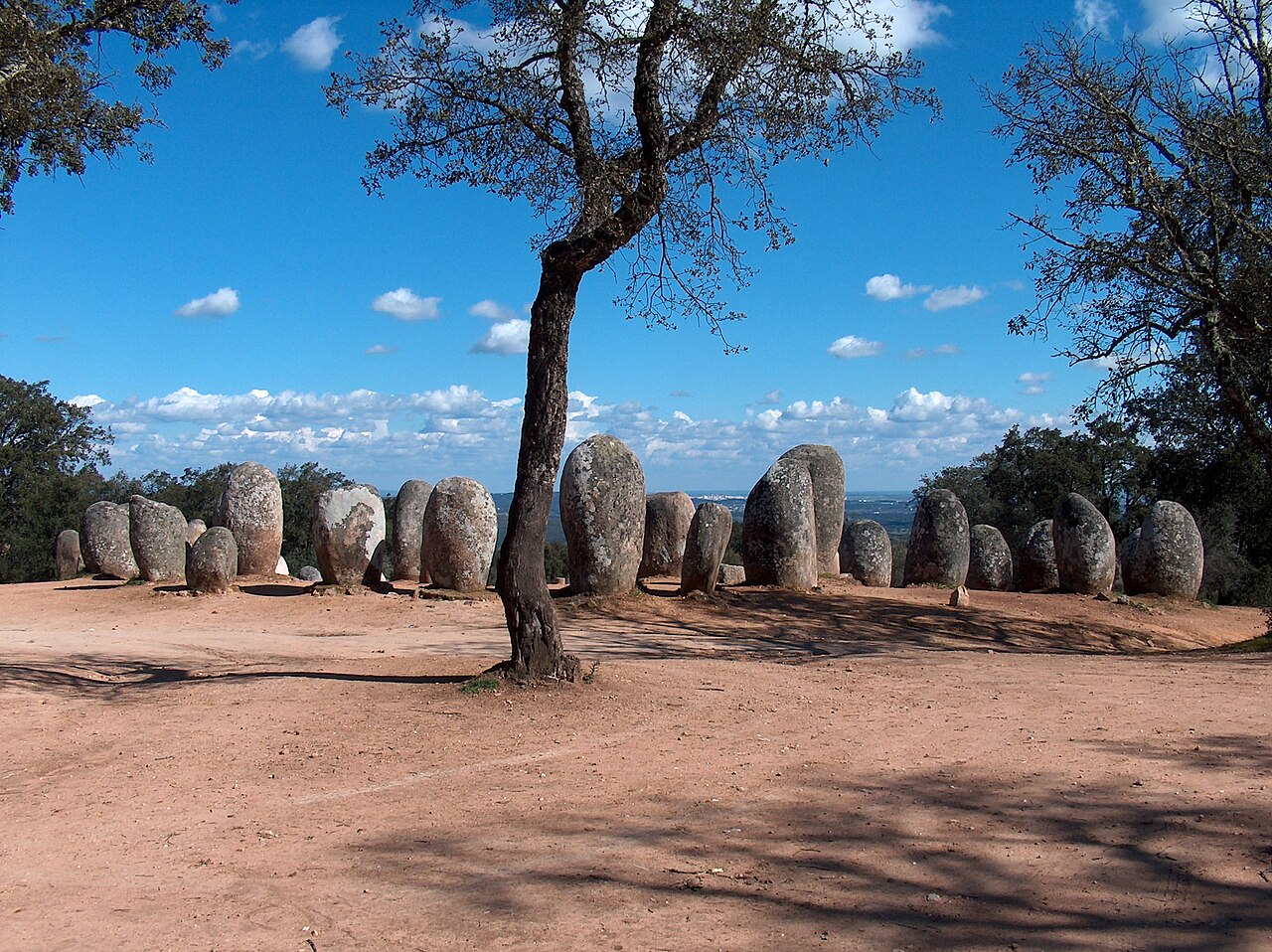
Photo: Wikimedia Commons · Public domain

Hidden among cork oaks west of Evora, the Cromeleque dos Almendres is the largest stone circle complex in Iberia: about 95 rounded granite monoliths arranged in a double horseshoe-and-oval on an east-facing slope. Rediscovered only in 1966 by researcher Henrique Leonor Pina, the monument was raised in phases beginning around 6000 BC — among the earliest megalithic constructions anywhere — and modified over three millennia. Several stones carry pecked circles, crooks and radiating motifs, and the complex, together with the nearby Almendres menhir, shows orientations towards the equinox and solstice sunrises that have made it a touchstone of Iberian archaeoastronomy.

See it on the globe →
The mainstream view

What archaeology says

Portuguese archaeology, led by researchers such as Mario Varela Gomes, reconstructs Almendres as a long-lived sanctuary built in at least two or three major phases: an early Neolithic setting of smaller circles around 6000 BC, enlarged in the fifth millennium with larger monoliths arranged in irregular ellipses, and remodelled again into the Chalcolithic. This sequence — argued from stone typology, engravings and comparison with dated tombs nearby — makes it plausibly the oldest surviving stone circle complex in Europe, pre-dating Stonehenge's sarsen circle by more than three millennia.

The monument's axis runs roughly east-west down the slope, and studies of Alentejo megaliths show a strong regional pattern of orientation towards sunrise arcs, especially the equinoxes. A line from the cromlech to the solitary 4.5-metre Almendres menhir, about 1.4 kilometres away, points approximately to the winter solstice sunrise, and many scholars accept the complex functioned as a social and ceremonial aggregation site where the agricultural year was ritually marked.

Caution remains over precision. The stones have been re-erected after millennia of tilting and falling, absolute dates come mainly from associated material rather than the sockets themselves, and Iberian specialists warn that phase chronology at Almendres is looser than popular accounts suggest — 'c. 6000 BC' is a defensible reading of the earliest phase, not a radiocarbon certainty.

Key evidence cited
  • Stone typology, engravings and regional parallels support construction phases from the sixth to the third millennium BC
  • The complex is the largest in Iberia, with about 95 surviving monoliths in a coherent double-enclosure plan
  • The monument's axis and the sight-line to the Almendres menhir fit equinoctial and winter solstice sunrise arcs
  • Systematic studies of Alentejo megaliths show consistent regional orientation towards sunrise, indicating deliberate practice
  • Decorated stones with circles, crooks and radiating motifs parallel imagery in dated passage graves nearby
The alternative view

What the skeptics propose

The bolder school of interpretation treats Almendres as a purpose-built observatory of startling antiquity. Some Portuguese and international researchers argue the twin-ellipse layout encodes not just equinoctial sunrise but lunar standstill azimuths and the rising of specific stars, with the engraved 'radiating sun' and crescent motifs read as explicit astronomical notation. On this view the Evora landscape — with dozens of cromlechs, menhirs and aligned tombs — was a coordinated observing network millennia before the classic megalithic floruit, making the Alentejo, not Wessex or Brittany, the cradle of European astronomy.

A related argument concerns transmission: if organised sky-watching sanctuaries existed in Iberia by 6000 BC, diffusionists contend, the megalithic idea spread from the Atlantic south-west northwards — a case strengthened in recent years by radiocarbon syntheses suggesting megalithism originated in north-west France and Iberia and travelled by sea. Critics reply that early dates for the first Almendres phase rest on typology rather than direct dating, and that reading standstills and stellar targets into re-erected stones is unsafe.

At the fringe, the site attracts claims of ley lines, energy grids and Atlantean survivals, encouraged by its atmospheric setting; local dowsers hold regular gatherings there. Academic researchers dismiss these, while acknowledging the monument's genuine astronomical orientations deserve more rigorous survey than they have yet received.

Key evidence cited
  • Claimed alignments to lunar standstills and stellar risings would make the complex a full observatory rather than a sunrise shrine
  • Early radiocarbon syntheses placing megalithic origins in Iberia and north-west France support the region's primacy
  • The 'sun with rays' engraving on stone 56 is read by some as the earliest explicit solar symbol in western Europe
  • The density of cromlechs and menhirs around Evora suggests a planned ritual-astronomical landscape
  • The earliest proposed phase, c. 6000 BC, precedes every other candidate stone circle in Europe by centuries or more

Genuinely open questions

  1. Can direct dating of stone sockets confirm the sixth-millennium origin of the first circles?
  2. How much did twentieth-century re-erection alter the alignments now being measured?
  3. Do the engraved motifs record astronomical knowledge or purely symbolic and pastoral imagery?
  4. Did the megalithic idea really spread from Iberia northwards along the Atlantic?

Worth knowing

Almendres stood unrecognised in a cork oak plantation until 1966 — one of Europe's oldest monuments was rediscovered around the same time humanity was preparing to fly to the Moon.