Ancient Knowledge · Xiangfen County, Shanxi Province, China

Taosi Observatory

Twelve slits in a rammed-earth wall that may be the oldest observatory in East Asia — and the throne of a legend

Mainstream: c. 2100 BCAlternative: c. 2300 BC — the working observatory of the legendary Emperor Yao35.88°, 111.50°

At a glance

Taosi Observatory
Photo: Gary Todd · CC0

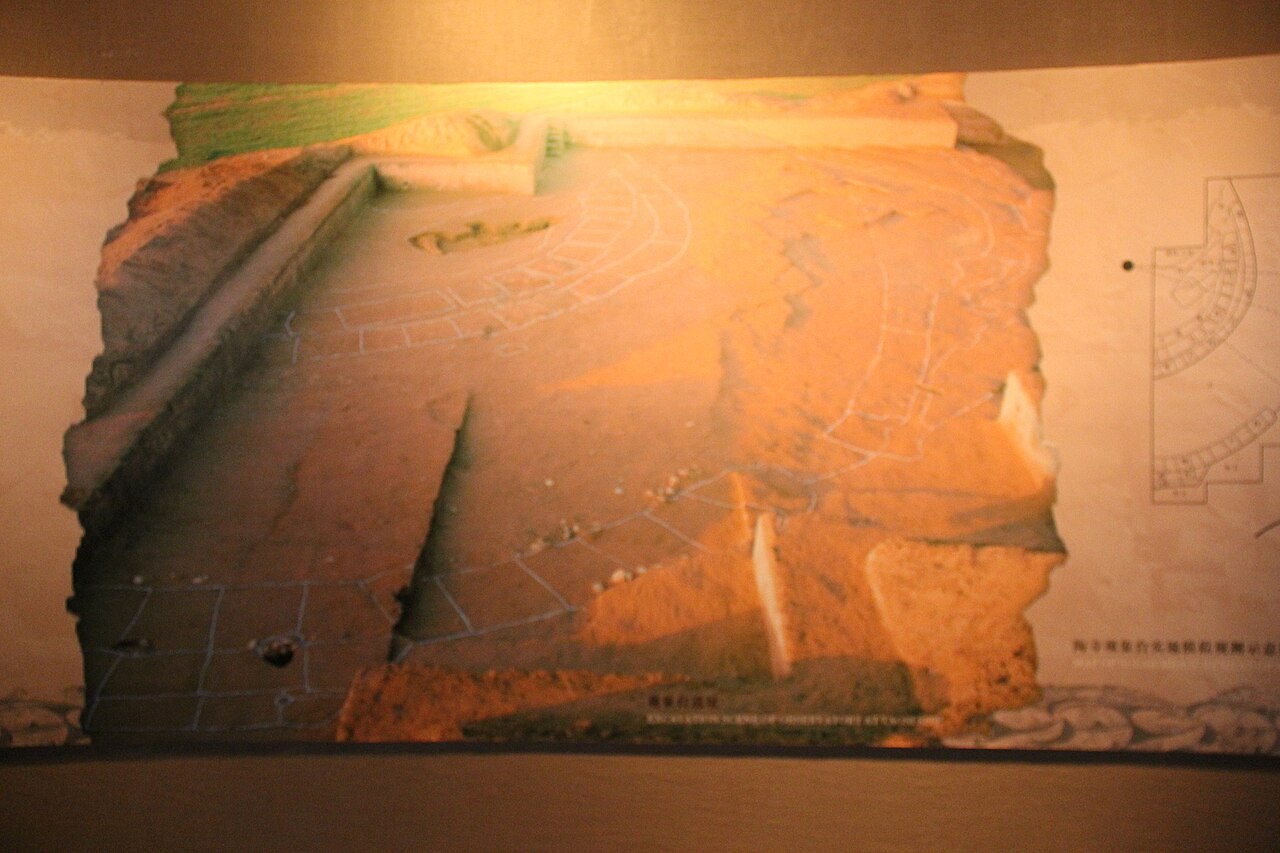
At Taosi, a vast walled town of the late Longshan period in China's Fen River valley, archaeologists led by He Nu of the Chinese Academy of Social Sciences excavated between 2003 and 2005 a strange semi-circular rammed-earth platform, labelled IIFJT1. Reconstruction showed it once carried a curved wall pierced by twelve narrow slits: viewed from a central observation point, the sun rises through successive slits at different dates, including the solstices, across the eastern skyline of Mount Taer. Radiocarbon dated to about 2100 BC, Taosi is claimed as the oldest known observatory in East Asia — and, more provocatively, as the capital of the legendary sage-king Yao, whose astronomers the ancient texts describe.

See it on the globe →
The mainstream view

What archaeology says

The excavated platform is a three-tiered semi-circle about 60 metres across at its widest, its outer arc originally carrying ten to thirteen rammed-earth pillars separated by slits only 15 to 20 centimetres wide. From a marked observing point at the centre, simulations and two years of on-site sunrise observations by Chinese astronomers showed that the winter solstice sun rises through the second slit and the summer solstice sun through the twelfth, with intermediate slits marking other dates — a calendar dividing the year into roughly 20 observable intervals, suited to scheduling agriculture and ritual.

Taosi itself strengthens the case: the 280-hectare city had palaces, elite tombs, craft quarters and evidence of social stratification. One elite tomb yielded a lacquered wooden rod identified by researchers as a gnomon shadow template, alongside what may be a paint-marked scale — the earliest known instruments of Chinese gnomonic astronomy. Sinologist and historian of astronomy David W. Pankenier has analysed how the platform could coordinate lunar months with the solar year, effectively operating a lunisolar calendar with intercalation.

The chronological match with the traditional dates of Emperor Yao — whom the Canon of Yao in the Book of Documents credits with commissioning astronomers Xi and He to fix the solstices and a 366-day year — is treated by most scholars as suggestive rather than probative: Taosi shows that the textual memory of state-sponsored astronomy in the Yao era has a real Longshan-period foundation, even if no inscription names its rulers.

Key evidence cited
  • Radiocarbon dates place the platform's use around 2100 BC in the Taosi middle period
  • Two years of direct sunrise observations from the reconstructed centre point confirmed solstice alignments through the surviving slit foundations
  • The 12-slit design yields a practical division of the solar year consistent with an agricultural and ritual calendar
  • A lacquered gnomon shadow rod from an elite Taosi tomb is the earliest known instrument of Chinese positional astronomy
  • Taosi's palatial architecture, elite cemetery and 280-hectare walls demonstrate a state-level society capable of institutional sky-watching
The alternative view

What the skeptics propose

Within China, a stronger claim is widely promoted: that Taosi simply is Pingyang, the capital of Emperor Yao, and the observatory the very institution described in the Canon of Yao. Advocates, including some senior figures in the Chinese archaeological establishment, point to the convergence of date, scale, location in the heartland of Yao legends, and the observatory itself as effectively confirming a figure long dismissed as mythical. On this reading the platform pushes documented Chinese state astronomy back before 2000 BC and vindicates the historicity of the pre-Xia sage-kings — with implications for the contested Xia dynasty debate as a whole.

Sceptics, both Chinese and Western, urge caution on several counts. The identification of every slit's astronomical target involves choices about the observing point and horizon; critics note the pillars survive only as foundations, so slit widths and heights are reconstructed; and the leap from 'Longshan city with a sunrise-watching platform' to 'Yao's capital' imports legend into archaeology. The Yao attribution, they argue, serves contemporary narratives about 5,000 years of continuous Chinese civilisation as much as it serves the evidence.

A separate debate concerns function: some researchers propose IIFJT1 was primarily an altar for sacrifices to the sky, with observation secondary — noting Chinese tradition never separated the two. The violent destruction of Taosi's elite quarter around 2000 BC, with desecrated tombs and massacred remains, adds a dark coda: whoever ran the observatory, their regime ended in revolt or conquest.

Key evidence cited
  • The site's date, location and scale match the traditional era and homeland of Emperor Yao in the Fen valley
  • The Canon of Yao explicitly describes royal astronomers fixing solstices and a 366-day year — precisely what the platform enables
  • Later place-names and temples in the Linfen region preserve millennia of local tradition identifying it as Yao's capital Pingyang
  • Chinese astronomical tradition's unbroken emphasis on horizon calendars and gnomons is argued to descend directly from Taosi practice
  • Proponents read the observatory as material proof that pre-Xia sage-king narratives encode real history, not myth

Genuinely open questions

  1. Was IIFJT1 primarily an observatory, an altar, or an integrated temple of sky and state?
  2. Can any inscription or artefact ever tie Taosi to the name of Yao, or will the identification remain circumstantial?
  3. How were the twelve slits' target dates chosen — solar calendar, lunisolar intercalation, or festival scheduling?
  4. Who destroyed Taosi's elite quarter around 2000 BC, and did its astronomical tradition survive elsewhere?

Worth knowing

To test the ruined observatory, Chinese researchers built a full-scale replica beside the excavation and spent two years watching sunrises through its slits — the winter solstice sun duly appeared in the predicted gap.