Ancient Engineering · Luoyang, Henan, China

Longmen Grottoes

A kilometre of limestone cliff carved into 100,000 Buddhas over four centuries — now being digitally reassembled after a century of looting.

Mainstream: AD 493 – c. 1127 (Northern Wei to Northern Song; main carving phases 493–755)Alternative: Date not seriously disputed — debate centres on the claim that the great Vairocana Buddha wears Empress Wu Zetian's face, and on who should hold the site's looted sculptures34.56°, 112.47°

At a glance

Longmen Grottoes
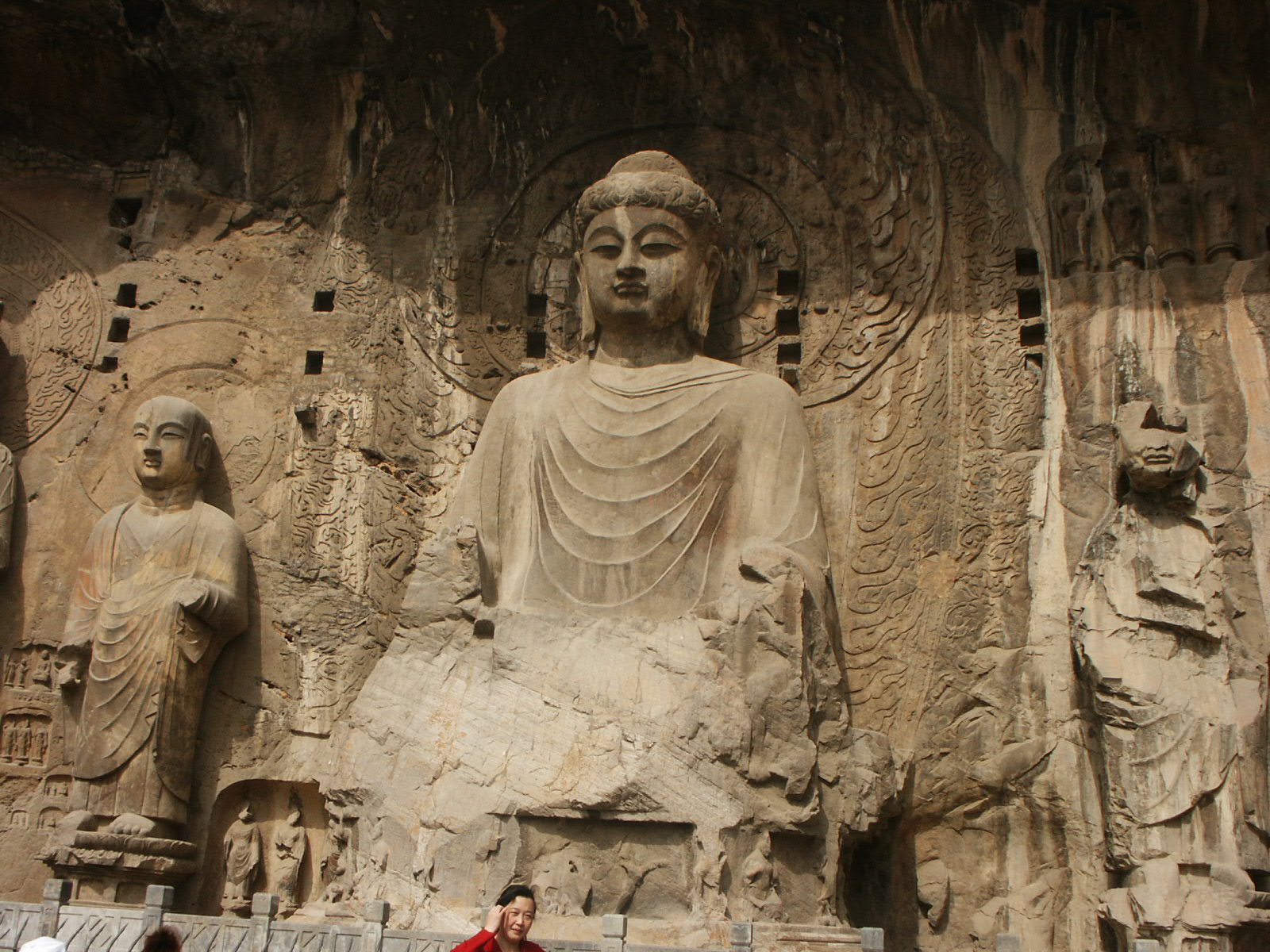
Photo: Gary Todd · CC0 1.0 (public domain)

Where the Yi River cuts a gorge between two limestone hills south of Luoyang, successive Chinese dynasties turned both cliff faces into one of the greatest concentrations of stone sculpture on Earth. The Longmen Grottoes comprise roughly 2,345 caves and niches, nearly 2,500 stelae and inscriptions, over 60 pagodas and as many as 100,000 carved Buddhist figures, ranging from statues two centimetres tall to the serene 17.14-metre Vairocana Buddha of Fengxian Temple. Work began in AD 493, when the Northern Wei court moved its capital to Luoyang, and continued in waves for over 400 years. Unlike many rock-cut sites, Longmen is extraordinarily well documented. Thousands of dedicatory inscriptions record who paid for individual carvings — emperors, empresses, generals, monks, guilds and ordinary families — and often why and when. That makes the site both a devotional landscape and a dated archive of medieval Chinese society. UNESCO inscribed it in 2000 as 'an outstanding manifestation of human artistic creativity'. The site's modern story is darker: in the early twentieth century dealers and collectors sawed off heads and entire reliefs for the international art market. The twenty-first-century response has been a remarkable digital campaign — high-resolution scanning, virtual restoration and augmented reality — aimed at reuniting the scattered fragments with the cliffs, at least on screen.

See it on the globe →
The mainstream view

What archaeology says

The historical sequence is secure. About 30 per cent of the caves date to the Northern Wei (493–534), beginning with Guyangdong — which alone holds around 800 inscriptions, the richest epigraphic record in any Chinese cave temple — and the imperial Binyang caves. After a quieter Sui and early Tang interval, roughly 60 per cent of the carving belongs to the High Tang (626 to the mid-eighth century), culminating in Fengxian Temple, completed in 676 under Emperor Gaozong. A surviving inscription records that Empress Wu Zetian donated 20,000 strings of cash from her cosmetics budget in 672 to speed the work. Art historian Amy McNair's study Donors of Longmen (2007) reconstructed the politics and piety behind the major commissions from precisely this inscriptional evidence.

Conservation is now led by the Longmen Grottoes Research Institute, which since the 2010s has scanned the caves in high resolution and pursued 'digital reunification' with partners including Xi'an Jiaotong University and the University of Chicago's Center for the Art of East Asia, where Katherine Tsiang pioneered digital reconstruction of looted Chinese cave temples. In 2023 the looted 'Empress Wenzhao Worshipping the Buddha' procession relief from Binyang Central Cave — its fragments split between the site and American museums — became the first to be digitally revived in situ via augmented reality, and researchers have published automated methods for virtually restoring the cave's damaged portrait reliefs. A Tang-dynasty Guanyin figure became China's first stone statue restored entirely by digital means, guided by early twentieth-century photographs.

For mainstream scholarship, Longmen is the opposite of a mystery: it is the best-dated cliff sculpture programme in the world, a place where the carvers, patrons, prices and prayers are frequently written on the rock itself.

Key evidence cited
  • Nearly 2,500 dated stelae and dedicatory inscriptions naming donors, dates and motives
  • Guyangdong's c. 800 inscriptions anchoring the Northern Wei phase from AD 493
  • The 672 inscription recording Wu Zetian's 20,000-string donation to Fengxian Temple, completed 676
  • Unfinished niches preserving every stage of hammer-and-chisel carving
  • UNESCO inscription (2000) and the Longmen Grottoes Research Institute's full 3D scan archive
The alternative view

What the skeptics propose

The liveliest popular claim at Longmen is that the colossal Vairocana Buddha of Fengxian Temple is a portrait of Wu Zetian, China's only female emperor. The idea rests on her documented sponsorship, the statue's unusually soft, full-cheeked features — it is often called the 'Mona Lisa of the East' — and later traditions linking her self-image to the cosmic Buddha. Guides and much Chinese popular writing present the identification as fact. Sceptical art historians, including Amy McNair, counter that no contemporary text says the face is hers, that Wu was a consort rather than sovereign in 672, and that the features follow High Tang sculptural ideals seen elsewhere. The portrait claim is unprovable either way, which is exactly why it thrives.

A second strand of alternative commentary concerns scale and method: online writers periodically marvel that 100,000 figures were cut with hammer and chisel and hint at lost techniques. Here the inscriptions themselves are the rebuttal — they record named workshops, timescales and payments across four centuries, and unfinished niches preserve every stage of carving. Unlike sites such as the Longyou Caves, where no records exist, Longmen documents its own construction almost to excess.

The genuinely contested question is restitution. Chinese researchers have traced sawn-off heads and reliefs to collections including the Metropolitan Museum of Art and the Nelson-Atkins Museum, and argue digital reunification should be a prelude to physical return; Western museums generally maintain the pieces were acquired legally under the standards of the time. That debate — cultural property, not chronology — is where Longmen's real controversy now lives.

Key evidence cited
  • The Vairocana Buddha's distinctive, feminine features cited as a portrait of Wu Zetian
  • Later traditions and popular histories treating the Wu Zetian identification as established
  • Absence of any contemporary text explicitly describing the statue's face as hers
  • The sheer statistical scale — 100,000 figures — used to argue for lost organisational techniques
  • Provenance research tracing looted heads and reliefs into named Western museum collections

Genuinely open questions

  1. Was the Vairocana Buddha's face really modelled on Wu Zetian, or is that a later legend?
  2. Can digital reunification of looted fragments lead to negotiated physical returns from Western museums?
  3. How much sculpture has been lost entirely — and can AI reconstruction from old photographs be trusted as a historical record?

Worth knowing

The Wanfo (Ten Thousand Buddha) Cave actually contains some 15,000 carved Buddhas — the smallest just two centimetres tall — completed, its inscription notes, in a single year (680) by two monastic supervisors.