Ancient Engineering · Tangshan, Jiangning District, Nanjing, China

Yangshan Quarry

The largest building stones ever cut by human hands — three stele blocks totalling over 31,000 tonnes, abandoned still attached to the mountain.

Mainstream: AD 1405–c. 1407 (Yongle era, Ming dynasty; quarry in use since the Six Dynasties)Alternative: Date not seriously disputed — skeptics instead ask why a supremely competent Ming state cut blocks it could never move, and whether some workings are older32.07°, 119.00°

At a glance

Yangshan Quarry
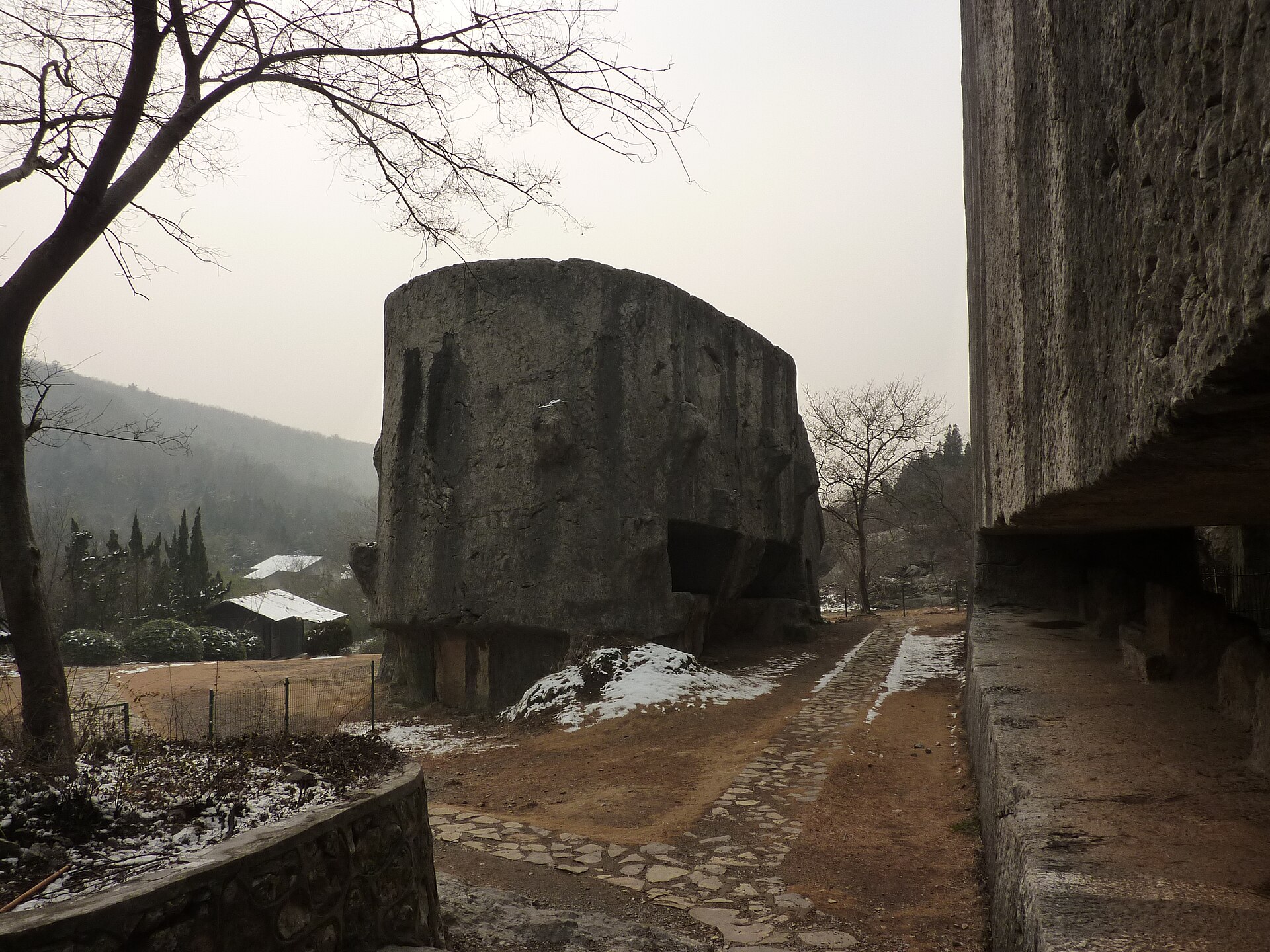
Photo: Vmenkov · CC BY-SA 3.0

In a limestone quarry east of Nanjing lie the three parts of a monument that would have dwarfed anything in the ancient world: the base, body and crown of a colossal memorial stele ordered by the Yongle Emperor in 1405 to honour his father, the Ming founder Hongwu, at the Ming Xiaoling mausoleum. The base block is 30.35 metres long and weighs about 16,250 tonnes; the body, 49.4 metres long, about 8,799 tonnes; the crown about 6,118 tonnes. Assembled, the stele would have stood roughly 73 metres tall — a 20-storey building of solid stone. All three pieces were almost fully dressed, then abandoned, still connected to the living rock by narrow spines. They remain the largest stones ever quarried, and the central question they pose is disarmingly simple: why cut them at all?

See it on the globe →
The mainstream view

What archaeology says

The historical record is unusually secure. The Yongle Emperor, who had just taken the throne by overthrowing his own nephew in a civil war, ordered the giant stele in 1405 as an extravagant act of filial piety toward Hongwu — part of the same burst of legitimising megaprojects that produced the Forbidden City, the Treasure Fleet of Zheng He and the Yongle Encyclopedia. Thousands of workers cut the three blocks from Yangshan's limestone, and local tradition preserves the cost: labourers who failed to produce their daily quota of rubble faced punishment, and the nearby village of Fentou ('grave mound') is said to take its name from the burials of workers who died. Around 1407 the project was halted, and in 1413 a conventional stele — the Shengong Shengde stele, still an imposing 8.78 metres — was erected at Ming Xiaoling instead.

Why begin at all? Ming engineers were the world's best movers of megaliths: within two decades they hauled stones of 200–300 tonnes (with some records suggesting larger) over 70 kilometres to Beijing on artificial ice roads in winter, a technique analysed in a 2013 engineering study. But 8,000–16,000 tonnes is two orders of magnitude beyond that, and historians conclude the scheme outran feasibility — whether through courtly overreach, deliberate propaganda in which the gesture mattered more than completion, or a genuine miscalculation recognised only once the blocks took shape. Some scholars suspect Yongle's advisers allowed an impossible imperial whim to proceed until it could be quietly abandoned without loss of face.

The quarry itself had supplied Nanjing with stone since the Six Dynasties (AD 220–589), and the stele blocks preserve dense fields of chisel marks, wedge pits and drainage cuttings entirely consistent with documented Ming quarrying technique.

Key evidence cited
  • Ming records of the Yongle Emperor's 1405 stele commission for the Ming Xiaoling mausoleum
  • The substitute Shengong Shengde stele erected at Ming Xiaoling in 1413
  • Dense chisel marks, wedge pits and drainage cuttings matching documented Ming quarrying technique
  • Local tradition and the 'Fentou' village name preserving memory of the workforce and its casualties
  • Documented Ming megalith logistics (ice-road transport to Beijing) defining exactly what was — and was not — possible
The alternative view

What the skeptics propose

The alternative literature seizes on the project's apparent irrationality. Writers on sites like Ancient Origins and dedicated projects such as Megalithic China ask how a bureaucracy capable of building the Forbidden City could spend two years and thousands of lives dressing blocks that any competent engineer would know were immovable — and suggest the official story is incomplete. One school proposes the Ming were re-dressing or appropriating far older workings: the quarry's use since at least the Six Dynasties is documented, and proponents argue some cuttings, scoop-like extraction marks and immense rectilinear faces resemble megalithic quarry sites elsewhere in the world more than they resemble hammer-and-chisel work, hinting at an older stone-cutting tradition with capabilities since lost.

A more speculative fringe — including ancient-astronaut commentators and writers who fold Yangshan into a global 'impossible megaliths' catalogue alongside Baalbek's trilithon stones — suggests the blocks were cut by, or in imitation of, a lost civilisation with means of transport we no longer understand, with the Ming stele story a later rationalisation attached to existing stones. They note that the body block alone outweighs the largest Baalbek stone by a factor of five or more, and ask why the Yongle court, famous for meticulous planning, produced no surviving engineering plan for moving the pieces.

Mainstream historians find none of this necessary. The Ming records naming the project, the 1413 substitute stele, the folklore of worker deaths, and tool marks matching 15th-century technique form a closed case; imperial megaprojects overreaching and being abandoned is a pattern seen worldwide. The genuinely open historical question — what the court actually intended, and when it privately knew the stele could never be moved — is debated within conventional history, and the alternative theories are best read as a sharpened version of that same puzzle.

Key evidence cited
  • The core paradox: a supremely capable state cutting blocks two orders of magnitude beyond its transport ability
  • The quarry's documented pre-Ming use since the Six Dynasties, leaving room for older workings
  • Extraction marks and vast rectilinear faces proponents compare to megalithic quarries elsewhere
  • The absence of any surviving Ming engineering plan for moving or erecting the pieces
  • The body block outweighing the famous Baalbek trilithon stones several times over

Genuinely open questions

  1. Did the Yongle court ever seriously plan to move the stele, or was the gesture itself the point?
  2. Exactly when and why was the decision to abandon taken, and who made it?
  3. How much of the visible quarry working predates the 1405 commission?

Worth knowing

Had it been finished, the Yangshan stele would have stood about 73 metres tall — taller than the towers of Notre-Dame — and its base block alone weighs more than 16 fully loaded Airbus A380s.