Ancient Engineering · Longyou County, Zhejiang, China

Longyou Caves

Twenty-four vast hand-carved caverns hidden under village ponds for two thousand years — with no mention in any historical record.

Mainstream: Probably pre-Qin to Han era (before c. 200 BC – AD 23, on pottery finds); construction undatedAlternative: Date not seriously disputed — sceptics instead question how a million cubic metres of stone was removed with such machine-like regularity, by whom, and why no record survives29.06°, 119.18°

At a glance

Longyou Caves
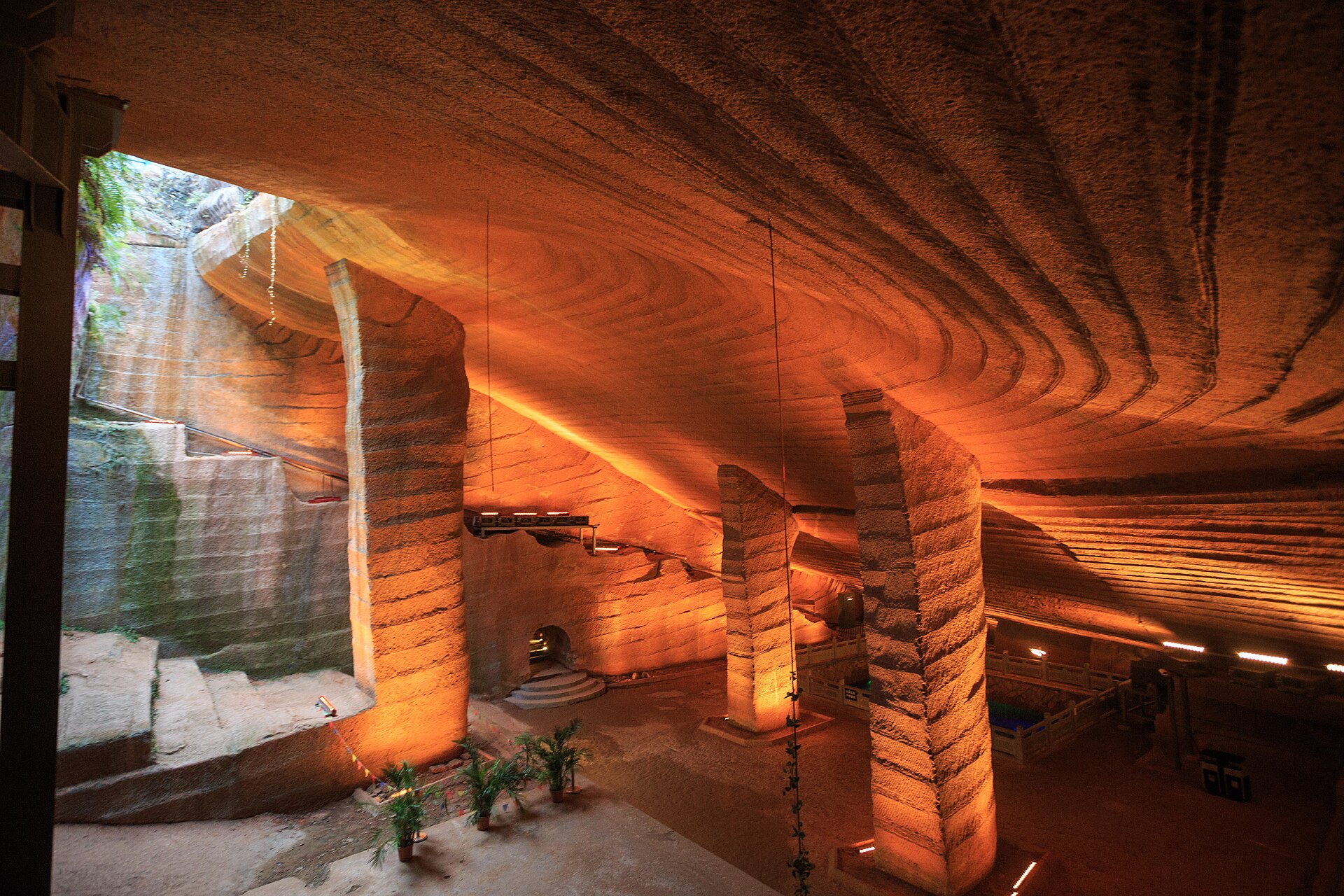
Photo: Zhangzhugang · CC BY-SA 4.0

In June 1992, farmers at Shiyan Beicun village near the Qu River decided to pump out a deep pond long rumoured to be bottomless. After seventeen days of pumping, they found not a pond but an enormous man-made cavern — and investigation soon revealed at least 24 more cut into the siltstone of Fenghuang Hill. Each cavern descends up to 30 metres, with ceilings supported by massive columns left in place, and covers up to about 2,000 square metres. Nearly every surface — walls, ceilings, pillars — is dressed with strikingly uniform bands of parallel chisel marks. The total excavation is estimated at close to a million cubic metres of rock, yet no historical document mentions the caves' construction, and no spoil heap has ever been identified.

See it on the globe →
The mainstream view

What archaeology says

Chinese researchers generally place the caverns before or around the Qin and Han dynasties. Pottery recovered from the silt has been dated to between 206 BC and AD 23, giving a minimum age of about two thousand years, and a 17th-century poem by Yu Xun shows the chambers were known (as the 'Xiaonanhai stone chambers') in later imperial times, when some served as Buddhist retreats. Short iron and steel chisels found in one cavern, together with the tool marks themselves, indicate the rock was quarried top-down in shallow layers by large organised workforces — entirely within the capabilities of Bronze and Iron Age China, which produced comparably vast projects from royal tombs to canals.

The genuine scholarly puzzle is purpose, not possibility. Hypotheses aired at Chinese symposiums and in the engineering literature include quarrying (the fine-grained siltstone was useful stone, and blocks could be barged away down the Qu River, which would explain the missing spoil), storage cellars, tomb complexes, and a military staging or concealment role — one popular suggestion links them to King Goujian of Yue hiding troops in the 5th century BC. A 2009 engineering study by Li and colleagues in Tunnelling and Underground Space Technology analysed the caverns' remarkable stability, showing the ancient builders maintained consistent wall angles, ceiling inclinations and pillar placement that modern rock mechanics endorses.

Archaeologists such as Yang Hongxun of the Chinese Academy of Social Sciences have acknowledged frankly that the site is anomalous: the investment of labour is enormous, the decorative-looking chiselling seems far beyond utilitarian need, and the total silence of the historical record for a project of this scale in literate China is genuinely odd. Mainstream opinion treats these as open research questions rather than reasons to abandon a conventional timeline.

Key evidence cited
  • Pottery in the cave silt dated to 206 BC – AD 23, giving a minimum two-thousand-year age
  • Iron and steel chisels found in one cavern, matching the tool marks
  • A 17th-century poem by Yu Xun showing the chambers were known in later imperial times
  • The 2009 Li et al. engineering study explaining the caverns' stability through consistent, skilled design
  • Parallels with other massive documented labour projects of Bronze and Iron Age China
The alternative view

What the skeptics propose

Alternative writers — the caves are a staple of Ancient Origins listicles and the Ancient Aliens television franchise — start from the same anomalies the academics concede. The parallel chisel bands run in uncannily even courses about 60 centimetres wide, set at a consistent 60-degree angle, across tens of thousands of square metres; to some eyes they resemble the step-over pattern of a mechanical cutting head more than hand work by torchlight. Proponents ask how the excavators lit the deep interiors (no soot layers from lamps or torches have been reported), how they surveyed chambers to keep walls between adjacent caverns parallel — some just 50 centimetres apart, without ever breaking through — and where a million cubic metres of stone went without leaving a trace in the landscape or the literature.

From these questions, the conclusions diverge. The strong version, aired on Ancient Aliens, invokes lost high technology or non-human assistance. Softer versions propose a forgotten pre-dynastic culture with organisational abilities out of step with the textbook narrative, or argue that the chiselling encodes symbolic or ritual information we can no longer read — noting its resemblance to markings on pottery of the region's Spring and Autumn period.

Sceptics reply that absence of records is unsurprising — pre-Qin documents from this region barely survive at all, and quarries rarely merited chronicles; that stone shipped away by river is exactly the kind of spoil that leaves no heap; that bamboo torches burn clean and light questions are arguments from ignorance; and that the chisel marks, impressive as they are, show the small irregularities of handwork when examined closely. The caves, they argue, are a monument to how much ancient labour could achieve and how much ancient history was simply never written down — not to lost machines.

Key evidence cited
  • Machine-like regularity of the parallel chisel bands across nearly every surface
  • No identified spoil heap for an estimated one million cubic metres of excavated rock
  • Complete absence of the caves from China's otherwise rich historical record
  • Walls between adjacent caverns kept parallel to within tight tolerances without break-throughs
  • No reported soot or lamp traces explaining how the deep interiors were lit

Genuinely open questions

  1. What were the caverns actually for — quarry, storage, tombs, troop concealment, or something else entirely?
  2. Why was every surface finished with laborious decorative chiselling far beyond structural need?
  3. How did the builders survey and light the chambers, and where did the excavated stone go?

Worth knowing

The villagers who found the first cavern in 1992 had to pump water out of the 'bottomless' pond for seventeen straight days before the chamber emerged — and locals had fished those ponds for generations with no idea what lay beneath.