Belief & Society · Xiangkhouang Plateau, Laos

Plain of Jars

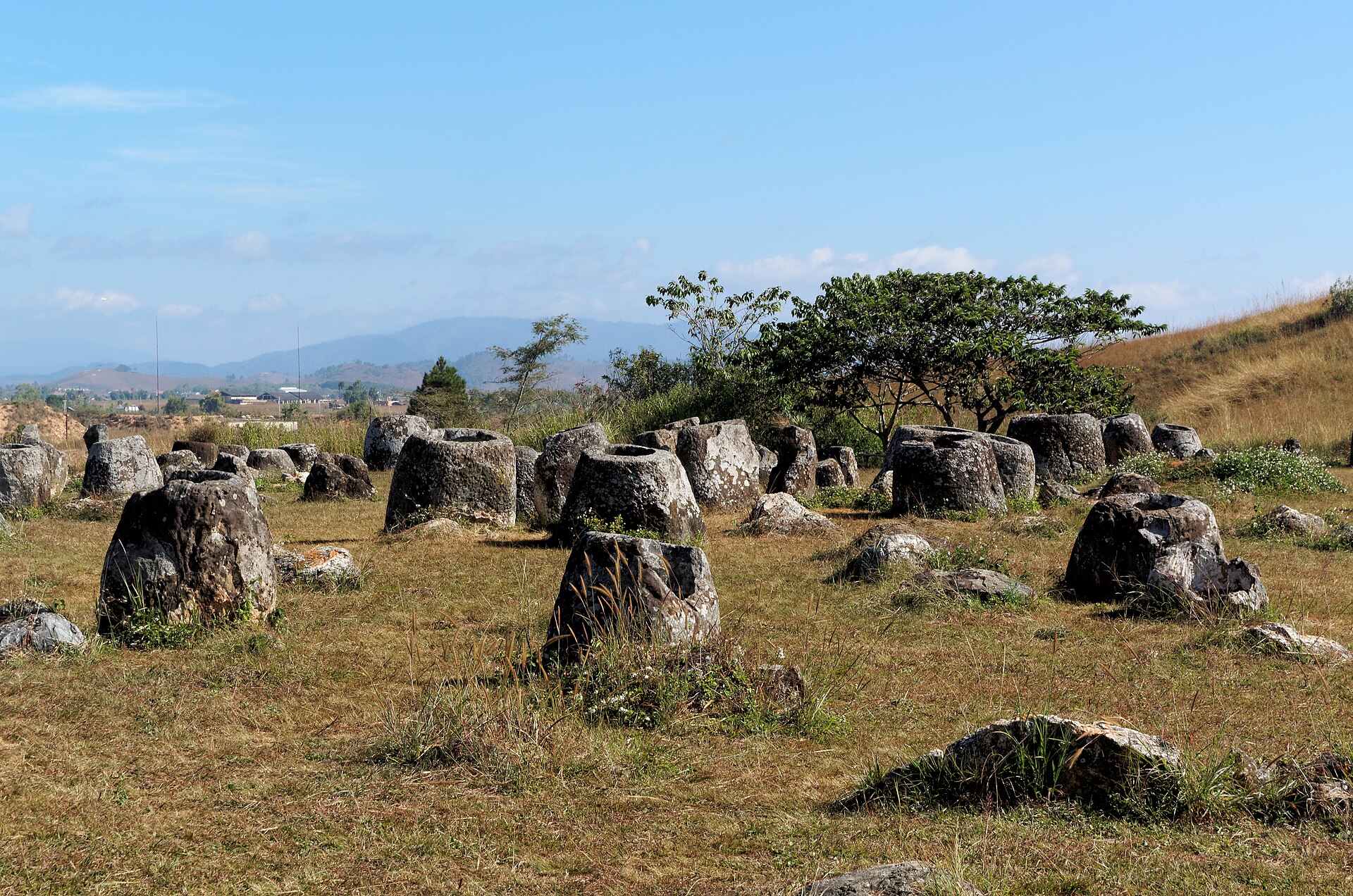
Thousands of giant stone jars scattered across a bomb-cratered plateau — cups of giants in legend, prehistoric mortuary vessels to science.

Mainstream: Jars placed c. 1240–660 BC (OSL dating); mortuary use continuing into the 9th–13th centuries ADAlternative: Date not seriously disputed — local legend instead attributes the jars to a race of giants, and sceptics ask who the makers really were and why the tradition vanished19.43°, 103.15°

At a glance

Plain of Jars
Photo: Jakub Hałun · CC BY-SA 4.0

Across the Xiangkhouang Plateau of upland Laos lie more than 2,100 megalithic stone jars, grouped in over 120 recorded sites, the largest standing about 3 metres tall and weighing many tonnes. Carved mostly from sandstone, the jars sit in clusters on hills and saddles, often with stone discs, burials and grave goods nearby. First systematically studied by French archaeologist Madeleine Colani in the 1930s, the sites were inscribed as a UNESCO World Heritage landscape in 2019. The plateau was also among the most heavily bombed places on Earth during the Vietnam War era, and unexploded ordnance still restricts research to cleared paths at many sites.

See it on the globe →
The mainstream view

What archaeology says

Colani's pioneering surveys concluded the jars were mortuary monuments of an Iron Age culture: she found burnt human teeth and bone, glass beads and a possible crematorium cave at Site 1. Modern excavations led by Dougald O'Reilly of the Australian National University, Louise Shewan of the University of Melbourne and Thonglith Luangkhoth of the Lao Department of Heritage from 2016 onward confirmed the funerary picture, uncovering primary burials, bundled secondary burials and interments in small ceramic vessels placed around the megalithic jars.

The long-standing dating problem was attacked with new methods in a 2021 PLOS ONE study. Optically stimulated luminescence on sediments sealed beneath the jars indicated they were hauled into position between roughly 1240 and 660 BC — the late second to early first millennium BC — while radiocarbon dates on the surrounding burials show the sites remained in ritual use for well over a thousand years, into the 9th–13th centuries AD. Detrital zircon geochronology matched the stone of the Site 1 jars to a quarry about 8 kilometres away, and at the quarry serving Site 2 half-hewn jars can still be seen in the living rock, documenting the carving process.

What remains genuinely unknown is who made them. No settlements of the jar-makers have been securely identified, the culture left no writing, and the striking parallels with megalithic jar fields in Assam, north-east India — 1,300 kilometres away, and also wrapped in local giant legends — hint at long-range cultural connections that researchers, including recent joint Indian-Australian fieldwork, are still trying to explain.

Key evidence cited
  • Colani's 1930s finds of burnt human bone, teeth and beads identifying the jars as mortuary monuments
  • 2016–2020 ANU–Melbourne–Lao excavations revealing primary, secondary and ceramic-jar burials around the megaliths
  • 2021 OSL dates placing jar emplacement at c. 1240–660 BC
  • Detrital zircon analysis matching Site 1 jars to a quarry about 8 km away, where half-carved jars remain
  • Radiocarbon dates showing continuous ritual use into the 9th–13th centuries AD
The alternative view

What the skeptics propose

Local tradition has never doubted who made the jars: giants. In the best-known Lao legend, the giant king Khun Cheung (Khun Jeuam) defeated a wicked rival after a long war and carved the enormous vessels to brew and store celebratory rice wine — lau hai — for his victorious army. Another strand of folklore holds that the jars collected monsoon rainwater for caravans, or that they are the drinking cups of a vanished race of enormous men. Alternative-history writers give these stories weight, arguing that giant legends attach to megalithic sites from Laos to Assam to the Andes too consistently to be coincidence, and that folk memory sometimes preserves real information — as it arguably did in placing the jars' makers deep in the past long before OSL dating agreed.

Fringe interpretations go further, folding the jars into a global lost-civilisation narrative: the sheer labour of quarrying, hollowing and moving multi-tonne stone vessels across kilometres of upland terrain is presented as evidence of forgotten engineering capability, and the absence of any identified settlement, name or written trace of the makers is read as the signature of a culture erased from history.

Mainstream researchers respond that nothing about the jars requires giants or lost technology: the quarries are local, unfinished jars show ordinary carving stages with iron tools, and an 8-kilometre haul of even the largest jar is well within the demonstrated capacity of organised Iron Age communities using sledges, rollers and manpower. The 'missing people', they note, are simply under-excavated — Laos remains one of the least archaeologically explored countries in Asia, not least because millions of unexploded bombs still make digging dangerous. The giant legends are treated respectfully as intangible heritage — UNESCO's listing cites them — but as mythology, not testimony.

Key evidence cited
  • The Khun Cheung legend of giants brewing victory rice wine in the jars
  • Recurring giant traditions attached to strikingly similar jar fields as far away as Assam, India
  • The engineering effort of hollowing and moving jars weighing up to 10–20 tonnes
  • No securely identified settlements, name or script of the jar-making culture
  • The jars' scale — the largest could comfortably hold a crouching adult human, or a giant's drink

Genuinely open questions

  1. Who were the jar-makers, and where did they live — why have their settlements not been found?
  2. What is the real relationship between the Lao jar fields and the similar megalithic jars of Assam?
  3. Were the jars primarily for exposing and decomposing the dead before secondary burial, as many researchers suspect?

Worth knowing

Xiangkhouang is among the most heavily bombed provinces on Earth — during the 'Secret War' more ordnance fell on Laos than on all of Europe in World War II — yet many jars survived, and visitors today must walk only between markers laid by bomb-clearance teams.