Ancient Engineering · Rapa Nui (Easter Island), Chile

Rapa Nui (Easter Island) & the Moai

Nearly a thousand giant statues on the world's most isolated inhabited island — which oral tradition says walked to their platforms.

Mainstream: Settled c. AD 1200; moai carved c. 1250–1600Alternative: Some propose a far older horizon — Robert Schoch has suggested parts of Rano Raraku could predate the end of the Ice Age-27.12°, -109.29°

At a glance

Rapa Nui (Easter Island) & the Moai
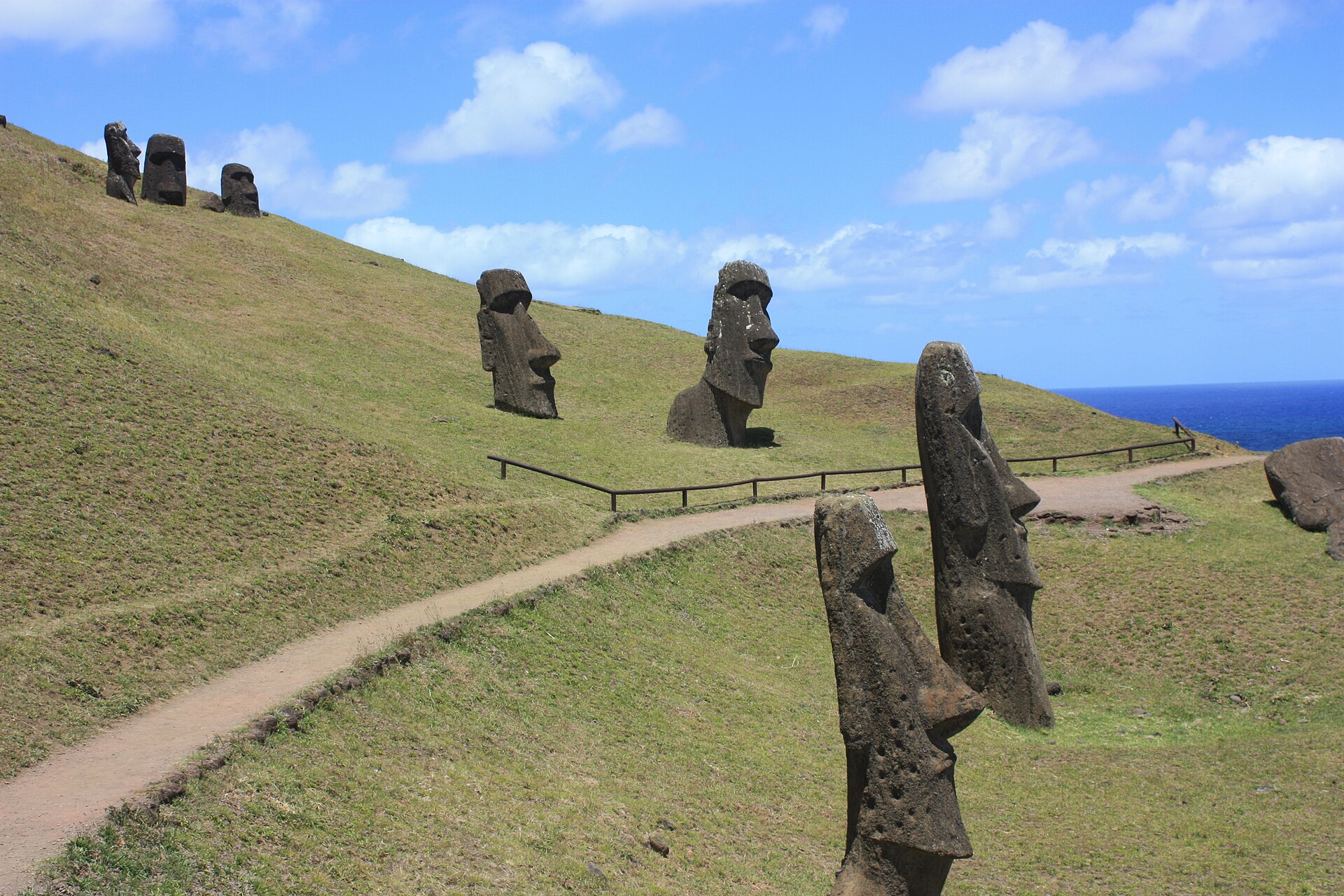
Photo: Arian Zwegers · CC BY 2.0

Rapa Nui, 3,500 kilometres off the Chilean coast, is the most remote permanently inhabited island on Earth — and its people carved nearly 1,000 moai, monolithic ancestor figures averaging 4 metres tall, with the largest erected weighing over 80 tonnes. About 95 per cent were quarried from the volcanic tuff of Rano Raraku crater, where 887 statues in every stage of completion still lie, including an unfinished giant 21.6 metres long. The moai were raised on ceremonial platforms (ahu) ringing the coast, eyes turned inland to watch over their communities. How they were moved, why carving stopped, and what happened to Rapa Nui society have fuelled a century of debate — with several long-running arguments dramatically reframed by research since 2012.

See it on the globe →
The mainstream view

What archaeology says

Archaeology and radiocarbon dating indicate Polynesian voyagers settled Rapa Nui around AD 1200, at the tail end of the great eastern Pacific expansion, and carved moai between roughly 1250 and 1600. The statues developed from wider Polynesian ancestor-figure traditions, and every stage of manufacture is documented in the quarry at Rano Raraku. On transport, the long-dominant image of statues hauled prone on wooden sledges (championed by Jo Anne Van Tilburg, who tested a sledge replica) has been strongly challenged by Carl Lipo and Terry Hunt's 'walking' hypothesis: moai abandoned along roads have wide D-shaped bases and a forward lean suited to being rocked upright side-to-side with ropes. In 2012 their team walked a 4.35-tonne replica 100 metres in 40 minutes with just 18 people, and a 2025 Journal of Archaeological Science study added physics modelling, 3D analysis of 962 statues and road evidence, answering critics point by point. Rapa Nui oral tradition always said the moai walked.

The 'ecocide' narrative — popularised by Jared Diamond's Collapse (2005), in which islanders felled every tree, triggered war, famine and demographic catastrophe, toppling their own statues — has fared badly. Hunt and Lipo argued in The Statues that Walked (2011) that deforestation was driven substantially by introduced Polynesian rats eating palm seeds, that there is little evidence of pre-European warfare (the obsidian 'spearpoints', mata'a, are mostly general-purpose tools), and that islanders farmed the poor soils ingeniously with rock-mulch gardens. A 2024 satellite study of those gardens suggested the island supported a modest, stable population of around 3,000–4,000 rather than a boom-and-bust of tens of thousands.

Ancient DNA delivered the strongest blow: a 2024 Nature study of 15 historical Rapanui genomes by Moreno-Mayar and colleagues found no genetic bottleneck in the 1600s — the population grew steadily from settlement until the 1860s, when Peruvian slave raids and introduced disease removed a third of the islanders. The same study confirmed about 10 per cent Native American ancestry entering the gene pool around 1250–1430, evidence of pre-European contact between Polynesia and the Americas. The real collapse, researchers conclude, was colonial, not ecological suicide.

Key evidence cited
  • Radiocarbon dates placing settlement c. AD 1200 and moai carving c. 1250–1600
  • 887 moai in every production stage at Rano Raraku, documenting manufacture
  • The 2012 and 2025 walking-moai experiments: 18 people moved a 4.35-tonne replica 100 m in 40 minutes
  • 2024 Nature ancient-DNA study showing steady population growth and no 17th-century collapse
  • Rock-mulch garden surveys indicating a stable population of roughly 3,000–4,000
The alternative view

What the skeptics propose

Easter Island has attracted alternative theories longer than almost any site. Thor Heyerdahl famously argued the island was first civilised from South America, sailing the balsa raft Kon-Tiki from Peru in 1947 to prove the voyage possible, and pointing to the finely fitted basalt masonry of Ahu Vinapu, which he compared to Inca walls at Cuzco. Genetics has since shown the population is emphatically Polynesian — yet the 2024 discovery of genuine pre-European Native American admixture means Heyerdahl's core intuition of trans-Pacific contact was not entirely wrong, even if he had the direction and the protagonists reversed.

Geologist Robert Schoch, of Sphinx water-erosion fame, has raised the more radical possibility that some moai are far older than accepted: statues at Rano Raraku stand buried up to their shoulders in metres of sediment, which he suggests may represent many millennia of accumulation, and he sees possible extreme weathering consistent with an origin before the end of the last Ice Age. Graham Hancock has sympathetically aired the idea, folding Rapa Nui into his lost-civilisation survey as a possible outpost of pre-cataclysm seafarers, and pointing to the island's rongorongo script — one of very few independent writing systems, still undeciphered — as a hint of a deeper heritage.

Mainstream researchers reply that the sediment burying the quarry moai is not slow natural deposition but rapid slopewash of quarrying spoil from the crater walls above, that excavated statues show iron-hard consistency with 13th–17th-century carving, and that radiocarbon dates from the island show no trace of human presence before about AD 1100–1200 — on an island so small that earlier occupation could hardly hide. Rongorongo, meanwhile, is generally thought to be a post-European-contact invention inspired by seeing Spanish writing in 1770, though 2024 radiocarbon dating of one tablet's wood to the 15th century has reopened that question intriguingly.

Key evidence cited
  • Heyerdahl's Kon-Tiki voyage and the Inca-like fitted masonry of Ahu Vinapu
  • Genuine pre-European Native American ancestry (c. 10 per cent) confirmed in Rapanui genomes
  • Schoch's argument that deep sediment burial at Rano Raraku implies great age
  • The undeciphered rongorongo script, with one tablet's wood recently dated to the 15th century
  • Oral traditions of moai moved by mana — supernatural power — rather than muscle

Genuinely open questions

  1. Where and when did Polynesians and Native Americans actually meet — on Rapa Nui, in South America, or elsewhere in the Pacific?
  2. Is rongorongo a true pre-contact writing system, and can it ever be deciphered?
  3. Why did moai carving stop, and what exactly toppled the statues between European visits?

Worth knowing

Rapa Nui oral tradition always insisted the moai 'walked' to their platforms, commanded by chiefs wielding mana — and in 2012 archaeologists rocked a 4.35-tonne replica down a road exactly as the legends describe, upright and swaying step by step.