Ancient Engineering · Rapa Nui (Easter Island), Chile

Ahu Vinapu, Easter Island

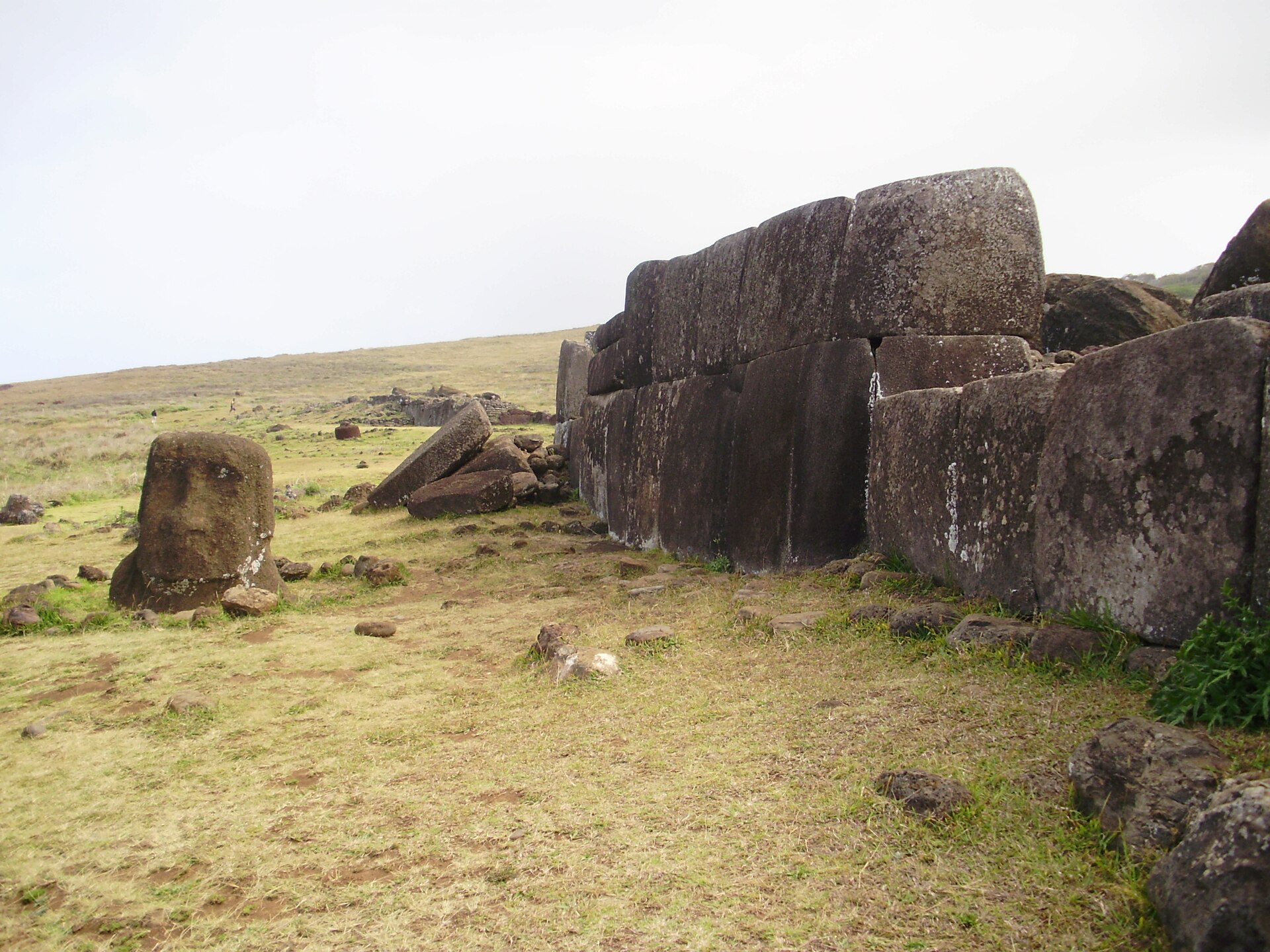
The Easter Island wall that looks unmistakably Inca — the single stone monument that launched Thor Heyerdahl's whole theory of contact from the east.

Mainstream: c. AD 1400–1600 (finest wall dated to c. AD 1516)Alternative: Not radically re-dated, but claimed by Heyerdahl as evidence of much earlier South American contact-27.18°, -109.41°

At a glance

Ahu Vinapu, Easter Island
Photo: Jorge Morales Piderit · CC0 1.0

Ahu Vinapu is a ceremonial platform complex on the south coast of Rapa Nui, near the airport at Hanga Roa. It is famous not for its moai — which stood here as elsewhere — but for one wall. The seaward face of the platform known as Ahu Vinapu 1 (also called Ahu Tahira) is built from large, carefully dressed basalt slabs fitted together with fine mortarless joints, an effect so strikingly like the polygonal precision masonry of Cusco and Sacsayhuamán in Peru that visitors and scholars alike have long done a double-take. For Thor Heyerdahl this single wall was decisive evidence, and Vinapu became ground zero for the century-long argument over whether Rapa Nui's culture flowed only from Polynesia to the west or also from South America to the east.

See it on the globe →
The mainstream view

What archaeology says

The archaeological consensus is that Rapa Nui was settled by Polynesian voyagers from the west, most likely from the Mangareva or Marquesas region, around AD 1200, and that its monumental culture — moai, ahu and the fitted stonework of Vinapu — developed locally on the island rather than being imported from the Andes. The Norwegian archaeologist Arne Skjolsvold and others who excavated Vinapu found that the celebrated fine-fitted Ahu Vinapu 1 wall is relatively late (dated to around AD 1516), while the rougher, upright-slab facing of the neighbouring Ahu Vinapu 2 is actually earlier (around AD 857). That sequence runs directly opposite to what a South American import model predicts: the 'Inca-looking' refinement is an endpoint of local evolution, not a founding template.

Scholars also stress that the resemblance to Andean masonry is superficial. The Vinapu wall is a facing veneer of dressed slabs over a rubble-and-earth core, not the solid interlocking polygonal blocks of Sacsayhuamán, and the two traditions arrive at a similar look by different means. The genetic and linguistic evidence points overwhelmingly to a Polynesian founding population. A 2024 ancient-DNA study of Rapanui individuals, together with earlier work, confirms the islanders are Polynesian in origin — while also detecting a genuine but minor Native American genetic contribution (around ten per cent), which most researchers interpret as the trace of a contact event somewhere in the eastern Pacific, not as evidence that South Americans built Vinapu.

Key evidence cited
  • Radiocarbon dating placing the fine Vinapu 1 wall late (c. AD 1516), after the rougher Vinapu 2 (c. AD 857)
  • The wall being a dressed-slab veneer over rubble, structurally unlike solid Andean polygonal masonry
  • Overwhelmingly Polynesian genetics and language among the Rapanui
  • A 2024 ancient-DNA study confirming Polynesian origin with only minor Native American admixture
  • A clear local developmental sequence for ahu and stonework on the island
The alternative view

What the skeptics propose

Thor Heyerdahl made Ahu Vinapu the cornerstone of his South American contact theory. To him the fitted wall was unmistakably Andean in conception, echoing the pre-Inca masonry of Tiahuanaco and the walls of Cusco, and he argued it could not be coincidence that the finest stonework on the world's most isolated island so closely mirrored the finest stonework of the nearest continent to windward. Heyerdahl proposed that Rapa Nui and eastern Polynesia were reached, at least in part, by seafarers from South America — a case he dramatised with the 1947 Kon-Tiki raft voyage, which showed that a balsa craft could in principle drift from Peru into Polynesia on wind and current. On his reading, Vinapu 1 belonged to an early, skilled building phase later rebuilt by less capable hands, the reverse of the orthodox chronology.

Heyerdahl's specific diffusionist model has not survived as mainstream archaeology, but his central intuition — that there was real contact across the eastern Pacific — has aged far better than his critics once expected. The recurring discovery that the sweet potato, an American cultivar, was grown across pre-contact Polynesia, and the modern genetic detection of Native American ancestry in Rapanui and other Polynesians dated to before European arrival, both vindicate the idea that Polynesians and Americans met. Supporters of Heyerdahl's broad vision argue that the establishment was too quick to dismiss him wholesale, and that Vinapu's Andean 'flavour', while no longer taken as proof of South American masons, sits comfortably alongside the now-accepted picture of trans-Pacific contact.

Key evidence cited
  • The striking visual likeness of the Vinapu 1 wall to Cusco and Tiahuanaco masonry (Heyerdahl)
  • The Kon-Tiki voyage demonstrating a Peru-to-Polynesia raft crossing is feasible
  • The pre-contact spread of the American sweet potato across Polynesia
  • Genetically detected pre-European Native American ancestry in Rapanui and other Polynesians
  • Heyerdahl's claim that Vinapu 1 was an early skilled phase later rebuilt more crudely

Genuinely open questions

  1. Did the fine Vinapu masonry arise purely locally, or does its Andean look reflect a real transfer of ideas?
  2. Where and when did the documented Polynesian–Native American contact actually take place?
  3. Why does the island's finest fitted wall date later than its rougher neighbour, opposite to Heyerdahl's model?

Worth knowing

Heyerdahl was so sure Vinapu proved contact from the east that he sailed the balsa raft Kon-Tiki 6,900 kilometres from Peru into Polynesia in 1947 just to prove such a voyage was possible — the resemblance of one wall helped launch one of the twentieth century's most famous expeditions.