What archaeology says
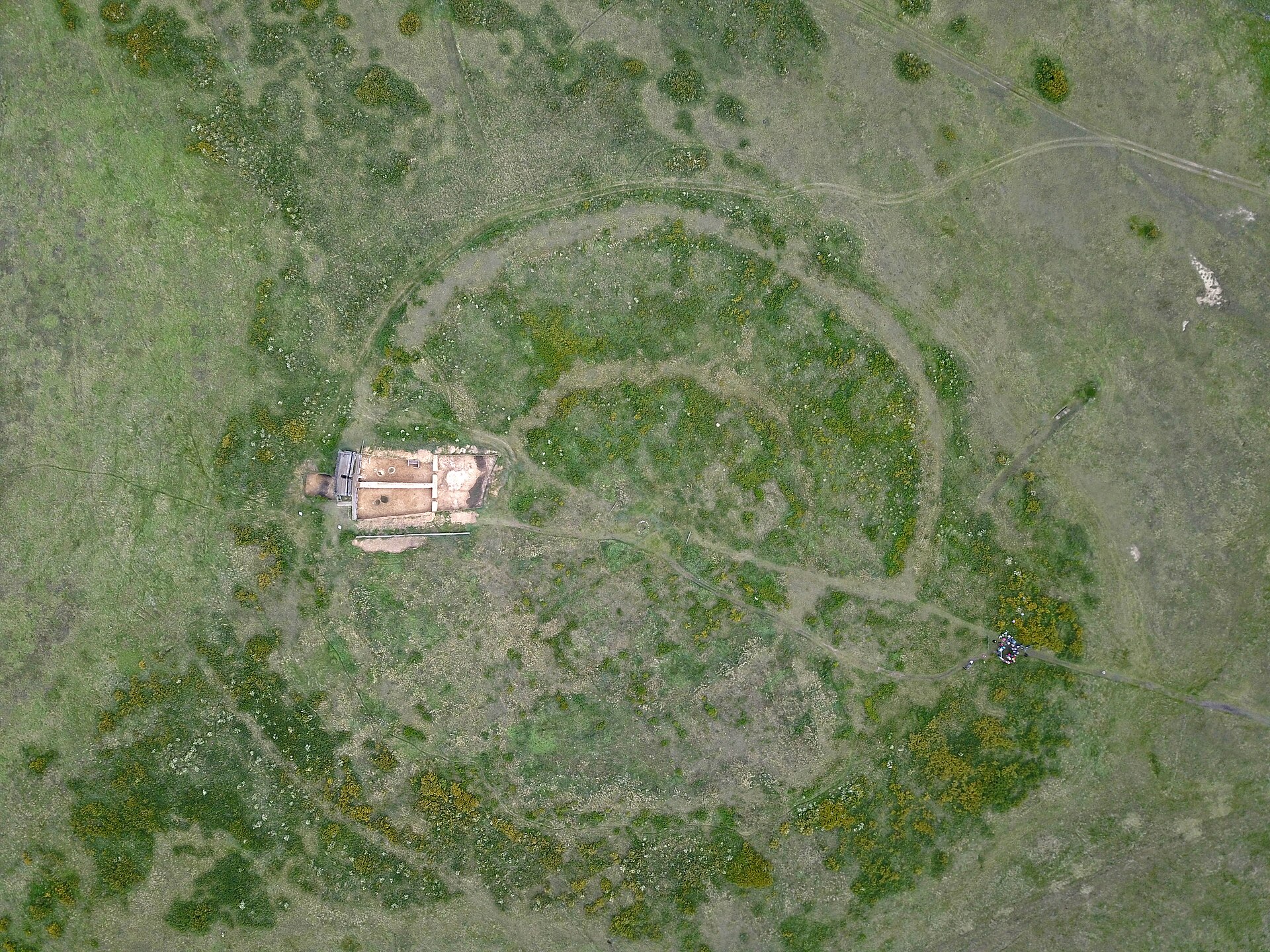
Excavations led by Gennady Zdanovich of Chelyabinsk State University from 1987 revealed a remarkably planned settlement occupied for perhaps one to two centuries around 2050–1900 BC, then deliberately burned and abandoned — apparently by its own inhabitants, since almost no valuables were left behind. The layout is highly standardised: trapezoidal houses share party walls in two concentric rings, drainage gutters run beneath a circular street, and the four entrances align roughly with the cardinal points. Radiocarbon dates, metalwork, ceramics and the associated Sintashta cemeteries anchor the chronology firmly in the Middle Bronze Age.
Arkaim matters enormously to mainstream prehistory because the Sintashta culture is the leading candidate for the speakers of Proto-Indo-Iranian — the ancestral tongue of Sanskrit and Avestan. Sintashta graves at neighbouring sites contain the earliest known spoke-wheeled chariots (c. 2000 BC), sacrificed horses and advanced bronze weaponry, and the culture's intensive copper metallurgy appears to be what the fortified towns were organised around. Genetic and linguistic evidence ties Sintashta to eastward migrations from the Corded Ware horizon of Europe, and its descendants (the Andronovo horizon) spread across the steppe towards Iran and India. In that limited sense, Arkaim genuinely is connected to the peoples later called Aryans — a linguistic label the site's political admirers have inflated far beyond the evidence.
The site's survival is itself a landmark: public campaigning by Zdanovich and others forced the cancellation of the Bolshekaragansky reservoir in 1991 — almost unheard of in the late Soviet Union — and Arkaim became a protected museum-reserve. Researchers continue to debate what the settlement actually was: a town, a ceremonial centre, a metallurgical factory-fort, or all three; only about half the site has been excavated, the rest deliberately left for future methods.
- Radiocarbon dates and Sintashta ceramics placing occupation at c. 2050–1900 BC
- Standardised ring-plan architecture with wells, hearths and metallurgical furnaces in nearly every dwelling
- Earliest known spoke-wheeled chariots (c. 2000 BC) in burials of the same culture nearby
- Genetic and linguistic evidence linking Sintashta to Proto-Indo-Iranian speakers and Corded Ware ancestry
- More than twenty similar fortified 'Country of Towns' settlements across the Southern Urals