Origins of Civilisation · Tabasco, Mexico

La Venta & the Olmec Colossal Heads

Mesoamerica's possible 'mother culture' — and the battleground for one of archaeology's most heated identity debates.

Mainstream: c. 1200–400 BC (apogee c. 900–400 BC)Alternative: Date not seriously disputed — diffusionists instead argue the Olmec were shaped by African or other Old World visitors, a claim archaeology firmly rejects18.10°, -94.04°

At a glance

La Venta & the Olmec Colossal Heads
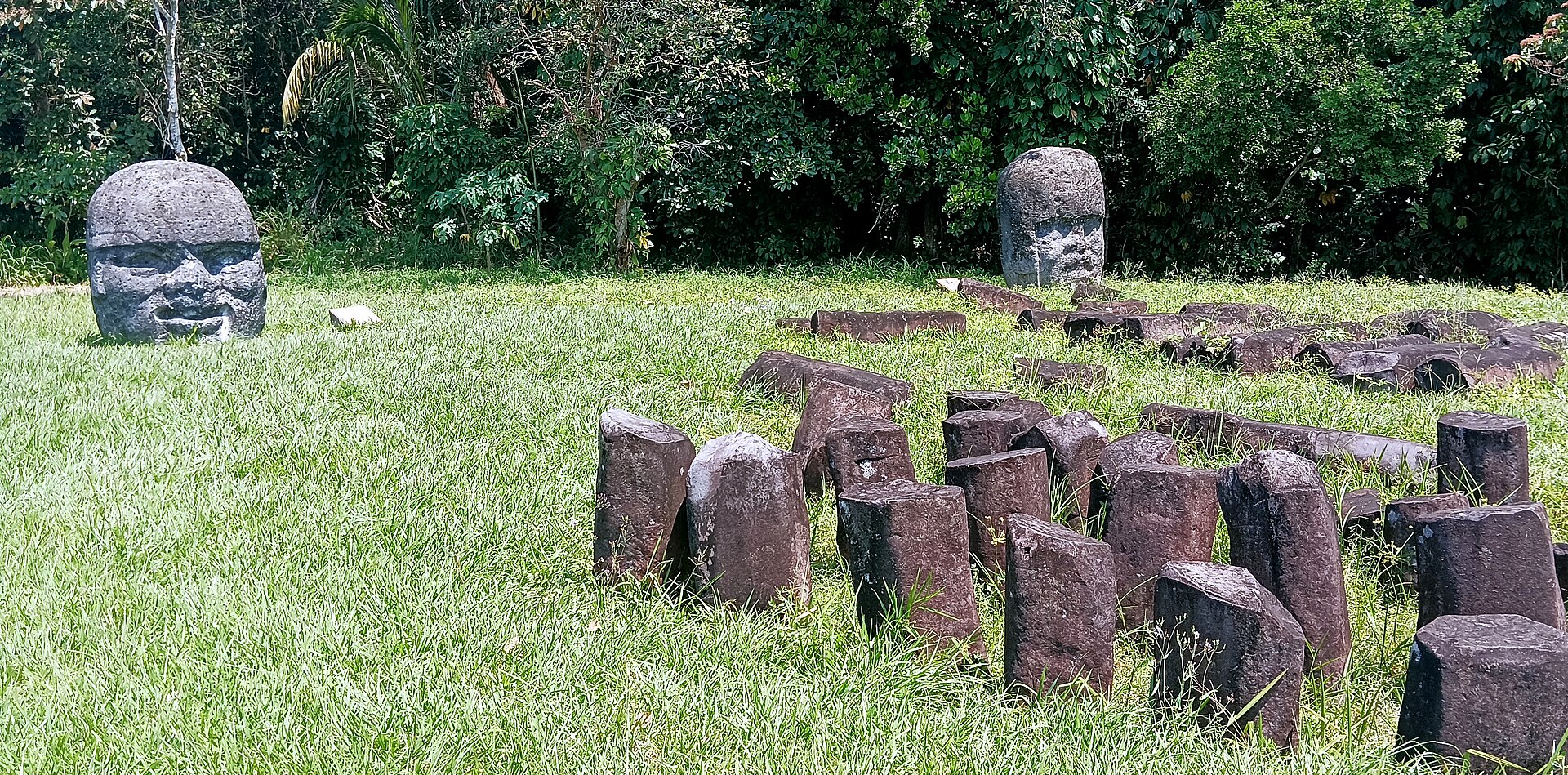
Photo: Mario E. Fuente Cid · CC BY 4.0

La Venta, on a low island of high ground amid the wetlands of Tabasco near the Gulf of Mexico, was the greatest Olmec centre of its day. Its Great Pyramid (Complex C) is a clay mound some 34 metres high containing an estimated 100,000 cubic metres of earth fill, and its ceremonial court, Complex A, concealed some of the strangest buried treasures in the ancient Americas — including three huge mosaic pavements of polished serpentine blocks, each deliberately entombed almost as soon as it was laid. Four colossal basalt heads, up to 2.8 metres tall, stood at the site; seventeen such heads are now known across the Olmec heartland. The Olmec are the earliest complex culture of Mesoamerica, and everything from later writing to the calendar and the ballgame has been argued to trace back to them.

See it on the globe →
The mainstream view

What archaeology says

The Olmec were effectively rediscovered by Matthew Stirling, whose excavations at La Venta and Tres Zapotes between 1940 and 1943 (with Philip Drucker and Waldo Wedel, backed by the National Geographic Society) convinced a sceptical field that a sophisticated civilisation had flourished on the Gulf Coast long before the Maya. Radiocarbon dates published after Drucker's 1955 season bracketed La Venta's main occupation to roughly 900–400 BC, with the wider Olmec tradition beginning at San Lorenzo by about 1400–1200 BC. At a 1942 conference, Mexican archaeologist Alfonso Caso famously declared the Olmec the 'cultura madre' — mother culture — of Mesoamerica; scholars such as Kent Flannery and Joyce Marcus have since argued for 'sister cultures' developing in parallel, and that debate remains genuinely open within the discipline.

The colossal heads themselves are read as portraits of individual rulers, each wearing a distinctive helmet-like headgear, some apparently recarved from earlier throne monuments. The basalt came from the Cerro Cintepec area of the Tuxtla Mountains, in some cases moved 80–100 kilometres, presumably by raft and roller — a staggering logistical feat for a society without draught animals or the wheel. Complex A's buried offerings, including Massive Offering 3 with its 50 tonnes of finished serpentine sealed under thousands of tonnes of clay, show organised labour and ritual on a grand scale. On the question of who the Olmec were, the evidence is unambiguous to archaeologists: their art, iconography and material culture are continuous with earlier local traditions, and the living peoples of the Gulf Coast region share the broad facial features carved on the heads.

Key evidence cited
  • Radiocarbon dates from La Venta and San Lorenzo placing the Olmec centuries before any proposed Old World contact
  • Continuous local development of Olmec art and settlement from earlier Gulf Coast cultures
  • Basalt sourced to the Tuxtla Mountains and worked with local techniques, some heads recarved from Olmec thrones
  • No African artefact ever found in a controlled excavation in the pre-Columbian Americas
  • No pre-Columbian African DNA detected in studies of Native American populations
The alternative view

What the skeptics propose

Claims that the colossal heads depict Africans go back to 1862, when José Melgar, who saw the first head found at Tres Zapotes, described it as 'Ethiopian'. The argument was revived most influentially by Rutgers professor Ivan Van Sertima in his 1976 bestseller They Came Before Columbus, which proposed that Nubian-Egyptian voyagers of the 25th Dynasty (c. 700 BC) reached the Gulf Coast, were received as royalty, and left their stamp on Olmec civilisation — citing the 'Negroid' features of the heads, alleged Egyptian parallels in pyramid-building and mummification, and supposed pre-Columbian transfers of plants such as cotton and the bottle gourd. The book became a landmark of the Afrocentrist movement and remains in print.

Mainstream archaeology's rebuttal has been unusually thorough. A detailed 1997 critique in Current Anthropology by Gabriel Haslip-Viera, Bernard Ortiz de Montellano and Warren Barbour concluded the proposal was 'without foundation': the colossal heads were carved centuries before the 25th Dynasty existed, no genuine African artefact has ever been recovered from a controlled excavation anywhere in the pre-Columbian Americas, and the heads' features match the indigenous peoples of the region rather than any imported population. Botanists note the bottle gourd crossed the ocean far too early for human agency of the kind proposed, and genetic studies of Native American populations show no trace of pre-Columbian African admixture. Critics also point out the claim writes Native Americans out of their own achievements. Van Sertima defended his thesis until his death in 2009, and his supporters argue the academy dismissed him too quickly — but no new supporting evidence has emerged in half a century.

Key evidence cited
  • Facial features of the colossal heads that Melgar (1862) and Van Sertima (1976) read as African
  • Van Sertima's claimed parallels between Olmec and Egyptian-Nubian kingship, pyramids and ritual
  • Alleged pre-Columbian presence of Old World plants such as cotton and the bottle gourd
  • Olmec civilisation's seemingly rapid florescence on the Gulf Coast, read by diffusionists as external stimulus
  • A long folk tradition, predating modern archaeology, of seeing the heads as 'foreign' faces

Genuinely open questions

  1. Was Olmec culture the 'mother culture' of Mesoamerica, or one of several interacting sister cultures?
  2. How exactly were multi-tonne basalt boulders moved 80–100 kilometres through swamp and river country?
  3. Why were La Venta's serpentine mosaic pavements and massive offerings buried immediately after completion?

Worth knowing

Several colossal heads appear to be recycled royal furniture — carved from older 'altar' thrones, meaning a dead ruler's seat of power could be literally reshaped into his portrait.