Ancient Engineering · San Juan Teotihuacán, Mexico

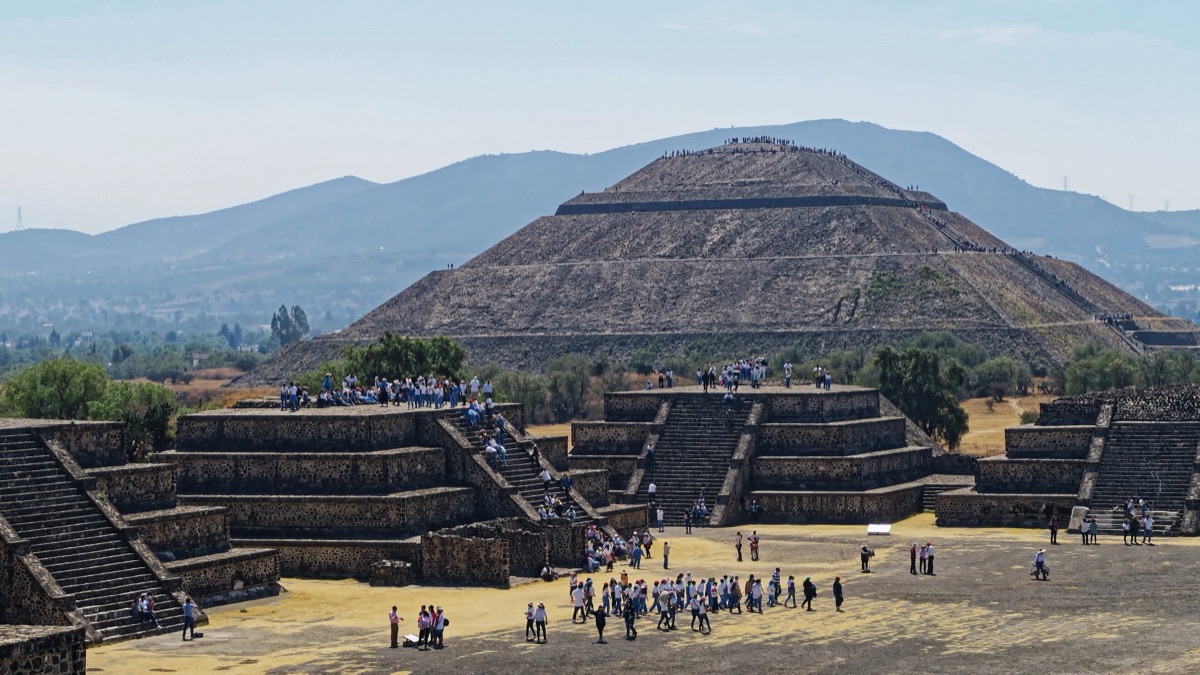
Teotihuacan (Pyramid of the Sun)

A city so old and anonymous that even the Aztecs found it in ruins and called it 'the place where the gods were made'.

Mainstream: c. AD 100–250 (Pyramid of the Sun completed c. AD 200)Alternative: Founding by a far older 'lost civilisation' proposed by some; others dispute the city's mathematical design as beyond its builders19.69°, -98.84°

At a glance

Teotihuacan (Pyramid of the Sun)
Photo: Wikimedia Commons

Teotihuacan, about 40 km northeast of Mexico City, was the largest city in the pre-Columbian Americas, home to perhaps 100,000–125,000 people at its peak around AD 450. Its ceremonial core is organised along the 2.5-km 'Avenue of the Dead', dominated by the Pyramid of the Sun — roughly 65 metres tall and about 220 metres per side, one of the largest pyramids ever built — along with the Pyramid of the Moon and the Feathered Serpent Pyramid. The identity of its builders, who left no deciphered writing system, remains one of Mesoamerica's great puzzles.

See it on the globe →
The mainstream view

What archaeology says

Archaeologists date the city's rise to the first centuries AD through radiocarbon dating, ceramic sequences and stratigraphy: the Pyramid of the Sun was raised in essentially one massive effort of rubble, adobe and volcanic stone around AD 200, over an earlier man-made tunnel-and-chamber system. The city was a planned metropolis with apartment compounds, obsidian workshops, and neighbourhoods of foreigners from Oaxaca, the Gulf Coast and the Maya region, attested by burials, pottery and isotope studies of skeletons. Sacrificial burials with military regalia found inside the Feathered Serpent Pyramid and Pyramid of the Moon anchor construction dates and reveal a powerful, expansionist state.

Because the Teotihuacanos left no readable texts, their ethnicity and language are unknown; the name 'Teotihuacan' is Aztec, applied a millennium after the city burned and was abandoned around AD 550–650. Excavations continue to produce spectacular finds: from 2003 Sergio Gómez explored a sealed tunnel beneath the Feathered Serpent Pyramid, uncovering tens of thousands of offerings, walls dusted with pyrite to glitter like stars, and pools of liquid mercury — likely a symbolic underworld river. The city's 15.5-degree skew from cardinal orientation is understood as an astronomical/calendrical alignment tied to horizon events and sacred mountains.

Key evidence cited
  • Radiocarbon dates and ceramic stratigraphy placing construction in the first centuries AD
  • Dedicatory sacrificial burials inside the pyramids anchoring building phases
  • Isotope studies showing a cosmopolitan population of known Mesoamerican regions
  • Continuity of Mesoamerican religious iconography (Storm God, Feathered Serpent)
  • The sealed Feathered Serpent tunnel's offerings dating to the city's documented era
The alternative view

What the skeptics propose

Graham Hancock, in 'Fingerprints of the Gods', argued Teotihuacan encodes sophisticated lost knowledge: he cites claims (following Hugh Harleston Jr.) that the Avenue of the Dead lays out a scale model of the solar system's orbital distances, that the Pyramid of the Sun's base-to-height ratio incorporates pi with high accuracy, and that the city's layout parallels Giza's — suggesting both inherited a template from an Ice Age civilisation. He and others also note the legend of Quetzalcoatl, a civilising god said to have arrived from elsewhere, as a memory of survivors bringing knowledge to Mesoamerica.

Proponents point to physical curiosities: thick sheets of mica — a mineral sourced hundreds or thousands of kilometres away, possibly Brazil — found sandwiched invisibly within structures, which writers like Hancock suggest served a technological (insulating) rather than decorative purpose, since it could not be seen. They also emphasise that no one knows who built the city, leaving room, they argue, for a much older origin than archaeology allows.

Mainstream scholars reply that the planet-spacing and pi claims rely on selective unit choices ('Hunabs') not supported by Mesoamerican metrology, that mica had ritual value precisely because it was buried, and that radiocarbon and ceramic evidence leaves no gap for a vastly older city. The Giza parallel is dismissed as pattern-seeking between two three-pyramid groups. But scholars agree the builders' identity, the meaning of the mica, and the city's precise astronomical scheme remain genuinely open research questions.

Key evidence cited
  • Harleston's claimed solar-system proportions along the Avenue of the Dead
  • Pi-like ratios claimed in the Pyramid of the Sun's dimensions
  • Concealed mica sheets from distant sources built invisibly into structures
  • The builders' unknown identity and the Aztecs' belief the city was divine and ancient
  • Claimed layout parallels between Teotihuacan and Giza (Hancock)

Genuinely open questions

  1. Who were the Teotihuacanos, and what language did they speak?
  2. What was the purpose of the mica deposits and the liquid mercury beneath the Feathered Serpent Pyramid?
  3. Why was the city violently burned and abandoned around AD 550–650?

Worth knowing

Archaeologists found pools of shimmering liquid mercury and walls glittering with pyrite dust in a tunnel sealed beneath the Feathered Serpent Pyramid for nearly 1,800 years — possibly a miniature cosmos with rivers of the underworld.