Ancient Engineering · Mexico City, Mexico

Cuicuilco Circular Pyramid

A circular pyramid entombed in lava on the edge of Mexico City — and the source of a century-old dating feud.

Mainstream: c. 800–600 BC (first construction; buried by the Xitle eruption c. AD 245–315)Alternative: c. 6500 BC (Byron Cummings' 1920s sediment estimate, revived by Charles Hapgood and cited by Graham Hancock)19.30°, -99.18°

At a glance

Cuicuilco Circular Pyramid
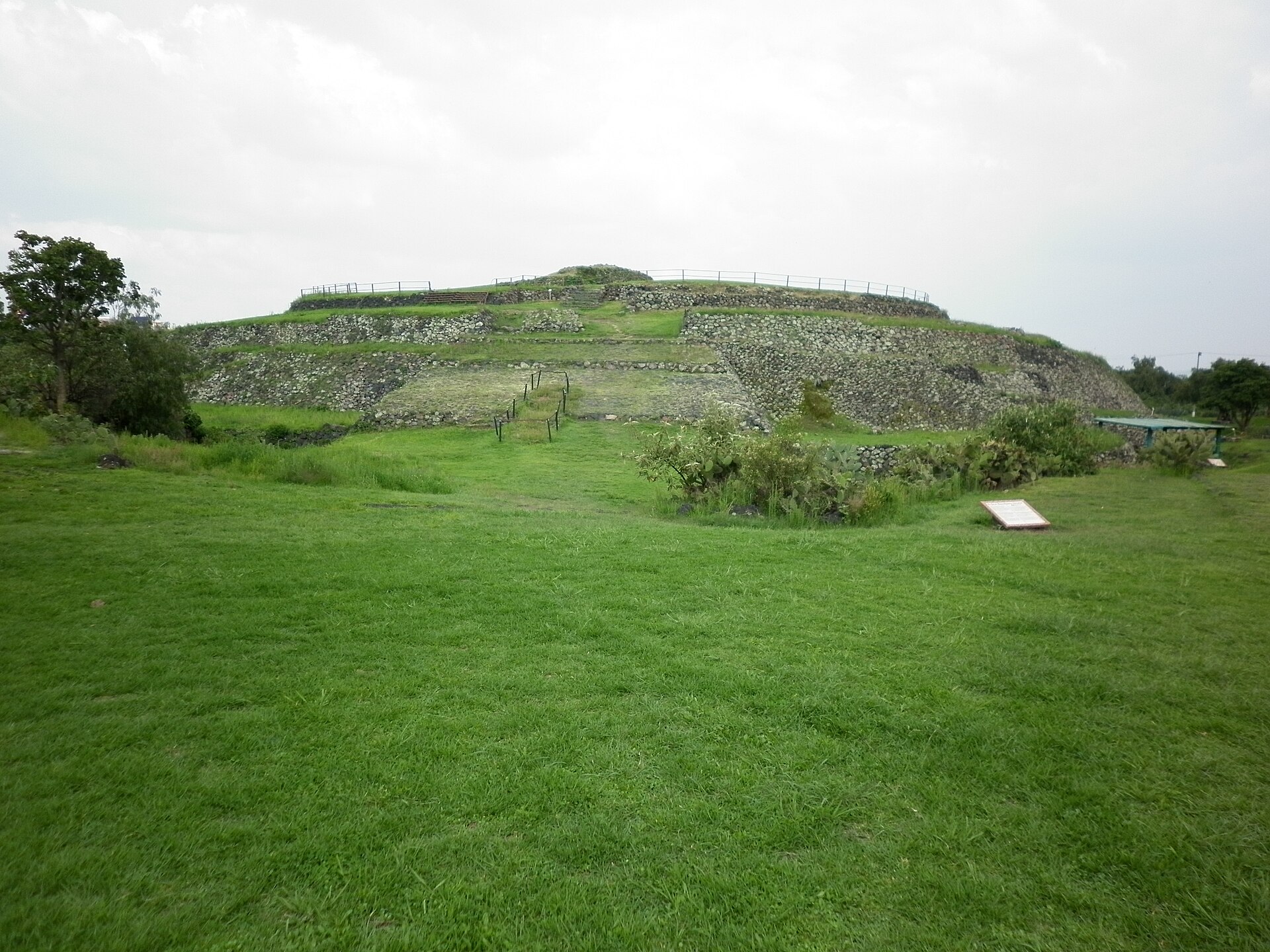
Photo: Rafael Aparicio · CC BY-SA 3.0

Cuicuilco is one of the oldest major ceremonial centres of the Valley of Mexico: a truncated circular pyramid about 110 metres across and originally some 18 metres high, built of earth and river cobbles in concentric tiers, with ramps and stairways rising to summit altars. It was the heart of a town of perhaps 20,000 people that dominated the southern lake basin centuries before Teotihuacan rose. Its fate was extraordinary: the nearby Xitle volcano erupted early in the first millennium AD, and the Pedregal lava flow buried the city — lapping around the great pyramid itself — sealing the site under metres of basalt on which the southern suburbs of Mexico City now stand. Excavators in the 1920s had to blast through the lava with dynamite to reach it.

See it on the globe →
The mainstream view

What archaeology says

Cuicuilco was excavated from 1922 by Byron Cummings of the University of Arizona (with Manuel Gamio), and later by Eduardo Noguera and, in the 1960s, Heizer and Bennyhoff. The modern consensus, built on stratified ceramics and repeated radiocarbon campaigns, is that the pyramid was first raised around 800–600 BC in the Late Preclassic, enlarged in several stages to its final four-tiered form, and that Cuicuilco declined — probably in the face of Teotihuacan's rise, and possibly harried by ashfalls from Popocatépetl — before being definitively entombed by Xitle. A careful geological study by Claus Siebe (2000) radiocarbon-dated charcoal from directly beneath the lava to about 1,670 years before present, placing the eruption around AD 245–315 — and showing the city was largely abandoned before the lava came. The eruption's main victim was memory: Cuicuilco's refugees are thought to have swelled early Teotihuacan.

The site matters to archaeology as a 'missing link': its circular, tiered monumentality shows that large-scale civic-ceremonial construction was under way in the Basin of Mexico centuries before Teotihuacan, and its abandonment illustrates how volcanism repeatedly redirected Mesoamerican history. Salvage work since the 1990s — the site is now hemmed in by a shopping centre, office towers and the Olympic Village of 1968, whose construction destroyed outlying mounds — continues to refine the sequence, and a second radiocarbon series in the 1990s confirmed the conventional dates.

Key evidence cited
  • Radiocarbon dates on the sub-lava sediments (c. 2,200 BP maximum), redone and confirmed in the 1990s
  • Siebe's 2000 study dating the Xitle eruption to c. AD 245–315 from charcoal sealed beneath the lava
  • Standard Late Preclassic ceramics throughout the construction fills and occupation layers
  • Evidence the city was already declining before the eruption, consistent with Teotihuacan's contemporaneous rise
  • Architectural parallels with other Preclassic circular platforms in central and western Mexico
The alternative view

What the skeptics propose

Cuicuilco is a founding text of alternative prehistory, and unusually, the heresy began with the excavator himself. Geologist George E. Hyde had estimated the Pedregal lava at 7,000 years old, and Cummings — measuring roughly 5.5 metres of sediments and ash between the lava above and the pyramid's pavements below, and assuming slow steady accumulation — announced in the 1920s that the temple must be about 8,500 years old, making it 'the oldest temple in the Americas', a claim carried to the world in National Geographic. Charles Hapgood, the crustal-displacement theorist admired by Einstein, revived the case in the 1960s, and Graham Hancock cited Cuicuilco in Fingerprints of the Gods (1995) as evidence that civilisation in the Americas may be vastly older than accepted — noting that a pyramid half-buried by a prehistoric lava flow sat awkwardly beside conventional chronologies. Later fringe writers have kept the '8,500-year-old pyramid' alive online, sometimes inflating Cuicuilco into a relic of Atlantis or of a pre-flood world.

The mainstream rebuttal is unusually crisp, because the question was settled by the very technique whose absence created the mystery. Radiocarbon dating — unavailable to Cummings — shows the sediments between pavement and lava accumulated rapidly (much of the material is flood- and ash-deposited, not slow soil growth), with dates no older than about 2,200 years; the pottery within them is standard Preclassic ware; and charcoal sealed beneath the lava dates the eruption itself to the third or fourth century AD. Sceptical investigators such as Jason Colavito have traced how the 8,500-year figure survives in alternative literature by citation of 1920s sources long after the underlying geology was redone. Even so, the affair is a genuinely instructive episode: for three decades, respectable published science really did contain a pyramid apparently older than its covering lava allowed, and defenders of alternative research cite Cuicuilco as proof that anomalies deserve investigation rather than ridicule — while critics cite it as proof that anomalies usually dissolve under better measurement.

Key evidence cited
  • Cummings' measured 5.5 metres of stratified sediment between the pyramid's pavement and the lava
  • Hyde's original 7,000-year geological estimate for the Pedregal lava flow
  • The 1920s 'oldest temple in America' conclusion published under a major university's authority
  • Hapgood's and Hancock's argument that the anomaly was buried rather than resolved
  • The pyramid's unusual circular form, unlike later Mesoamerican norms, suggesting an archaic tradition

Genuinely open questions

  1. How much of Cuicuilco's town and outlying architecture remains unexcavated beneath metres of solid lava?
  2. Did Popocatépetl ashfalls, Teotihuacan's pull, or local decline empty the city before Xitle finished it?
  3. How far back does the circular-pyramid tradition go in the Basin of Mexico, given so much lies unreachable?

Worth knowing

Cuicuilco may be the only major pyramid whose excavation required dynamite — Cummings' team blasted through up to six metres of solid volcanic rock in the 1920s just to reach the structure buried beneath.