Ancient Engineering · Cholula, Puebla, Mexico

Great Pyramid of Cholula

The largest pyramid on Earth by volume — hiding in plain sight beneath grass, trees and a Spanish church.

Mainstream: c. 300 BC – AD 900 (built in successive stages over a millennium)Alternative: Date not seriously disputed — alternative writers instead invoke the colonial-era legend of the giant Xelhua and a pre-flood origin for the first pyramid19.06°, -98.30°

At a glance

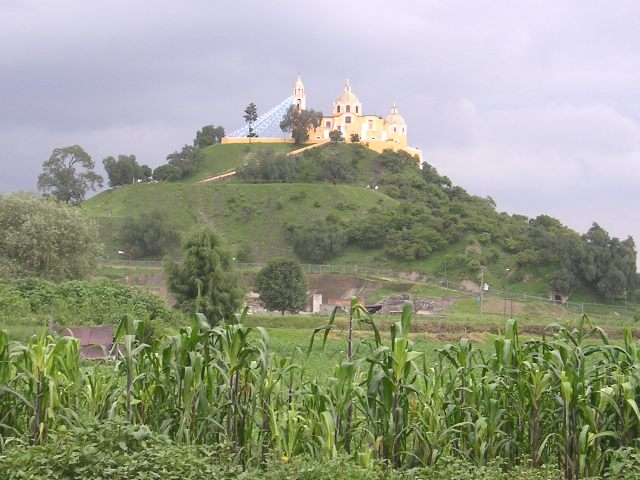
Great Pyramid of Cholula
Photo: Hajor · CC BY-SA 3.0

The Great Pyramid of Cholula, called Tlachihualtepetl ('man-made mountain') in Nahuatl, is by volume the largest pyramid — and by some reckonings the largest monument — ever constructed anywhere: roughly 4.45 million cubic metres, nearly twice the volume of the Great Pyramid of Giza, on a base about 400 metres to a side. Yet most visitors would never know. Built up in adobe-brick stages over more than a thousand years and abandoned before the Spanish conquest, it was so overgrown that it resembles a natural hill, and in 1594 the Spanish crowned it with the church of Nuestra Señora de los Remedios, which still holds Mass on its summit. Cholula itself is among the oldest continuously inhabited cities in the Americas.

See it on the globe →
The mainstream view

What archaeology says

Archaeology knows the pyramid largely from the inside. Swiss-American scholar Adolph Bandelier made the first study in 1881, and from 1931 the architect Ignacio Marquina drove exploratory tunnels through the mound — eventually some eight kilometres of them — revealing that the visible mass encases a nested sequence of at least four major pyramids and many partial enlargements, each built over its predecessor. Construction began in the Late Preclassic, around the 3rd century BC, and continued in stages through the Classic period to around AD 900, with ceramics, radiocarbon dates and construction styles tying the phases to the broader sequence of highland Mexico. Murals found within — most famously Los Bebedores ('the Drinkers'), a 60-metre frieze of figures drinking pulque from about AD 200 — and the Chapulines mural of skull-headed grasshoppers belong to a distinctive local tradition with links to Teotihuacan.

In the Postclassic era the city's religious focus shifted to a new temple of Quetzalcoatl nearby, and the great pyramid was left to weather into a hill, though it remained a shrine to a rain goddess and a burial ground — hundreds of interments have been recovered from its flanks and surrounds, with INAH excavations as recently as the 2020s still turning up burials, offerings and structural remains around the complex. When Hernán Cortés reached Cholula in 1519 — perpetrating the notorious massacre in the city — the pyramid was already ancient and overgrown; the church later built on its summit is why the interior has never been fully excavated and why the monument, uniquely among the world's largest, remains mostly unexplored.

Key evidence cited
  • Eight kilometres of exploratory tunnels revealing nested construction stages of adobe brick
  • Ceramic sequences and radiocarbon dates tying each stage to the Preclassic–Classic sequence of highland Mexico
  • Murals such as Los Bebedores (c. AD 200) matching known Mesoamerican artistic traditions
  • Hundreds of excavated burials and offerings around the pyramid spanning its period of use
  • Continuity of the site as a functioning shrine into Aztec and colonial times, explaining its preservation
The alternative view

What the skeptics propose

Cholula's alternative tradition begins with the Spanish themselves. A legend recorded around 1566 by the Dominican friar Pedro de los Ríos tells that before the great flood the land was inhabited by giants; seven survived, and one of them, Xelhua, built the great mound of Cholula as a memorial to the mountain that saved him — building it so high that the gods, angered that it might reach the clouds, hurled fire from heaven and killed the workmen. Nineteenth-century writers and modern alternative historians alike have been struck by how closely this echoes both the biblical Flood and the Tower of Babel, and authors from Ignatius Donnelly to Graham Hancock have folded Cholula into the case that a worldwide family of flood-and-tower myths preserves the memory of a real lost civilisation destroyed by cataclysm. Hancock, who treats central Mexico's Quetzalcoatl traditions as memories of civilising survivors from that lost world, includes Cholula among the sacred sites whose mythology hints at far greater antiquity than archaeology allows.

Some fringe writers go further, suggesting the deepest construction phases have never been dated because the pyramid's core is inaccessible beneath the church, leaving room — they argue — for a first shrine thousands of years older than the accepted sequence. The sheer scale is also pressed into service: why, they ask, would a provincial city out-build Egypt and Teotihuacan unless the mound enshrined something already anciently sacred?

Mainstream archaeologists reply that the tunnels have in fact sampled the earliest levels, and that ceramics and radiocarbon consistently place the first pyramid in the last few centuries BC — a period when monumental construction was flowering right across Mesoamerica. The Xelhua story, they note, was written down half a century after the conquest, by friars steeped in Genesis, and syncretism between native and biblical flood narratives is well documented; it is evidence for how myths blend, not for antediluvian engineering. The pyramid's size needs no lost race: it is the cumulative product of a thousand years of a city repeatedly enlarging its own sacred mountain.

Key evidence cited
  • The 1566 Xelhua legend of giants, a great flood and fire from heaven, recorded by Pedro de los Ríos
  • Striking parallels between the Cholula myth and the Babel and flood narratives of the Old World
  • Hancock's argument that Quetzalcoatl civiliser myths encode memories of a lost civilisation's survivors
  • The unexcavated core beneath the church, leaving the earliest construction incompletely dated
  • The anomalous scale — the world's most voluminous pyramid built by a city otherwise unremarkable in size

Genuinely open questions

  1. What lies at the unexcavated heart of the pyramid, permanently sealed beneath a protected colonial church?
  2. Why did Cholula, of all Mesoamerican cities, keep enlarging one mound until it became the largest pyramid on Earth?
  3. How much of the Xelhua giant-and-flood legend is genuinely pre-Hispanic, and how much post-conquest blending?

Worth knowing

When Cortés and his men marched past in 1519, they took the largest pyramid ever built for a natural hill — and the Spanish unknowingly consecrated their church on top of it, meaning Catholic Mass has now been celebrated on a pagan pyramid for over 400 years.