Ancient Engineering · Meidum, Egypt

Meidum Pyramid

Egypt's strangest ruin — a tower rising from a hill of its own debris, and the pyramid that may have collapsed.

Mainstream: c. 2620–2580 BC (begun under Huni?, completed by Sneferu)Alternative: Date not seriously disputed — sceptics instead contest the trial-and-error collapse story and point to anomalies such as Mastaba 17's sealed, empty granite sarcophagus29.39°, 31.16°

At a glance

Meidum Pyramid
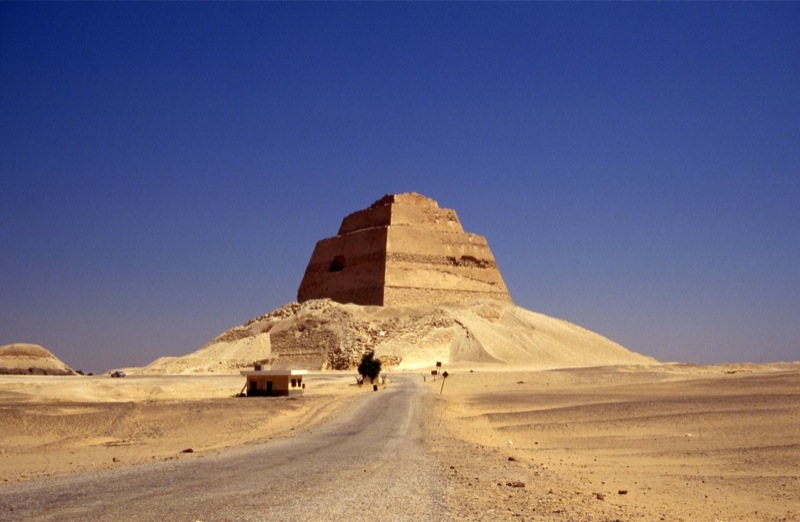
Photo: Charlie Phillips · CC BY 2.0

The pyramid of Meidum, about 100 kilometres south of Cairo, is unlike anything else in Egypt: a three-stepped stone tower rising out of an enormous mound of rubble, which locals long called el-haram el-kaddab — 'the false pyramid'. It began as a seven- then eight-step pyramid and was later converted into Egypt's first true smooth-sided pyramid by filling in the steps and adding an outer casing. At some unknown date the outer layers catastrophically gave way, leaving the exposed core we see today. Meidum also introduced the internal design template — descending passage, corbelled chamber at ground level — and the standard pyramid-complex layout of causeway and temples that Giza would later perfect.

See it on the globe →
The mainstream view

What archaeology says

Most Egyptologists assign the original stepped structure to the very end of the 3rd Dynasty — possibly begun by Huni, Sneferu's shadowy predecessor — with Sneferu completing it and later, around his 28th or 29th year, returning to convert it into a true pyramid. No inscription of Huni has ever been found at the site, and the strongest textual evidence points the other way: graffiti left by 18th Dynasty visitors in the small mortuary temple praise the monument as belonging to King Sneferu, showing that a thousand years later Egyptians themselves credited him. Excavations by Flinders Petrie (1891), Ludwig Borchardt, Gerald Wainwright and later Ali el-Khouli traced the three construction phases (labelled E1, E2 and E3) still legible in the masonry.

The great debate concerns the collapse. Physicist Kurt Mendelssohn argued in the 1970s that the outer casing slid off catastrophically while construction was still under way — a disaster witnessed by the builders that, he proposed, directly caused the angle change at the Bent Pyramid. Most Egyptologists now reject a construction-era collapse: the mortuary temple at the pyramid's foot was found intact beneath the debris rather than crushed by it in antiquity, no workers' bodies or abandoned tools were found, and the debris contains later material, suggesting the outer layers failed gradually or in stages over many centuries, helped along by stone robbers. The 18th-century Danish traveller Frederic Norden drew the pyramid with more of its casing intact than survives today, showing decay continued into modern times. Nearby stands Mastaba 17, a giant mudbrick tomb of an unknown high official, and the tombs of Nefermaat and Rahotep, which yielded the famous 'Meidum Geese' painting and life-like statues now in the Egyptian Museum.

Key evidence cited
  • 18th Dynasty visitors' graffiti in the mortuary temple naming the monument as Sneferu's
  • Three construction phases (E1, E2, E3) physically legible in the masonry, recording step-to-true conversion
  • The intact mortuary temple found beneath the debris, arguing against a construction-era catastrophe
  • Architectural continuity: Meidum's passage-and-corbel design template reappears at Dahshur and Giza
  • Norden's 1737 drawings showing more casing intact, demonstrating gradual decay into modern times
The alternative view

What the skeptics propose

Meidum is a favourite exhibit for critics of the tidy 'evolution of the pyramid' narrative. Mendelssohn himself was an outsider — an Oxford physicist — and his catastrophe theory, though largely rejected by Egyptology, is still championed by alternative writers because it dramatises how fragile the official sequence is: if Meidum did not collapse during construction, they ask, why exactly did the Bent Pyramid's builders lose their nerve mid-build? Conversely, if it did, why did debris stripping reveal an unfinished, unused monument with no trace of a burial?

Researchers in the 'lost ancient technology' camp, such as Christopher Dunn and Ben van Kerkwyk, dwell on what Meidum lacks: no sarcophagus fragments confidently attributed to a king, no funerary inscriptions, no mummy — a pattern they see repeated across every early giant pyramid and take as evidence the tombs-first interpretation is wrong. They also point to Mastaba 17 next door, where Petrie's tunnellers found a superbly finished red granite sarcophagus, its lid still sealed with the corner chips of the closing ritual in place — and nothing but a robbed skeleton inside a completely uninscribed tomb. How, they ask, was a 40-tonne-plus granite box installed and finished so precisely at the dawn of the Pyramid Age, for an occupant nobody bothered to name? A separate minority reading, originating with Egyptologist Dietrich Wildung and picked up by alternative authors, suggests Meidum functioned as a cult monument or proto sun-temple rather than a tomb at all.

The mainstream reply is that absence of burials reflects four and a half thousand years of tomb robbing, not absence of purpose; that the E1–E3 construction seams physically record experimentation in progress; and that Denys Stocks' experimental work shows granite boxes like Mastaba 17's are achievable with Old Kingdom tools, patience and abrasive sand. But even conventional scholars concede that who lies behind Meidum — Huni, Sneferu, or both — and when the pyramid fell remain genuinely open.

Key evidence cited
  • Mendelssohn's building-disaster theory linking Meidum's collapse to the Bent Pyramid's angle change
  • No burial, royal sarcophagus or funerary inscription ever found in the pyramid
  • Mastaba 17's sealed but empty, uninscribed granite sarcophagus of superb workmanship
  • The unfinished mortuary temple and absent valley temple, suggesting the complex was never used
  • Wildung's suggestion that Meidum served as a cult or sun-temple monument rather than a tomb

Genuinely open questions

  1. When exactly did the outer casing collapse — during construction, in the New Kingdom, or gradually over millennia?
  2. Did Huni begin the pyramid, or was it Sneferu's project from the start?
  3. Who was the anonymous grandee of Mastaba 17, buried beside a royal pyramid in a sealed but unmarked granite sarcophagus?

Worth knowing

The 'Meidum Geese', a frieze painted in a tomb beside the pyramid around 2575 BC, is so naturalistic it is nicknamed 'Egypt's Mona Lisa' — ornithologists can identify the exact species, including some no longer seen in Egypt.