What archaeology says
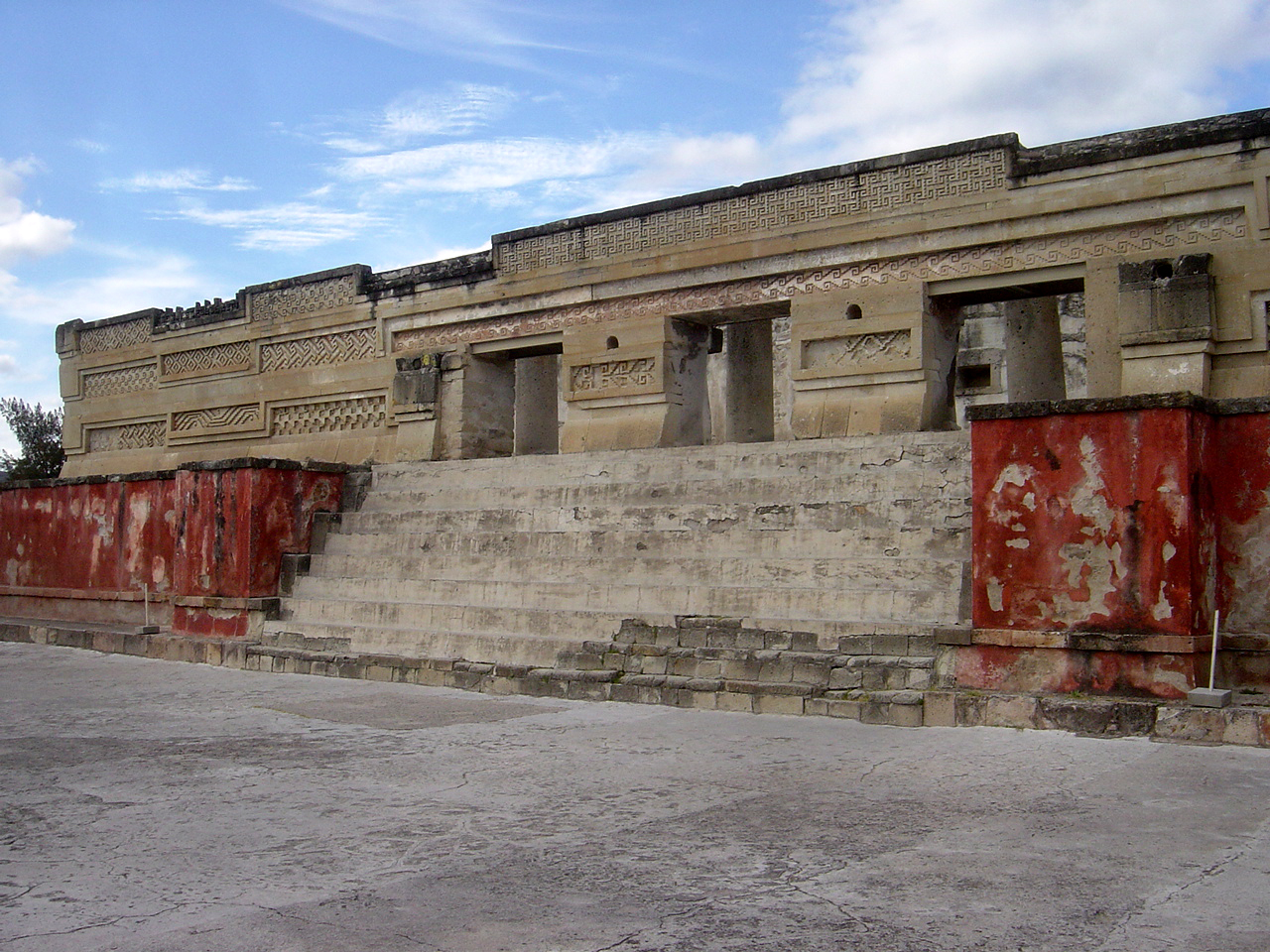
Archaeology places Mitla's grand surviving architecture in the Late Postclassic period, roughly AD 900 to the Spanish conquest, when it served as the seat of the Zapotec high priest, a figure the chronicles call the uija-tao. The five architectural groups, with their panels of stepped-fret mosaic in fourteen distinct geometric designs, represent the finest stone lattice work in Mesoamerica; cruciform subterranean tombs beneath the palaces are well documented and can be visited today. After the conquest, the Spanish built the church of San Pablo directly on top of the North Group's prehispanic platforms in the 16th century, a deliberate act of architectural supersession.
The story of a sealed underworld comes principally from the 17th-century Dominican chronicler Francisco de Burgoa, who wrote that friars entered a great underground chamber system — a common grave and shrine the Zapotecs regarded as the door to Lyobaa — found it foul and demon-haunted, and ordered the entrances walled up. Historians long treated this as embellished missionary rhetoric built on real but modest tombs.
The Lyobaa Project's results have made the question concrete. Non-invasive surveys using ground-penetrating radar, electrical resistivity tomography and seismic noise tomography in 2022 detected a large void beneath the church of San Pablo, on the order of 15 by 10 metres and beginning several metres down, apparently connected to deeper cavities, with two probable passages between about 5 and 8 metres deep. The 2023 season extended the survey and reported anomalies consistent with subterranean spaces under all the main architectural groups. INAH researchers stress that until anything is excavated, the voids' nature — natural caves, tombs, or a constructed complex — remains undetermined.
- Documented cruciform tombs beneath the palace groups show Zapotec subterranean construction at the site
- Lyobaa Project surveys (2022–23) by INAH, UNAM and ARX detected a void of roughly 15 by 10 metres beneath the San Pablo church, plus passages 5–8 metres down
- The 2023 season found geophysical anomalies beneath all major architectural groups, suggesting connected subterranean spaces
- Architecture and radiocarbon place the visible complexes in the Late Postclassic, AD 900–1521
- Burgoa's 17th-century account is late, second-hand and written with missionary purpose
- The Tlacolula valley's natural caves, including the UNESCO-listed prehistoric caves of Yagul and Mitla, offer a non-artificial explanation for voids