What archaeology says
Archaeologists date Candi Sukuh securely to the first half of the 15th century. The dating rests on candrasengkala — Javanese chronograms in which a pictorial scene encodes a year: a carving at the western gate showing a monster devouring a man, with birds in a tree, resolves to 1359 Saka, or AD 1437, and a giant 1.82-metre lingam from the site (now in the National Museum of Indonesia in Jakarta) carries an inscribed date equivalent to 1440. Stylistically and epigraphically the complex belongs to the final flowering of Majapahit-era religion, when court Hinduism was retreating to mountain sanctuaries as Islamic sultanates rose on Java's north coast.
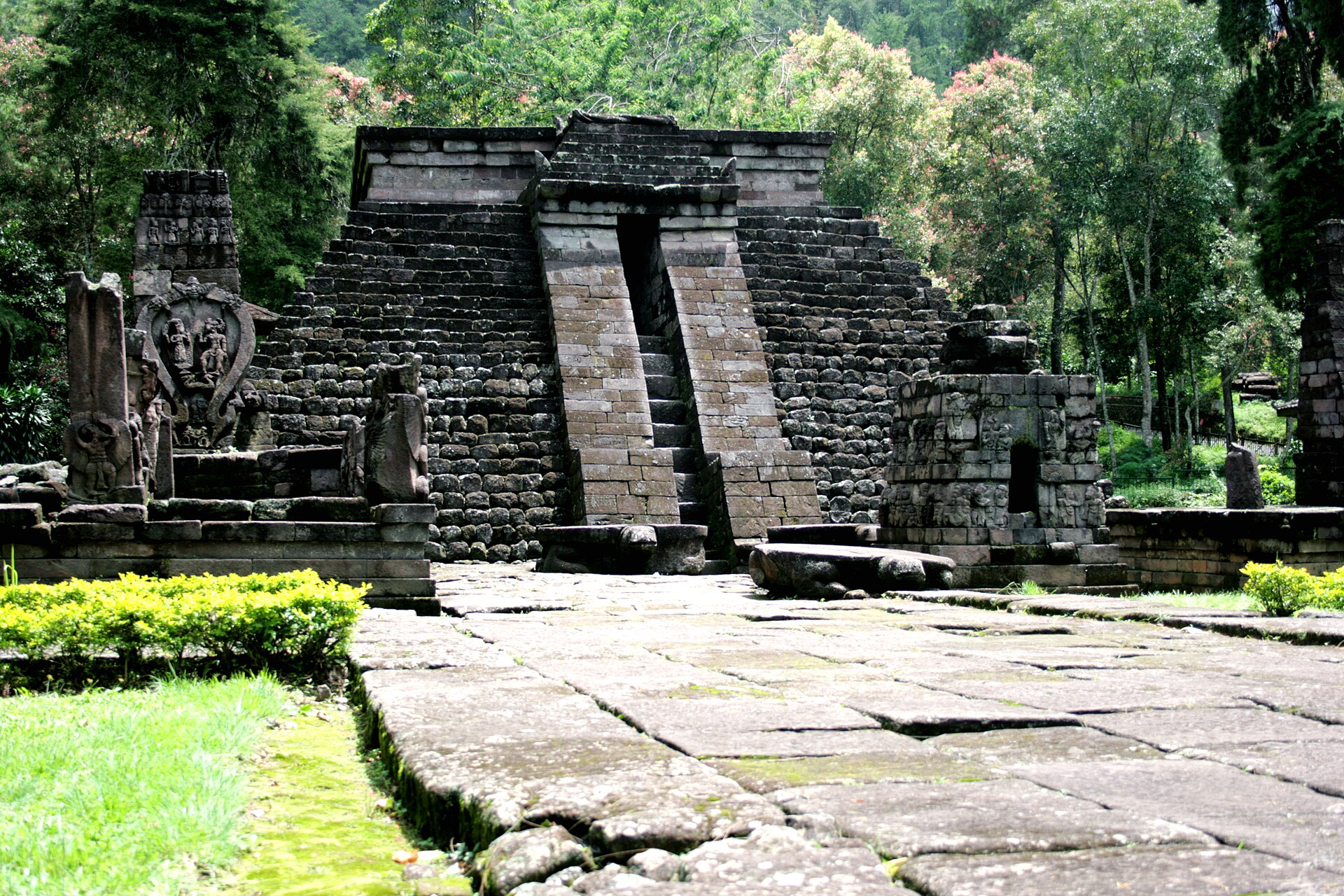
The temple's un-Indian appearance has a well-studied explanation. As imported Hindu-Buddhist orthodoxy weakened, Javanese builders revived the far older indigenous tradition of the punden berundak — the stepped terraced platform used for ancestor and mountain-spirit worship across Austronesian cultures for millennia. Sukuh and its neighbour Candi Cetho higher up the same volcano are seen as deliberate returns to this native form, with the pyramid representing the cosmic mountain and the whole complex oriented towards the sacred summit of Lawu. The site was reported to the West in 1815 during Thomas Stamford Raffles' administration of Java, described by the Dutch scholar Van der Vlis in 1842, and restored in stages from the late 1910s, with a major (and controversial) re-restoration completed in 2017.
The reliefs, carved in the flat wayang shadow-puppet style of East Java, narrate tales of Bhima, Garudeya and the liberation of souls, alongside a famous smithy scene in which a blacksmith forges a keris blade while an unusually posed dancing Ganesha looks on — read by scholars as evidence of the mystical status of metalworking in late Majapahit society.
- Pictorial chronogram at the western gate encoding the year AD 1437
- A dated inscription (equivalent to AD 1440) on the site's 1.82-metre lingam, now in Jakarta
- Reliefs carved in the late-Majapahit wayang style found across 15th-century East Java
- The indigenous punden berundak stepped-terrace tradition, which long predates Hindu Java
- Historical context: mountain sanctuaries multiplied as Majapahit court Hinduism declined