What archaeology says
Mainstream science treats Sundaland as a well-understood consequence of glacial sea-level change. Bathymetry and palaeogeographic reconstruction show that at the Last Glacial Maximum the Sunda Shelf was an exposed lowland, and that its inundation was in the main a gradual, if at times punctuated, drowning as meltwater raised global sea level over several thousand years — not a single biblical flood. This lost lowland was ecologically rich and was certainly inhabited by modern humans, so its drowning genuinely displaced coastal populations and reshaped the region's habitable geography.
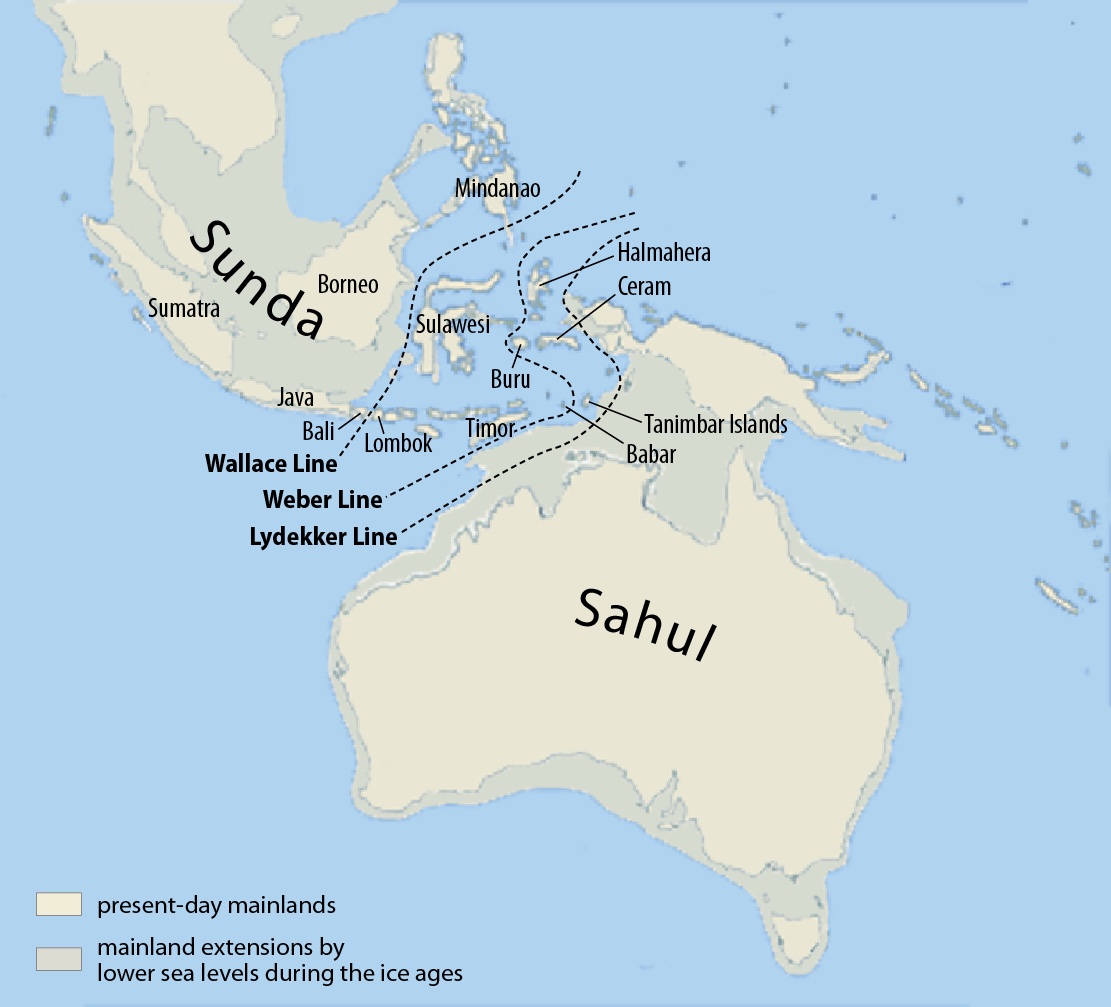
Sundaland matters for human dispersal. It was part of the route by which people reached Australia and New Guinea (across the Wallace Line into Sahul) tens of thousands of years ago, and its flooding is invoked to help explain later population movements and the spread of languages and farming in island Southeast Asia. Genetics has tested competing models: an 'out of Sundaland' hypothesis (favoured by some, including Stephen Oppenheimer) argued Sundaland was a demographic wellspring pushing populations outward, while genome-wide studies increasingly support an 'out of Taiwan' model for the Austronesian expansion, with a two-layer picture of an older Pleistocene population overlain by mid-Holocene arrivals.
The consensus is that Sundaland was a real, large, inhabited landscape drowned by ordinary post-glacial processes — significant for prehistory and for regional identity, but with no accepted evidence of cities, monuments or a 'lost civilisation' beneath its seas.
- Bathymetry and palaeogeographic maps showing the Sunda Shelf exposed at the Last Glacial Maximum
- Sea-level reconstructions showing gradual, punctuated drowning c. 14,000–7,000 years ago (~120 m rise)
- Sundaland's established role in the peopling of Sahul (Australia/New Guinea) across the Wallace Line
- Genome-wide data increasingly supporting 'out of Taiwan' over 'out of Sundaland' for Austronesians
- A two-layer dispersal model integrating Pleistocene and mid-Holocene populations