Origins of Civilisation · West Java, Indonesia

Gunung Padang

Is this Javan hilltop the world's oldest pyramid — or a natural volcanic hill wearing a megalithic crown?

Mainstream: c. 1st millennium BC – AD 600 (megalithic terraces)Alternative: Up to c. 25,000–14,000 BC for the deepest layers (Natawidjaja; 2023 paper retracted 2024)-6.99°, 107.06°

At a glance

Gunung Padang
Photo: Wikimedia Commons

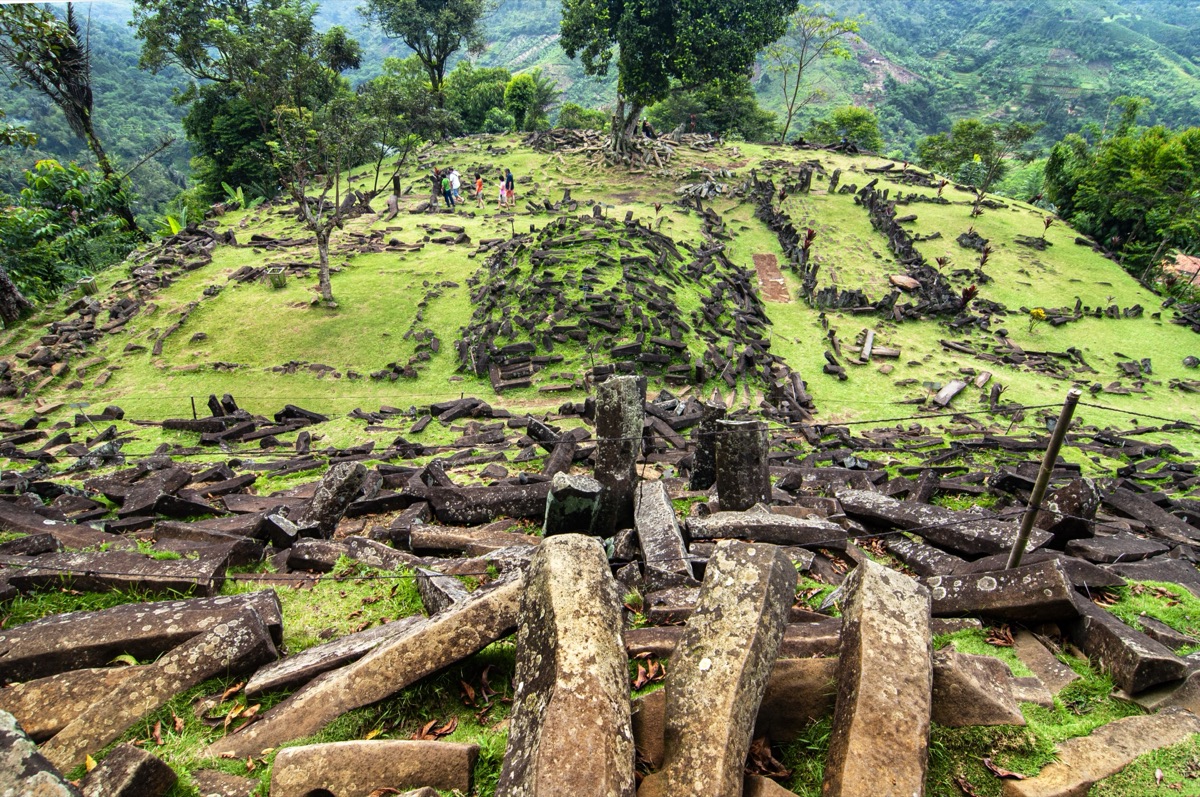
Gunung Padang ('Mountain of Enlightenment') is a hilltop site in West Java covered by the largest megalithic complex in Southeast Asia: five artificial terraces strewn with thousands of columnar basalt blocks arranged into enclosures, steps and standing stones. The hill rises about 100 metres above the surrounding valleys and has long been a place of local pilgrimage. Since the 2010s it has become the world's most contested 'pyramid' candidate, after an Indonesian government-backed team claimed the entire hill is an artificial, layered construction of staggering antiquity.

See it on the globe →
The mainstream view

What archaeology says

Most archaeologists regard Gunung Padang as a punden berundak — a traditional Indonesian stepped terrace sanctuary — built on top of a natural volcanic hill. The columnar basalt blocks are naturally formed (columnar jointing is a common volcanic phenomenon, as at the Giant's Causeway), quarried or gathered from the hill itself and arranged by people on the summit. Radiocarbon dates and artefacts associated with the visible terraces suggest construction broadly in the first millennium BC to mid-first millennium AD; Indonesian archaeologist Lutfi Yondri's work places the builders' activity around 117 BC–AD 45. Volcanologist Sutikno Bronto interpreted the hill as the eroded neck of an ancient volcano.

In October 2023, geologist Danny Hilman Natawidjaja and colleagues published a paper in Archaeological Prospection claiming the hill conceals multiple constructed layers, the deepest built as far back as 25,000–14,000 BC — which would make it vastly older than any known monument on Earth. After an investigation, the journal retracted the paper in March 2024: the publisher concluded the radiocarbon dates came from natural soil samples not associated with any artefacts or features that could be reliably interpreted as anthropogenic — so they date buried organic matter, not human construction. Critics such as archaeologist Flint Dibble and dating specialists noted the deeper layers yielded no tools, charcoal hearths, bones or any other trace of human activity.

For mainstream scholars, Gunung Padang is still an important site — the finest megalithic terrace complex in Indonesia — just not an Ice Age pyramid.

Key evidence cited
  • Columnar basalt forms naturally; the blocks match the hill's own volcanic geology
  • Artefact-associated dates place terrace construction in the last ~2,500 years
  • The retracted 2023 paper's deep radiocarbon dates came from natural soil with no artefacts
  • No tools, hearths, bones or occupation debris found in the claimed deep layers
  • The site fits the known Indonesian punden berundak (stepped sanctuary) tradition
The alternative view

What the skeptics propose

Danny Hilman Natawidjaja, a respected earthquake geologist at Indonesia's BRIN research agency, has argued since the early 2010s that Gunung Padang is a multi-generational engineered structure: a visible megalithic surface over progressively older constructed layers of arranged basalt columns, with the deepest 'core' shaped before 16,000 BC and possibly as early as 25,000 BC. His team's evidence comes from ground-penetrating radar, seismic and electrical-resistivity tomography suggesting ordered subsurface features and cavities, core drilling that they interpret as showing worked layers and even traces of 'cement' or fill between stones, and radiocarbon dates from soils at depth. The project enjoyed high-level backing under President Yudhoyono, and Graham Hancock showcased the site in his 2022 Netflix series 'Ancient Apocalypse' as prime evidence of a lost Ice Age civilisation.

After the 2024 retraction, Natawidjaja and all co-authors publicly disagreed with the journal's decision, calling it a suppression of unwelcome ideas rather than a correction of error, and maintaining that their geophysical data show the hill's interior is not natural. Supporters argue that the buried chambers indicated by tomography have never been directly excavated, so the mainstream cannot claim to have disproven the hypothesis — only that full excavation is politically and practically difficult.

Skeptics reply that extraordinary claims require anthropogenic evidence, and that dating soil under a hill tells you the age of the hill, not of a building. Even Natawidjaja's critics generally agree, however, that the site deserves further careful excavation, and that the surface megalithic complex itself is genuinely impressive and under-studied.

Key evidence cited
  • Geophysical surveys (GPR, seismic, resistivity) interpreted as showing ordered buried layers and cavities
  • Core drilling interpreted by Natawidjaja's team as revealing worked stone and fill at depth
  • Radiocarbon dates from deep strata reaching back over 20,000 years
  • Claimed arrangement of subsurface basalt columns inconsistent (they argue) with natural jointing
  • Government-sanctioned surveys in 2011–2014 that reported man-made subsurface features

Genuinely open questions

  1. What do the geophysical anomalies inside the hill represent — natural voids and lava structures, or something built?
  2. When precisely were the visible terraces built, given the wide spread of published dates?
  3. Will full stratigraphic excavation of the deeper layers ever be permitted, and what would it show?

Worth knowing

The 2023 Gunung Padang paper claimed a pyramid more than twice as old as the end of the Ice Age — and became one of the most publicised retractions in archaeology when reviewers realised the team had radiocarbon-dated plain soil rather than anything human-made.