Belief & Society · Magelang, Central Java, Indonesia

Borobudur

The world's largest Buddhist monument — a stone mandala-mountain that vanished under ash and jungle for nearly a thousand years.

Mainstream: c. AD 780–840 (Sailendra dynasty)Alternative: Claimed to encase a far older engineered hill — with fringe theories ranging from a pre-Buddhist sacred mound to Fahmi Basya's 10th-century-BC 'Temple of Solomon'-7.61°, 110.20°

At a glance

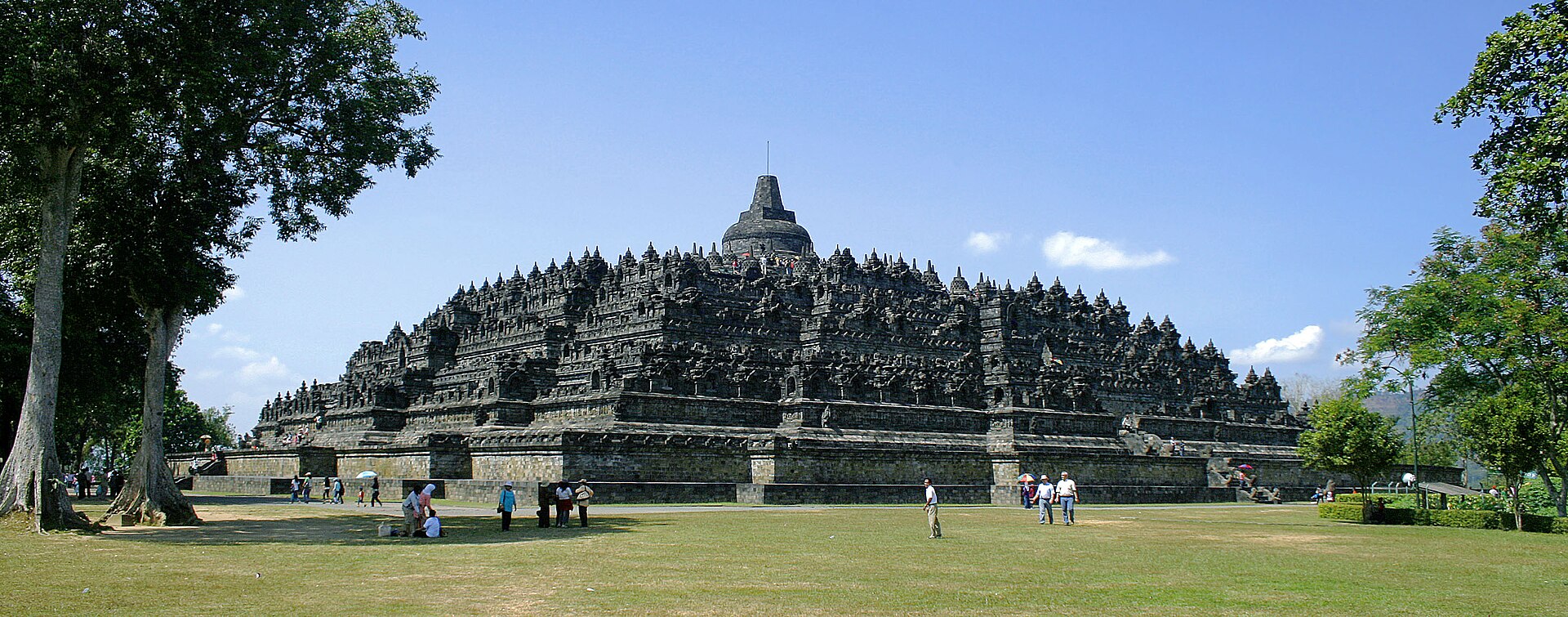
Borobudur
Photo: Gunawan Kartapranata · CC BY-SA 3.0

Borobudur is a colossal stepped pyramid-mandala of some 55,000 cubic metres of andesite, rising in nine platforms — six square, three circular — to a great central stupa 35 metres above the Kedu Plain of Central Java. Its galleries carry 2,672 relief panels and originally 504 Buddha statues, with 72 more seated inside latticed stupas on the upper terraces; walked in sequence, the reliefs form a pilgrim's path from the world of desire to enlightenment. Abandoned for centuries and buried under volcanic ash and vegetation, it was brought back to world attention in 1814 and is today Indonesia's most visited monument and a UNESCO World Heritage Site.

See it on the globe →
The mainstream view

What archaeology says

Scholars attribute Borobudur to the Sailendra dynasty, devout Mahayana Buddhists who ruled Central Java in the 8th and 9th centuries. Although no foundation inscription survives, dating rests on palaeography of short inscriptions on the hidden base reliefs, on the Karangtengah inscription of AD 824, and on the monument's five visible construction phases, which suggest work beginning around 780 and finishing in the 830s to 840s — roughly contemporary with the great Hindu rival complex at Prambanan. Crucially, the monument is not a solid pyramid: it is a stone mantle built over and around a natural hill, terraced and sculpted into the mandala form, which is why its architecture had to be repeatedly stabilised against waterlogging and slumping of the earthen core.

Borobudur was abandoned some time after the Mataram court shifted to East Java in the 10th century — plausibly linked to eruptions of nearby Mount Merapi — and its memory faded further as Java converted to Islam from the 15th century. In 1814 Thomas Stamford Raffles, then British governor, sent the Dutch engineer Hermann Cornelius to investigate reports of a buried monument; two months of clearing revealed the temple. Theodoor van Erp led the first major restoration in 1907–1911, and a landmark UNESCO-Indonesian campaign in 1975–1982 dismantled, catalogued and rebuilt over a million stones, inserting modern drainage behind the reliefs.

One genuine archaeological surprise remains on display: in 1885 restorers discovered a 'hidden foot' — 160 relief panels of the Karmawibhangga (the law of cause and effect) deliberately buried behind a broad encasement base, apparently added during construction either to stabilise the structure against collapse or to conceal imagery deemed inappropriate.

Key evidence cited
  • Palaeographic dating of inscriptions on the hidden base to c. AD 780–840
  • The Karangtengah inscription (AD 824) linked to the monument's endowment
  • Five documented construction phases consistent with a single Sailendra-era project
  • Thanikaimoni's pollen analyses finding no aquatic vegetation beneath the surrounds
  • Exhaustively Buddhist iconographic programme matching 9th-century Mahayana texts
The alternative view

What the skeptics propose

The most persistent alternative ideas concern what lies beneath and around the monument. In 1931 the Dutch artist W.O.J. Nieuwenkamp proposed that the Kedu Plain was once a lake and Borobudur was conceived as a lotus flower floating upon it — a poetic hypothesis the geologist R.W. van Bemmelen took semi-seriously. Pollen studies by Ganapathi Thanikaimoni in the 1970s and field studies by Caesar Voûte and J.J. Nossin in 1985–86 found no evidence of a contemporaneous lake, but in the 2000s Indonesian geologist Helmy Murwanto published chronostratigraphic evidence that a palaeolake did exist near the monument at various periods, partially rehabilitating the idea and keeping the debate alive. Related claims hold that catastrophic Merapi eruptions — perhaps the great eruption dated around 1006 — buried the temple suddenly in ash and lahars, a 'flood burial' narrative echoing wider catastrophist themes, rather than the slow abandonment mainstream historians favour.

A second strand argues the monument is older than its Buddhist skin. Because Borobudur demonstrably encases a natural hill, and because even mainstream scholarship accepts that pre-Buddhist structures may have stood there first, alternative writers propose the hill itself was an engineered sacred mound — a punden berundak of great antiquity — that the Sailendras merely resurfaced. Sundaland theorists such as Dhani Irwanto, extending Arysio Santos's claim that Atlantis lay in the Java Sea, place Borobudur within a supposedly ancient Indonesian cradle of civilisation, a case boosted in the public mind by the disputed claims of extreme antiquity at Gunung Padang in West Java.

The most colourful claim belongs to Indonesian mathematician Fahmi Basya, who has argued in a series of books since 2012 that Borobudur is the work of King Solomon and the Queen of Sheba, relocating the biblical kingdom of Saba to Java. Archaeologists and historians dismiss this outright — Solomon's traditional dates precede Borobudur by some 1,700 years, and the monument's iconography is exhaustively and specifically Buddhist — while the older-core theories founder on the lack of any excavated pre-Sailendra structure and the tight 8th-9th-century epigraphic dating.

Key evidence cited
  • The monument verifiably encases a natural hill, inviting claims of an older engineered core
  • Murwanto's chronostratigraphic evidence for a palaeolake near the monument
  • Nieuwenkamp's lotus-on-a-lake reading of the monument's design
  • Deep ash burial and the c. 1006 Merapi eruption as a possible sudden catastrophe
  • Fahmi Basya's 39 claimed correspondences between the reliefs and the Solomon story

Genuinely open questions

  1. What stood on Borobudur's hill before the Sailendras began building?
  2. Why was the Karmawibhangga base deliberately buried — engineering necessity or censorship?
  3. How large a role did the Merapi eruptions actually play in the monument's abandonment?

Worth knowing

Borobudur's reliefs include such detailed carvings of 8th-century outrigger ships that in 2003 a full-size replica, built from one panel, successfully sailed the 'Cinnamon Route' from Java to Ghana — proving the vessels depicted could cross the Indian Ocean.