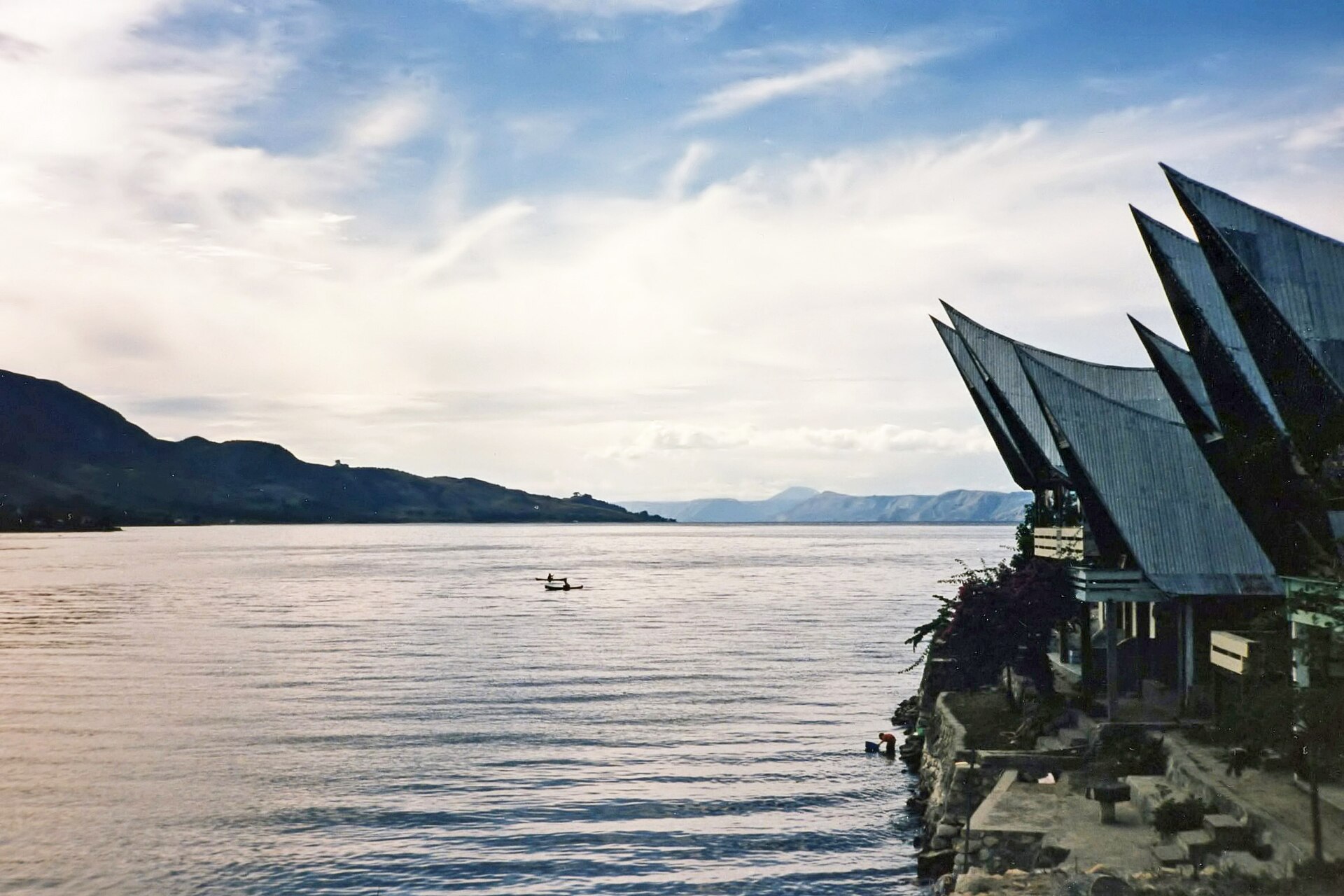
Catastrophe & Climate · Lake Toba, Sumatra, Indonesia

The Lake Toba Supereruption

The largest known eruption of the last two million years — and the volcano once blamed for nearly wiping out the human race.

Mainstream: c. 74,000 years ago (the Youngest Toba Tuff eruption)Alternative: Same date, but framed as a near-extinction event that throttled the human population to a few thousand — a claim now largely overturned2.68°, 98.88°

At a glance

The Lake Toba Supereruption
Photo: Bernard Gagnon (Bgag) · CC BY-SA 3.0

Lake Toba fills a caldera 100 kilometres long in northern Sumatra, the scar of a supereruption around 74,000 years ago that ejected some 2,800 cubic kilometres of magma — the Youngest Toba Tuff. Ash from the blast blankets South Asia in a layer traceable from India to the South China Sea and into ice cores at both poles. For a generation, Toba was the poster child for how a single geological catastrophe might have reshaped human evolution, supposedly plunging the planet into a volcanic winter that nearly extinguished our species. The evidence gathered since has complicated that dramatic story considerably.

See it on the globe →
The mainstream view

What archaeology says

The eruption itself is not in doubt: Toba is the best-documented supereruption in the human past, and its tephra provides an invaluable time-marker that lets archaeologists correlate sites across continents. The controversy is over its human and climatic consequences. In 1998 Stanley Ambrose proposed the 'Toba catastrophe hypothesis': that a six-to-ten-year volcanic winter, followed by a millennium of cooling, so devastated early modern humans that our ancestors were reduced to a few thousand breeding individuals — a genetic bottleneck he argued could be read in the low diversity of modern human DNA.

Over the following decades the evidence has turned against a catastrophic reading. Archaeological work led by Michael Petraglia at Jwalapuram in southern India found stone-tool assemblages directly below and above the Toba ash showing technological continuity, implying the same population persisted through the eruption. At Pinnacle Point in South Africa, Curtis Marean, Eugene Smith and colleagues identified microscopic Toba glass shards in occupation layers where human activity actually intensified afterwards. Deep-sea and Lake Malawi sediment records show no large temperature crash in Africa. Modern climate models and revised genetic analyses suggest the volcanic winter was real but more modest and regional than Ambrose imagined, and that the apparent bottleneck in human DNA is better explained by ordinary demographic processes than by a single eruption.

Key evidence cited
  • Continuous stone-tool traditions above and below the Toba ash at Jwalapuram, India (Petraglia)
  • Toba glass shards at Pinnacle Point, South Africa, in layers of increasing human activity (Marean, Smith)
  • Lake Malawi and marine sediment cores showing no large African temperature crash after the eruption
  • Revised genetic analyses attributing human diversity patterns to ordinary demography, not a single bottleneck
  • Climate models indicating a real but more modest and regional volcanic winter than first claimed
The alternative view

What the skeptics propose

The catastrophist position, in its strong original form, held that Toba was an evolutionary chokepoint — the moment our species came within a hair of extinction and was forged into its modern form. Ambrose marshalled the coincidence of the eruption's date with genetic estimates of a Late Pleistocene population bottleneck, and argued that a shattered, isolated human population would have been primed for rapid change and later expansion. The idea was compelling enough to dominate popular science writing for two decades and still surfaces in documentaries.

A softer version of the argument survives and deserves a fair hearing. Some researchers maintain that even a regionally severe winter would have hammered specific populations — particularly in India, sitting directly downwind under metres of ash — and that global archaeological visibility is too coarse to rule out local collapses and replacements. Others note that ice-core sulphate spikes and modelled aerosol loadings still allow for years of significantly cooler, drier conditions somewhere on Earth. The honest current picture is a middle ground: Toba was a genuine planetary-scale event that stressed ecosystems and probably devastated some human groups, but the sweeping 'humanity nearly died' narrative is not supported by the archaeological record, which repeatedly shows people carrying on.

Key evidence cited
  • Ambrose's original coincidence between the eruption date and a genetically inferred population bottleneck
  • Ice-core sulphate spikes consistent with years of significant global cooling somewhere on Earth
  • Metres-thick ash across India implying severe local devastation directly downwind of the caldera
  • Coarse archaeological visibility that cannot fully exclude regional human collapses and replacements
  • The theory's internal logic that isolation and stress could have primed later human expansion

Genuinely open questions

  1. How severe and how long-lasting was the volcanic winter, and did it vary sharply by region?
  2. Can the Late Pleistocene signal in human DNA be tied to any single event, or is it purely demographic?
  3. Did any human populations, especially in South Asia, actually collapse under the ashfall even if the species as a whole endured?

Worth knowing

The Toba ash layer is such a reliable time-stamp that archaeologists treat it as a gift: any site with a band of its glass shards can be dated to within a whisker of 74,000 years old across half the planet.