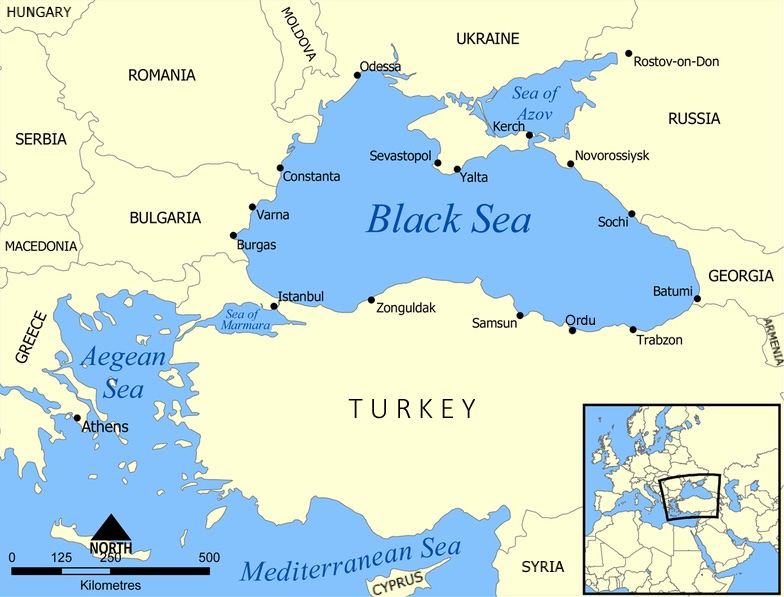
Catastrophe & Climate · Black Sea (Bosphorus & northern Turkey / Bulgaria coast)

The Black Sea Flood

Did the Mediterranean burst through the Bosphorus in a roar that drowned a country and seeded the world's flood myths — or did the sea simply creep in?

Mainstream: Marine reconnection of the Black Sea c. 6800-5600 BC, most likely gradualAlternative: A single catastrophic refill c. 5600 BC — proposed as the real event behind the Flood of Noah41.25°, 31.00°

At a glance

The Black Sea Flood
Photo: NormanEinstein · CC BY-SA 3.0 / GFDL

At the end of the last Ice Age the Black Sea was a shrunken freshwater or brackish lake, its surface well below that of the rising Mediterranean. As global sea level climbed with the melting ice sheets, salt water eventually spilled through the Bosphorus and reconnected the basin to the world ocean, drowning a broad band of former lakeshore. Whether this happened as a sudden, violent flood or a slow marine creep is one of the great debates of Quaternary science — and because the timing brushes against the age of the earliest farming villages and the roots of Near Eastern flood legends, it has spilled far beyond geology into the story of Noah himself.

See it on the globe →
The mainstream view

What archaeology says

Marine geologists agree the Black Sea was reconnected to the Mediterranean in the early Holocene, but the emerging consensus favours a more gradual and less apocalyptic process than the famous catastrophic model. In the 'outflow' and gradualist readings, championed by researchers such as Ali Aksu, Richard Hiscott and Valentina Yanko-Hombach, the transition was staged and in places two-way: fresh water may even have been flowing out through the Bosphorus while marine water worked its way in. Evidence cited includes back-stepping barrier islands and beach ridges on the Black Sea shelf, an underwater delta in the Marmara Sea near the strait, and microfossil and mollusc sequences showing a measured change in salinity rather than an overnight marine invasion.

On this view the sea level rose over centuries, perhaps rising a metre or so per year at most during the fastest phase, submerging coastlines steadily enough that people could retreat inland without a single drowning cataclysm. The reconnection is now generally placed somewhere in the window from about 6800 to 5600 BC, with the exact tempo still argued. Crucially, most specialists caution that even if the flooding was real and locally dramatic, tying it directly to a specific myth is speculative, since deluge stories appear independently across many cultures.

Key evidence cited
  • Back-stepping barrier islands and beach ridges on the Black Sea shelf indicating a staged transgression
  • An underwater delta in the Marmara Sea consistent with two-way flow through the Bosphorus (Aksu, Hiscott)
  • Microfossil and mollusc sequences showing gradual rather than instantaneous salinity change
  • Yanko-Hombach's synthesis of geological and archaeological data favouring a non-catastrophic model
  • Submerged Bulgarian coastal settlements documenting slower, survivable coastline migration
The alternative view

What the skeptics propose

The catastrophic hypothesis was launched in 1997 by Columbia geologists William Ryan and Walter Pitman, who argued that around 5600 BC the rising Mediterranean breached the Bosphorus in a violent cascade — a waterfall many times the volume of Niagara — that raised the Black Sea by tens of metres, flooded an area the size of a small country in a matter of months, and drove Neolithic farmers outward across Europe and the Near East. In their popular book they explicitly proposed this as the historical event behind Noah's Flood and the Mesopotamian deluge traditions.

The hypothesis gained its most dramatic support from Robert Ballard, discoverer of the Titanic, who surveyed the Turkish coast off Sinop and reported a drowned former shoreline about 155 metres down, exactly where a low lake stand would predict, along with a possible submerged structure and preserved organic remains in the anoxic depths. Advocates argue that a rapid inflow best fits the abrupt appearance of marine molluscs in the sediment and the sheer scale of land lost, and that the memory of coastal communities suddenly displaced is precisely the kind of event that oral tradition would preserve and magnify. Even as the strong version has lost ground, defenders maintain that the reconnection was at least fast enough to be traumatic for the people living on the vanished plain.

Key evidence cited
  • Ryan and Pitman's abrupt marine mollusc appearance dated near 5600 BC across the shelf
  • Ballard's drowned shoreline about 155 metres deep off Sinop, matching a former low lake stand
  • Organic remains and a possible built structure preserved in the anoxic deep waters near Sinop
  • The vast area of former lakeshore lost, argued to require a rapid rather than creeping rise
  • The clustering of Near Eastern and biblical deluge traditions offered as cultural memory of the event

Genuinely open questions

  1. How fast did the Black Sea actually refill — over months, or over centuries?
  2. Were people living on the drowned plain, and can their submerged settlements be securely dated?
  3. Do any flood myths preserve a genuine memory of this event, or is the link a modern narrative imposed on independent traditions?

Worth knowing

Because the Black Sea's depths are almost oxygen-free, ancient shipwrecks and organic material there survive in near-perfect condition — Ballard's expeditions found intact 2,400-year-old wooden ship timbers that would have rotted away in any normal sea.