Origins of Civilisation · Varna, Bulgaria

Varna Necropolis

The oldest hoard of worked gold on Earth, buried with a Copper Age chieftain a thousand years before the pyramids.

Mainstream: c. 4600–4300 BC (Chalcolithic, radiocarbon 4569–4340 BC)Alternative: Late flowering of a 'Old Europe' civilisation predating Egypt and Mesopotamia by millennia43.21°, 27.86°

At a glance

Varna Necropolis
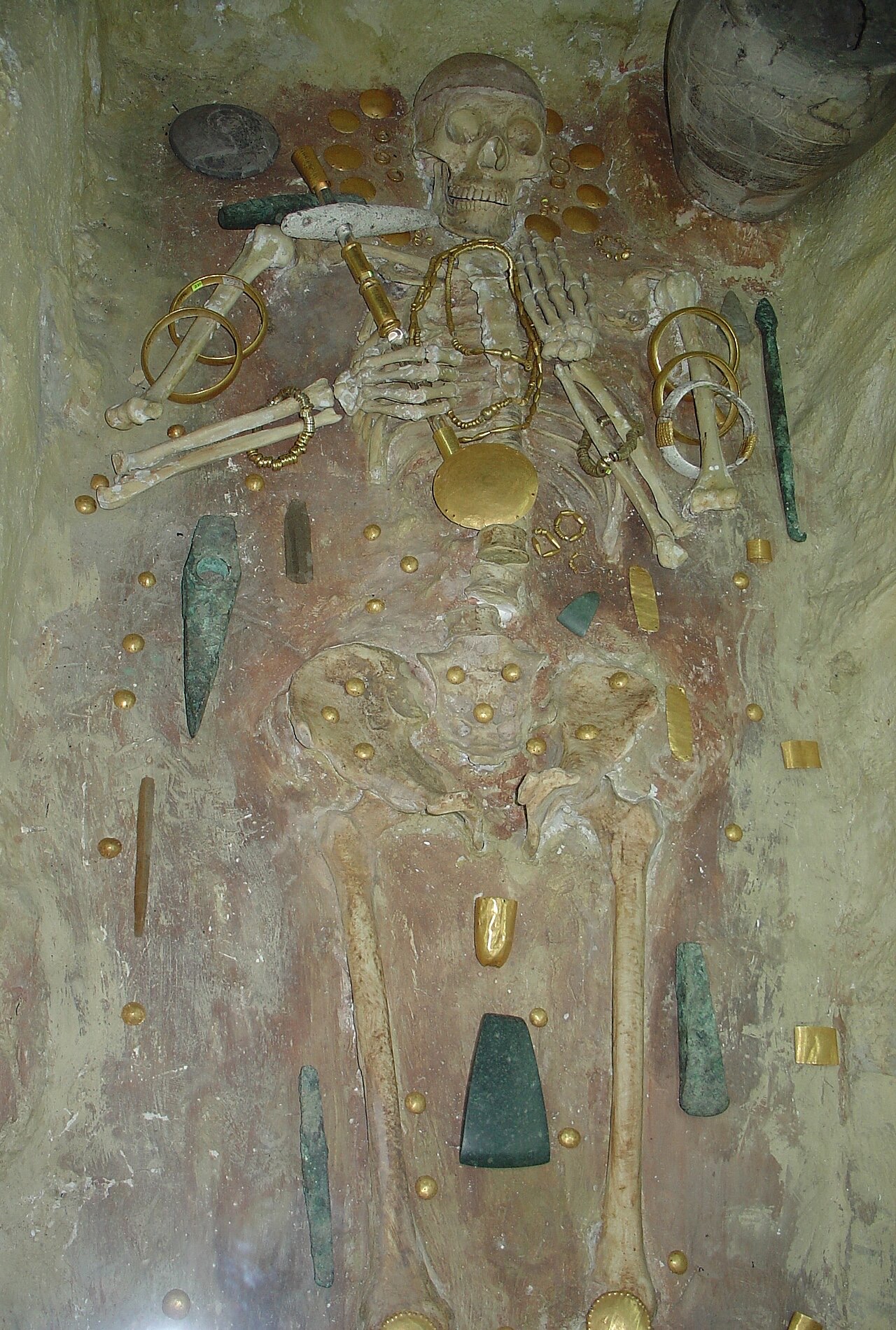
Photo: Yelkrokoyade · CC BY-SA 3.0

In October 1972 an excavator operator named Raycho Marinov, digging a cable trench in the industrial zone of Varna on Bulgaria's Black Sea coast, struck the world's oldest known gold treasure. The Chalcolithic cemetery excavated over the following two decades, chiefly by Ivan Ivanov of the Varna Museum, produced nearly 300 graves and around 3,000 gold artefacts weighing about six kilograms, radiocarbon dated to roughly 4560-4450 BC. Grave 43, a man in his forties buried with almost a thousand gold objects including a gold-sheathed sceptre and a gold penis sheath, held more gold than had been found in the entire rest of the world for that era, and rewrote the story of early inequality, metallurgy and power in prehistoric Europe.

See it on the globe →
The mainstream view

What archaeology says

Mainstream archaeology treats Varna as the smoking gun for the first strongly hierarchical society in Europe. The cemetery belongs to the Chalcolithic Varna culture, part of the network of Copper Age communities in the Balkans and lower Danube that were smelting copper at places like Ai Bunar and trading Spondylus shell across the continent. Radiocarbon dating published in 2006 fixed the graves at 4569-4340 BC, older than the royal tombs of Ur or the gold of Egypt by well over a thousand years.

The distribution of wealth is the point: a handful of graves, above all Grave 43 and several cenotaphs with clay masks, contain the overwhelming majority of the gold, while most burials have little or nothing. Scholars such as Ivan Ivanov, Henrieta Todorova and later John Chapman have read this as evidence of institutionalised social ranking, perhaps chiefly or even kingly power, sustained by control of metallurgy, salt production at nearby Provadia, and Black Sea exchange routes.

Equally significant is the ending: within a few centuries the brilliant Copper Age cultures of the western Black Sea declined sharply. Explanations range from climate deterioration and soil exhaustion to incursions by steppe pastoralists, the scenario built into Marija Gimbutas's Kurgan hypothesis and partly supported by later ancient-DNA studies of steppe ancestry spreading into Europe.

Key evidence cited
  • Radiocarbon dates of 4569-4340 BC published in 2006 make this securely the world's oldest large gold assemblage
  • About 3,000 gold artefacts weighing roughly six kilograms from nearly 300 graves
  • Extreme concentration of wealth in a few graves, classic evidence of institutionalised hierarchy
  • Local Balkan copper mines and salt-production sites such as Provadia-Solnitsata explain the economic base
  • Goldworking techniques develop logically from established Balkan copper metallurgy
  • Decline of the culture coincides with climate shifts and the appearance of steppe influences, matching wider European patterns
The alternative view

What the skeptics propose

Varna sits at the heart of the 'Old Europe' debate. Marija Gimbutas, the Lithuanian-American archaeologist who coined the term, argued that Copper Age southeastern Europe was a sophisticated, largely peaceful, goddess-centred civilisation that was destroyed by patriarchal horse-riding invaders from the steppe. Her followers point to Varna's gold, the symbolic cenotaph burials and the astonishing craft skill as proof that Europe, not Mesopotamia, hosted the world's first civilisation, an argument popularised by author Richard Rudgley and, in Bulgaria itself, embraced as a matter of national pride.

Writers further from the mainstream go beyond that. Some note the sheer technical perfection of the goldwork, thousands of standardised beads and appliqués, and ask whether a society without writing or cities should have been capable of it. Others link the drowned prehistoric settlements around Varna Lake to William Ryan and Walter Pitman's Black Sea flood hypothesis, in which a catastrophic marine inundation around 5600 BC seeded the world's deluge myths, casting the Varna culture as heir to flood survivors.

Mainstream researchers reply that the metallurgy, however brilliant, evolves visibly out of local copper working, that 'civilisation' is being redefined mid-argument, and that Gimbutas's peaceful matriarchy is contradicted by the very hierarchy and weapon-rich male graves Varna itself displays. The real, unresolved scholarly fight is over how and why steep inequality appeared here so early, and why it vanished again.

Key evidence cited
  • Gold craftsmanship of startling standardisation and quality with no known local apprenticeship trail
  • Grave 43 alone held more gold than the whole contemporary world combined, suggesting a forgotten power centre
  • Cenotaph graves with life-sized clay faces and gold regalia imply elaborate ideology usually associated with later states
  • Gimbutas's Old Europe model treats Varna as the climax of a lost pre-Indo-European civilisation
  • Submerged prehistoric settlements around Varna Lake connect to Black Sea flood scenarios
  • The culture's abrupt disappearance around 4100 BC remains only partly explained

Genuinely open questions

  1. Who was the man in Grave 43 — chief, priest-king, or something else entirely?
  2. Why do symbolic cenotaphs contain some of the richest assemblages?
  3. What ended the Varna culture: climate, invasion, internal collapse, or a combination?
  4. Are older phases of the goldworking tradition still undiscovered in the Balkans or under the Black Sea?

Worth knowing

The world's oldest gold treasure was found by accident by a 22-year-old backhoe operator digging a trench for an electrical cable — Raycho Marinov gathered the first pieces into a shoebox before anyone realised what they were.