What archaeology says
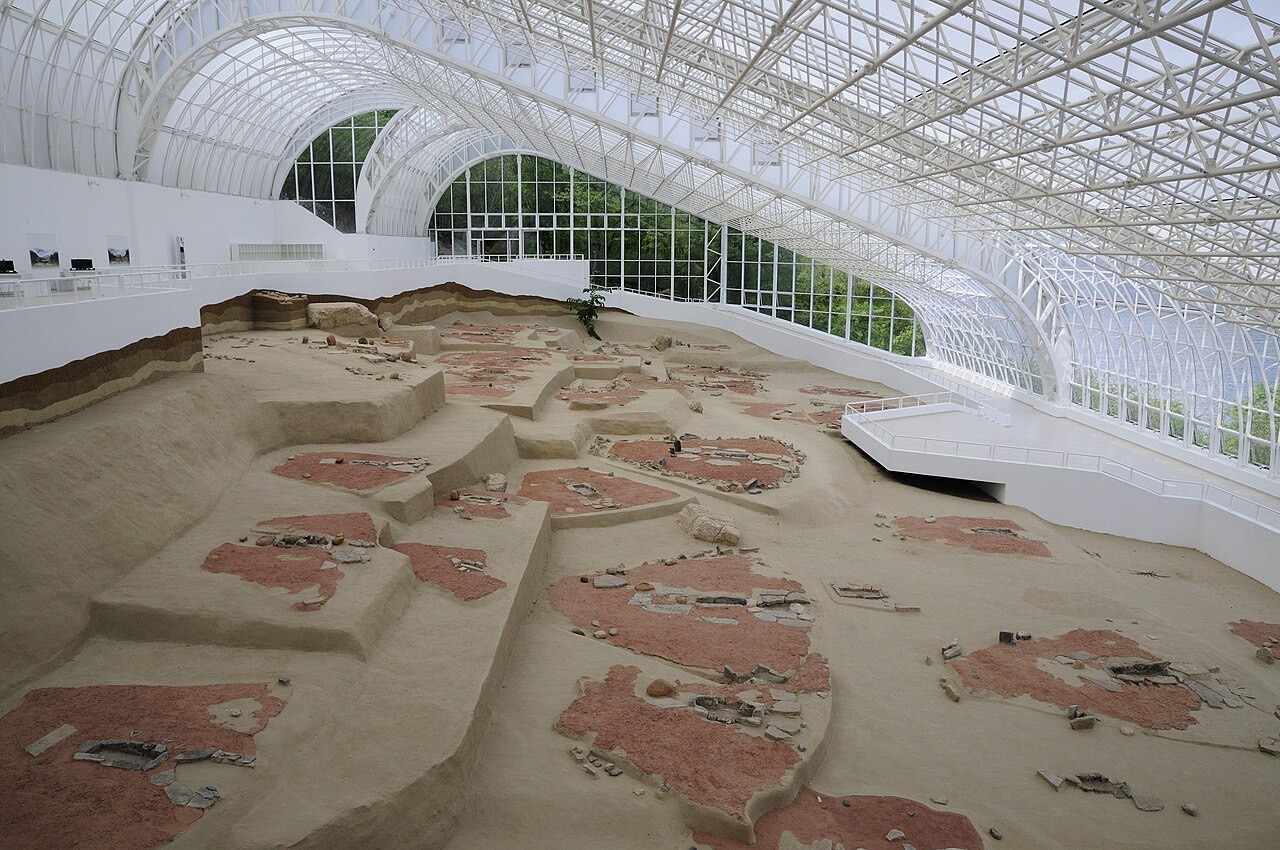
Mainstream archaeology regards Lepenski Vir as the flagship of the Iron Gates Mesolithic, a rare case of sedentary or semi-sedentary hunter-fisher communities building durable architecture long before, and then during, contact with farming. The economy leaned heavily on the river: beluga sturgeon, catfish and carp, confirmed by isotopic studies of human bone by researchers such as Clive Bonsall, which show strongly aquatic diets. The trapezoid buildings, their floors of burnt-lime plaster and their proportions repeated from house to house, indicate shared architectural rules sustained over generations.
Modern radiocarbon programmes have refined Srejović's original sequence: the terrace was used from around 9500 BC, while the iconic phase with the sculpted boulders and standardised trapezoidal buildings clusters around 6200-5900 BC — exactly when the first Neolithic farmers were arriving in the Danube gorges. Ancient-DNA studies published in the 2020s show local foragers and incoming Anatolian-ancestry farmers meeting, mixing and sometimes being buried under the same floors.
The fish-faced boulders, some combining human mouths and eyes with fish attributes, are usually interpreted through Srejović's own lens: ancestor figures or river deities of a fishing people, perhaps mediating a worldview in which humans and the great sturgeon of the Danube shared essence. Burials beneath house floors reinforce the reading of houses as ritual as well as domestic spaces.
- Radiocarbon dates spanning c. 9500-5500 BC, with the sculpted-boulder phase at c. 6200-5900 BC
- Isotope analyses showing diets dominated by Danube fish, especially sturgeon
- Fifty-plus carved sandstone boulders, the oldest monumental sculpture in Europe, found mostly around house hearths
- Standardised trapezoidal buildings with limestone-plaster floors implying strong shared building traditions
- Burials beneath floors linking houses to ancestor ritual
- Ancient DNA demonstrating interaction between local foragers and incoming Anatolian farmers