What archaeology says
Few ancient cities are better documented. Hugo Winckler's excavations from 1906 recovered the royal archives, Bedřich Hrozný deciphered Hittite in 1915 as the world's oldest recorded Indo-European language, and the German Archaeological Institute has dug at Hattusa for over a century — under Kurt Bittel, then Peter Neve, whose 1978–94 campaigns exposed more than two dozen temples in the Upper City, then Jürgen Seeher, and since 2006 Andreas Schachner, whose team combines excavation with geophysics, environmental science and the study of the city's granaries, water systems and urban development. The tablets record treaties, rituals, laws and building works, anchoring the city's chronology from its refoundation by Hattusili I around 1650 BC to its abandonment and destruction around 1180 BC amid the Late Bronze Age collapse.
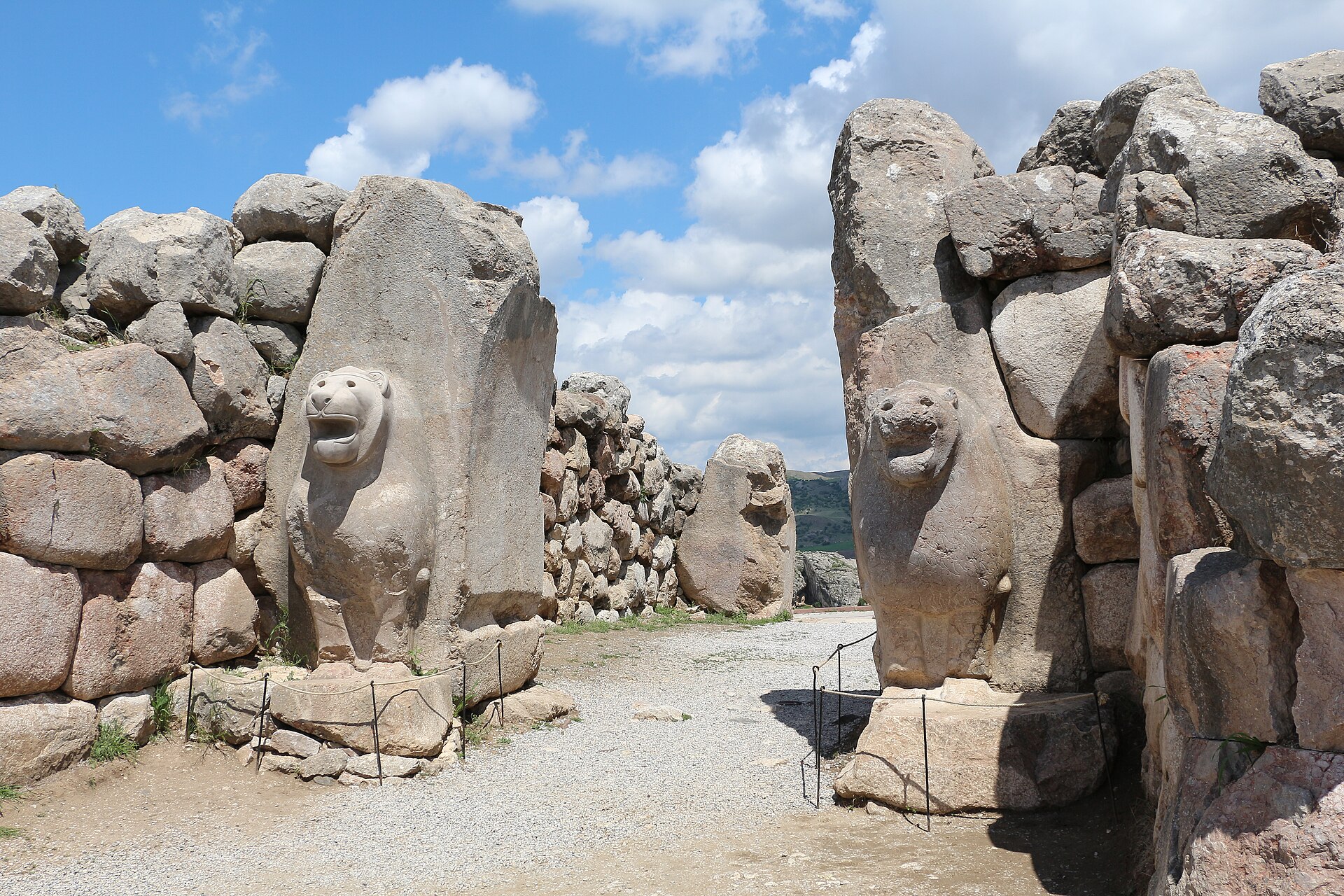
The contested stonework has conventional explanations rooted in Hittite building practice. The walls carried mudbrick superstructures on stone socles, and the neatly bored cylindrical holes that pepper the blocks are read as dowel and tie holes for timber framing, lewis-style lifting sockets and wedge holes for splitting blocks in the quarry; tubular drilling with bronze and abrasive sand was mature technology, documented in Egypt a millennium earlier, and the Hittites were also early adopters of iron. The tight polygonal jointing, like comparable styles in Mycenaean Greece, made rubble-cored walls earthquake-resistant and used irregular blocks efficiently. The Green Stone — a smooth cube of green nephrite or serpentinite, around a tonne, sitting in a room of the Great Temple — is undated and textually unattested, but Hittite religion venerated stones (the cult 'huwasi' stones), and excavators regard it as a cult object or offering stand of exotic imported rock, its gloss achievable by patient lapping. At Yazılıkaya, the reliefs are firmly dated to the 13th century BC; the geoarchaeologist Eberhard Zangger and astronomer Rita Gautschy have argued in peer-reviewed work since 2019 that the arrangement of deities functioned as a lunisolar calendar and image of the cosmos — an unorthodox but academically debated reading, not a fringe one.
- Tens of thousands of cuneiform tablets anchoring the city's construction history and chronology
- Over a century of stratigraphic excavation by the German Archaeological Institute (Winckler to Schachner)
- Drill holes clustering where dowels, lifting tackle and quarry wedges are structurally expected
- Tubular drilling and hard-stone polishing replicated experimentally with Bronze Age tools
- Polygonal masonry developing within the documented Hittite building sequence, as at Mycenae